
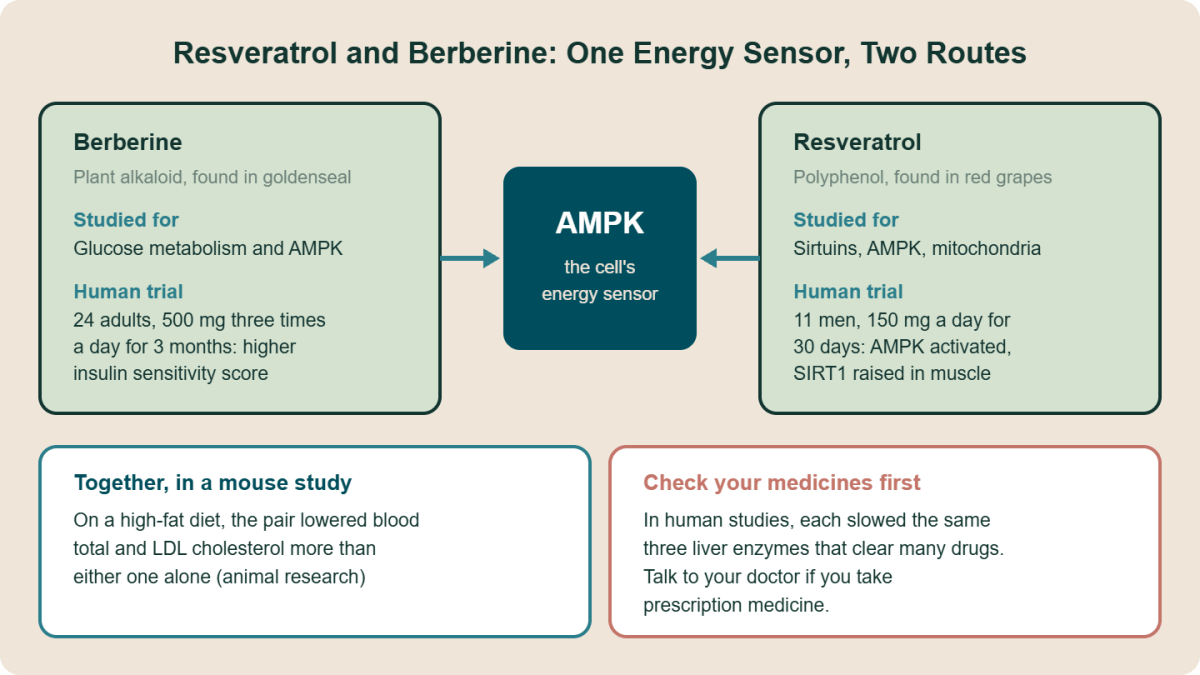
Yes, resveratrol and berberine can be taken together, and many people pair them for metabolic and healthy aging support. Both act on AMPK, the energy sensor inside your cells, by different routes: berberine is studied mainly for glucose metabolism, and resveratrol for sirtuins and cellular energy. Here is what the research shows for each, what a combination study found, how to time them and which medicine cautions matter.
Key Takeaways
- Berberine increased the activity of AMPK, the cell's energy sensor, in fat and muscle cells and improved glucose tolerance in rodents (Lee et al., 2006).
- In 24 adults with metabolic syndrome, berberine hydrochloride 500 mg three times a day before meals in a placebo-controlled trial raised an insulin sensitivity score (Pérez-Rubio et al., 2013).
- In 11 men with obesity, resveratrol 150 mg a day for 30 days activated AMPK and raised SIRT1 in muscle compared with placebo (Timmers et al., 2011).
- In mice on a high-fat diet, the two together lowered blood total and LDL cholesterol more than either one alone, and in liver cells resveratrol raised the amount of berberine inside the cells (Zhu et al., 2018).
- The main caution is medicines: in human studies, each one slowed the same three liver enzymes that clear many drugs, so talk to your doctor first if you take prescription medicine.

Featured in this article
Berberine Blend500 mg of berberine with 300 mg of Ceylon cinnamon per 2 capsules, plus bitter melon extract and chromium.
Shop Berberine BlendThird-party tested ingredients. Vegan capsules, made in the USA.
What Resveratrol and Berberine Are
Berberine is a yellow plant compound found in herbs such as goldenseal. It has been studied for how the body handles glucose and fats, and it supports healthy blood sugar levels already within a normal range. Our berberine ingredient page covers its background and forms.
Resveratrol is a polyphenol found in the skins of red grapes and in some berries. It is best known for its link to sirtuins, a family of enzymes that use NAD+ and help regulate how cells respond to energy and stress. In a 2003 lab study, resveratrol activated a sirtuin enzyme and extended lifespan in yeast (Howitz et al., 2003). See our resveratrol ingredient page for more.
The two come from different plants and do different jobs, but they meet at one point: AMPK.
Why People Take Berberine and Resveratrol Together
AMPK (AMP-activated protein kinase) works like a fuel gauge inside each cell. When energy runs low, it switches on processes that take up glucose and use fat for fuel, and it switches down processes that store energy. Both compounds have been studied for their effects on this sensor.
Berberine and AMPK
In fat and muscle cells grown in the lab, berberine increased AMPK activity and helped move glucose transporters to the surface of muscle cells. In mice and rats, it improved glucose tolerance and insulin action (Lee et al., 2006). In people, a randomized, placebo-controlled trial gave 24 adults with metabolic syndrome berberine hydrochloride 500 mg three times a day before meals for 3 months. After 3 months, the berberine group had a higher Matsuda index, a score of insulin sensitivity, and a smaller glucose response during an oral glucose test (Pérez-Rubio et al., 2013).
Resveratrol and AMPK
In a randomized, double-blind crossover study, 11 healthy men with obesity took resveratrol 150 mg a day or placebo for 30 days each. With resveratrol, AMPK was activated in muscle, levels of SIRT1 and PGC-1 alpha (a protein that directs mitochondria) rose, and fat-based energy use by mitochondria improved. Blood glucose and triglycerides were also lower with resveratrol (Timmers et al., 2011).
So the logic of the pair is simple: berberine brings the glucose and AMPK research, and resveratrol brings AMPK plus the sirtuin and mitochondria research. For each one in more depth, see berberine benefits and resveratrol benefits.
What a Combination Study Found
The most direct look at the pair comes from a 2018 study in mice and cells. Mice were fed a high-fat diet for 12 weeks, then given berberine (30 mg per kg a day), resveratrol (20 mg per kg a day) or both by mouth for 4 weeks. The combination lowered blood total cholesterol by 27.4 percent and LDL cholesterol by 31.6 percent, compared with about 7 to 11 percent for either compound alone. In liver cells, resveratrol increased the amount of berberine inside the cells by about 1.4 times, and the pair raised LDL receptors, which pull LDL out of the blood (Zhu et al., 2018).
This is animal and cell research, and it is the main reason the pairing gets attention. The human studies described above tested each compound on its own, which is why this guide covers them one at a time.
Berberine vs Resveratrol at a Glance
| Berberine | Resveratrol | |
|---|---|---|
| What it is | Plant alkaloid found in herbs such as goldenseal | Polyphenol found in red grape skins and some berries |
| Main focus of research | Glucose metabolism and AMPK | Sirtuins, AMPK and mitochondria |
| Human study above | 24 adults, 500 mg three times a day for 3 months; higher insulin sensitivity score | 11 men, 150 mg a day for 30 days; AMPK activated and SIRT1 raised in muscle |
| Absorption | Very little is absorbed from the gut | Well absorbed, then quickly converted, so little stays in its original form |
| Amounts in the studies above | 300 to 500 mg three times a day | 25 mg to 1 g a day |
| Key caution | Blood sugar medicines, other prescription medicines, pregnancy and breastfeeding | Prescription medicines, including blood thinning medicines |
On absorption: the National Center for Complementary and Integrative Health notes that very little berberine may be absorbed by the body (NCCIH, 2025). For resveratrol, a study of 6 volunteers given a 25 mg dose found at least 70 percent was absorbed, but most was quickly converted to sulfate and glucuronide forms, so very little original resveratrol reached the blood (Walle et al., 2004).
How to Take Resveratrol and Berberine Together
- Take berberine before meals. The human trial above gave it before meals, and our Berberine Blend label says 1 to 2 capsules, 1 to 3 times daily, 15 to 30 minutes before meals, or as recommended by your healthcare practitioner. Starting at the low end of that range is a gentle way to see how your stomach handles it. More detail is in the best time to take berberine.
- Take resveratrol at a set time each day. Many people take it in the morning with their other daily capsules. Our guide to the best time to take resveratrol covers morning, night and food.
- Be consistent. Both have been studied as daily intakes over weeks to months, not as single doses.
For the bigger picture of diet, movement, sleep and supplements, see our metabolic health guide.
Safety: Side Effects and Medicine Cautions
Side effects
Berberine's most common side effect is stomach and gut upset. In two 3-month pilot trials in adults with type 2 diabetes, 34.5 percent of people taking berberine had temporary gastrointestinal effects, and no liver or kidney problems were observed (Yin et al., 2008). Taking it before meals, as directed, and starting low can help. Our guide to berberine side effects covers the full picture.
Medicines
This is the most important part of taking the two together. In healthy men, berberine 300 mg three times a day for 2 weeks slowed three liver enzymes that clear many common drugs: CYP2D6, CYP2C9 and CYP3A4 (Guo et al., 2012). In 42 healthy volunteers, resveratrol 1 g a day for 4 weeks slowed the same three enzymes (Chow et al., 2010). When these enzymes slow down, the level of a medicine in the blood can rise.
- Talk to your doctor before taking either one if you take any prescription medicine.
- This matters most for medicines that lower blood sugar, since berberine can add to their effect. Our Berberine Blend label says to check with your healthcare provider before use if you take blood sugar medication.
- Talk to your doctor if you take blood thinning medicines.
Pregnancy and breastfeeding
NCCIH notes that the berberine in goldenseal can be harmful to newborns, and advises that people who are pregnant or breastfeeding not use goldenseal (NCCIH, 2025). Check with your healthcare provider before using berberine if you are pregnant or nursing.
Where Our Products Fit
Our Berberine Blend gives berberine 500 mg, Ceylon cinnamon 300 mg, bitter melon extract 100 mg and chromium picolinate 250 mcg in every 2-capsule serving, with ginger extract in vegan capsules. It is designed to support healthy blood sugar levels already within a normal range, metabolic health and steady daily energy.
For resveratrol, our Enhanced NMN includes resveratrol 200 mg and pterostilbene 100 mg in every 2-capsule serving, alongside NMN 750 mg, TMG 200 mg and vitamin B12 as methylcobalamin 750 mcg. Resveratrol is often paired with NMN because sirtuins depend on NAD+; see NMN and resveratrol for that pairing. Take 2 capsules in the morning, with or without food. Both products are made with third-party tested ingredients.
Enhanced NMN in the morning and Berberine Blend before meals fit easily into one daily routine. Benefits build with consistent daily use.

Featured in this article
Enhanced NMN750 mg of NMN plus resveratrol and pterostilbene per serving, in a daily capsule.
Shop Enhanced NMNThird-party tested ingredients. Vegan capsules, made in the USA.
Frequently Asked Questions
Can you take resveratrol and berberine together?
Yes, many people take them together as part of a daily metabolic and healthy aging routine. The main thing to check is your medicines, because in human studies each one slowed the same three liver enzymes that clear many drugs. If you take any prescription medicine, especially for blood sugar or blood thinning, talk to your doctor before starting either one.
What are the benefits of resveratrol and berberine together?
Both act on AMPK, the cell's energy sensor. Berberine supports healthy glucose metabolism and raised an insulin sensitivity score in a 3-month trial. Resveratrol activated AMPK and raised SIRT1 in muscle in a 30-day trial. In mice, the two together lowered blood cholesterol more than either one alone, which is the main reason the pairing gets attention.
Is berberine or resveratrol better?
They do different jobs, so it depends on your goal. Berberine is the one most studied for glucose metabolism and supports healthy blood sugar levels already within a normal range. Resveratrol is most studied for sirtuins, mitochondria and healthy aging. People with both goals often take both, one before meals and one with their morning capsules.
When should I take berberine and resveratrol?
Take berberine before meals: our Berberine Blend label says 15 to 30 minutes before meals. Resveratrol can be taken at a set time each day, and our Enhanced NMN directions say 2 capsules in the morning, with or without food. Keeping the same times every day matters most.
Do berberine and resveratrol both activate AMPK?
Yes, by different routes. Berberine increased AMPK activity in fat and muscle cells in lab research, and improved glucose tolerance in rodents. Resveratrol activated AMPK in the muscle of 11 men who took 150 mg a day for 30 days. That shared target is why they are often paired.
What are the side effects of berberine and resveratrol?
Berberine's most common side effect is temporary stomach and gut upset, which taking it before meals and starting low can ease. For both, the bigger point to check is how they affect the way the body clears prescription medicines: each slowed the same three drug-clearing liver enzymes in human studies, so check with your doctor if you take any.
Who should not take berberine and resveratrol?
Check with your healthcare provider first if you are pregnant or breastfeeding, if you take medicines that lower blood sugar or thin the blood, or if you take other prescription medicines. NCCIH notes that the berberine in goldenseal can be harmful to newborns.
Sources
- Lee YS, Kim WS, et al. Berberine, a natural plant product, activates AMP-activated protein kinase with beneficial metabolic effects in diabetic and insulin-resistant states. Diabetes, 2006. https://pubmed.ncbi.nlm.nih.gov/16873688/
- Pérez-Rubio KG, González-Ortiz M, Martínez-Abundis E, Robles-Cervantes JA, Espinel-Bermúdez MC. Effect of berberine administration on metabolic syndrome, insulin sensitivity, and insulin secretion. Metabolic Syndrome and Related Disorders, 2013. https://pubmed.ncbi.nlm.nih.gov/23808999/
- Timmers S, Konings E, Bilet L, et al. Calorie restriction-like effects of 30 days of resveratrol supplementation on energy metabolism and metabolic profile in obese humans. Cell Metabolism, 2011. https://pubmed.ncbi.nlm.nih.gov/22055504/
- Howitz KT, Bitterman KJ, Cohen HY, et al. Small molecule activators of sirtuins extend Saccharomyces cerevisiae lifespan. Nature, 2003. https://pubmed.ncbi.nlm.nih.gov/12939617/
- Zhu X, Yang J, Zhu W, et al. Combination of Berberine with Resveratrol Improves the Lipid-Lowering Efficacy. International Journal of Molecular Sciences, 2018. https://pubmed.ncbi.nlm.nih.gov/30563192/
- Walle T, Hsieh F, DeLegge MH, Oatis JE Jr, Walle UK. High absorption but very low bioavailability of oral resveratrol in humans. Drug Metabolism and Disposition, 2004. https://pubmed.ncbi.nlm.nih.gov/15333514/
- Yin J, Xing H, Ye J. Efficacy of berberine in patients with type 2 diabetes mellitus. Metabolism, 2008. https://pubmed.ncbi.nlm.nih.gov/18442638/
- Guo Y, Chen Y, Tan ZR, Klaassen CD, Zhou HH. Repeated administration of berberine inhibits cytochromes P450 in humans. European Journal of Clinical Pharmacology, 2012. https://pubmed.ncbi.nlm.nih.gov/21870106/
- Chow HH, Garland LL, Hsu CH, et al. Resveratrol modulates drug- and carcinogen-metabolizing enzymes in a healthy volunteer study. Cancer Prevention Research, 2010. https://pubmed.ncbi.nlm.nih.gov/20716633/
- National Center for Complementary and Integrative Health. Goldenseal. Updated February 2025. https://www.nccih.nih.gov/health/goldenseal
These statements have not been evaluated by the Food and Drug Administration. This content is for education and is not medical advice. Our products are not intended to diagnose, treat, cure or prevent any disease. Talk with a healthcare provider before starting a new supplement if you are pregnant, breastfeeding or taking medication.


Leave a comment
All comments are moderated before being published.
This site is protected by hCaptcha and the hCaptcha Privacy Policy and Terms of Service apply.