
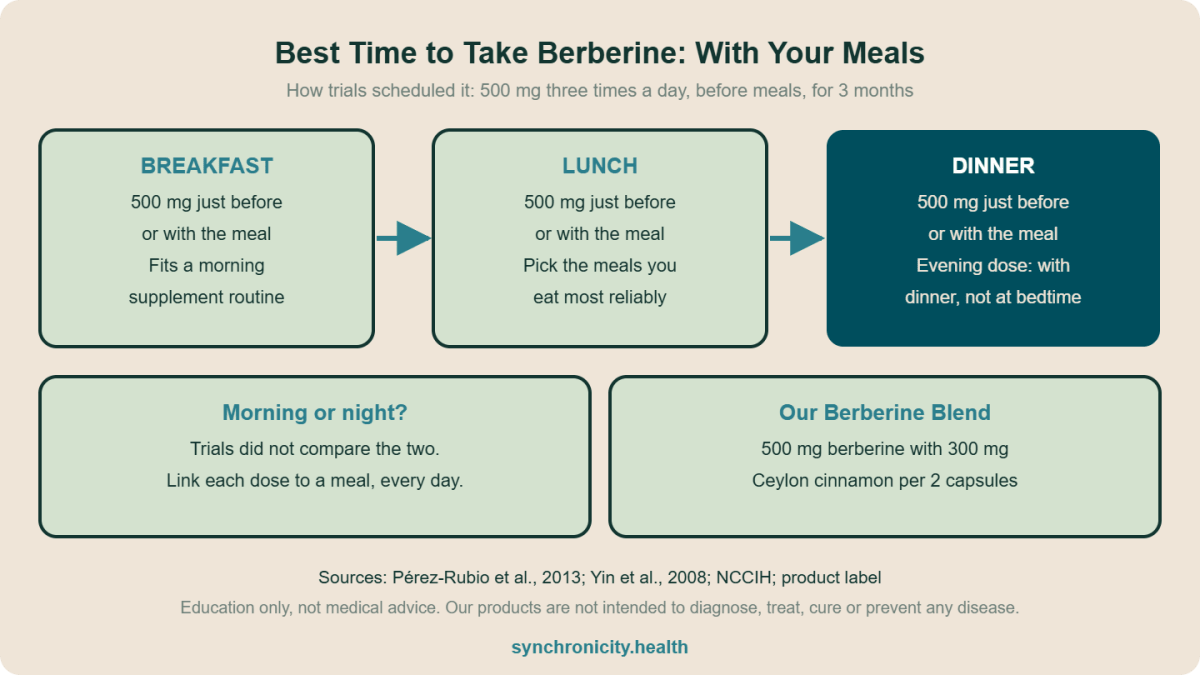
The best time to take berberine is with your meals, with the daily amount split across the day. That is how clinical trials have given it: typically 500 mg at a time, three times a day, just before or with meals, every day for about 3 months. Morning or night matters less than taking it at the same meals each day, since trials did not compare one time of day with another.
Key Takeaways
- Trials split berberine across the day. One gave 500 mg three times daily before meals for 3 months (Pérez-Rubio et al., 2013); another gave 0.5 g three times a day for 3 months (Yin et al., 2008).
- Berberine is poorly absorbed when swallowed, and trials gave it in repeated daily doses rather than one large dose (Liu et al., 2016).
- The trials did not compare morning with night dosing; tying each dose to a meal is the habit that matches the research.
- If you take it in the evening, take it with dinner rather than on an empty stomach at bedtime.
- The most common side effects are digestive, such as abdominal pain, constipation, diarrhea and nausea (NCCIH).

Featured in this article
Berberine Blend500 mg of berberine per serving with Ceylon cinnamon, bitter melon and chromium, taken with meals.
Shop Berberine BlendThird-party tested ingredients. Vegan, non-GMO, made in the USA.
When Is the Best Time to Take Berberine?
The short answer is: at mealtimes, every day. Most berberine trials were run in adults with metabolic conditions, and the useful part for timing is how they scheduled the doses, not what each trial measured. The pattern is consistent: the daily amount is split, and each dose goes with a meal.
| Trial | Who took part | Dose and timing | Length |
|---|---|---|---|
| Pérez-Rubio et al., 2013 | 24 adults with metabolic syndrome (12 on berberine) | 500 mg three times daily, before meals | 3 months |
| Yin et al., 2008 | Adults with type 2 diabetes, two small pilot studies | 0.5 g three times a day | 3 months |
| Zhang et al., 2008 | 116 adults with type 2 diabetes and dyslipidemia, placebo controlled | 1 g a day | 3 months |
Berberine is poorly absorbed when swallowed, and improving how much reaches the bloodstream is a major focus of berberine research (Liu et al., 2016). The schedule worth copying is the one trials used: repeated doses with meals, every day. For what each trial found and the week by week picture, see how long berberine takes to work and our berberine benefits guide.
Should You Take Berberine Before or After Meals?
Take it just before or with a meal. The clearest instruction in the trials comes from Pérez-Rubio and colleagues, who gave 500 mg three times daily before meals (Pérez-Rubio et al., 2013). In practice, that means swallowing your capsules as you sit down to eat, or in the few minutes before.
Taking it after a meal is fine if that is what you will remember. What matters most is that each dose is linked to food rather than taken on its own between meals.
Can you take berberine on an empty stomach?
You can, but it is not how it has been studied, and the digestive side effects that some people notice are the main reason to avoid it. NCCIH lists abdominal pain, constipation, diarrhea, nausea and vomiting as the most common side effects of berberine (NCCIH). If your stomach is sensitive, keep every dose with food.
Should You Take Berberine in the Morning or at Night?
Either works. None of the trials above compared morning with evening dosing, so there is no research reason to favor one over the other. The trials that split the dose three times a day covered breakfast, lunch and dinner, which means both morning and evening doses were part of the schedule from the start.
Pick the meals you eat most reliably. If you skip breakfast, start with lunch and dinner. If your biggest meal is dinner, that is a sensible place for one of your doses.
Can you take berberine before bed?
Take your evening dose with dinner rather than right before you lie down. A bedtime dose on an empty stomach does not match how berberine has been studied. If your evening meal is late, taking berberine with it is fine.
How to Split Your Daily Berberine Dose
Trials used daily totals of 1 g to 1.5 g, and the ones that reported a schedule split it into three 500 mg doses. Here is how that maps onto an ordinary day:
| Your routine | A simple way to time it |
|---|---|
| Three meals a day | A dose with breakfast, lunch and dinner, as in the three-times-daily trials |
| Two main meals | A dose with each of your two main meals |
| One serving a day | With your largest meal, at the same time each day |
Whatever you choose, follow the directions on your product label and do not take more to make up for a missed dose.
When to Take Berberine With Ceylon Cinnamon and Other Supplements
If your berberine already contains Ceylon cinnamon, the timing question answers itself: both go in at the same time, with the same meal. If you take them separately, there is no reason to space them apart, so pairing them at a meal keeps your routine simple. Our guide to berberine and Ceylon cinnamon together covers why they are paired, and Ceylon cinnamon supplements covers the cinnamon on its own.
Berberine also fits easily next to a morning routine. If you take our Enhanced NMN, its directions are 2 capsules in the morning, with or without food, so a berberine dose with breakfast can share the same moment. Anyone taking prescription medicine should check with their clinician before adding berberine, because it might interact with some medicines (NCCIH). For timing berberine alongside resveratrol, see our guide to resveratrol and berberine, which covers taking them together.
Side Effects and Timing
Most people tolerate berberine well; NCCIH describes it as generally well tolerated when taken by mouth. The side effects that do happen are mostly digestive. In a 3-month report on two pilot studies, 20 participants had stomach effects that passed, and no liver or kidney problems were seen (Yin et al., 2008). In the 116-person trial, five people taking berberine had mild to moderate constipation (Zhang et al., 2008).
Berberine is not for use during pregnancy or breastfeeding (NCCIH). Our full guide to berberine side effects covers who should check with a clinician first.
Where Our Berberine Blend Fits
Our Berberine Blend pairs 500 mg of berberine with 300 mg of Ceylon cinnamon per 2 capsules, plus bitter melon extract and chromium, in vegan capsules made with third-party tested ingredients. The 500 mg of berberine matches the per-dose amount used in the trials above, and because the Ceylon cinnamon is in the same capsules, one mealtime habit covers both. Follow the directions on the label for how many servings to take each day.
Benefits build with consistent daily use: months 1 to 2 can bring early changes, and 3 months and beyond is where the full benefit builds. Learn more on our berberine ingredient page and in our metabolic health and energy guide.
Featured in this article
Berberine Blend500 mg of berberine per serving with Ceylon cinnamon, bitter melon and chromium, taken with meals.
Shop Berberine BlendThird-party tested ingredients. Vegan, non-GMO, made in the USA.
Frequently Asked Questions
What is the best time to take berberine?
With meals, every day. Trials gave 500 mg three times a day, just before or with meals, for about 3 months.
Should I take berberine in the morning or at night?
Either is fine. Trials did not compare the two, and three-times-daily schedules included both a breakfast and a dinner dose.
Can I take berberine before bed?
Take your evening dose with dinner rather than on an empty stomach at bedtime, which is closer to how it has been studied.
Should I take berberine before or after meals?
Just before or with a meal is best; one trial gave 500 mg three times daily before meals. After a meal is fine if that is easier to remember.
Can I take berberine on an empty stomach?
It is better with food. Digestive side effects such as stomach pain, nausea or diarrhea are the most common complaint with berberine.
Is it better to take berberine once a day or split the dose?
Trials that reported a schedule split the daily amount into three doses with meals. If you take one serving a day, take it with your largest meal.
When should I take berberine with Ceylon cinnamon?
At the same meal. Our Berberine Blend puts 500 mg of berberine and 300 mg of Ceylon cinnamon in the same 2 capsules, so one mealtime dose covers both.
How long should I take berberine before judging it?
The trials in this guide each ran for 3 months of daily use.
Sources
- Pérez-Rubio KG, González-Ortiz M, Martínez-Abundis E, Robles-Cervantes JA, Espinel-Bermúdez MC. Effect of berberine administration on metabolic syndrome, insulin sensitivity, and insulin secretion. Metabolic Syndrome and Related Disorders, 2013. https://pubmed.ncbi.nlm.nih.gov/23808999/
- Yin J, Xing H, Ye J. Efficacy of berberine in patients with type 2 diabetes mellitus. Metabolism, 2008. https://pubmed.ncbi.nlm.nih.gov/18442638/
- Zhang Y, et al. Treatment of type 2 diabetes and dyslipidemia with the natural plant alkaloid berberine. Journal of Clinical Endocrinology and Metabolism, 2008. https://pubmed.ncbi.nlm.nih.gov/18397984/
- Liu CS, Zheng YR, Zhang YF, Long XY. Research progress on berberine with a special focus on its oral bioavailability. Fitoterapia, 2016. https://pubmed.ncbi.nlm.nih.gov/26851175/
- National Center for Complementary and Integrative Health. In the News: Berberine. Updated June 2023. https://www.nccih.nih.gov/health/in-the-news-berberine
These statements have not been evaluated by the Food and Drug Administration. This content is for education and is not medical advice. Our products are not intended to diagnose, treat, cure or prevent any disease. Talk with a healthcare provider before starting a new supplement if you are pregnant, breastfeeding or taking medication.


Leave a comment
All comments are moderated before being published.
This site is protected by hCaptcha and the hCaptcha Privacy Policy and Terms of Service apply.