
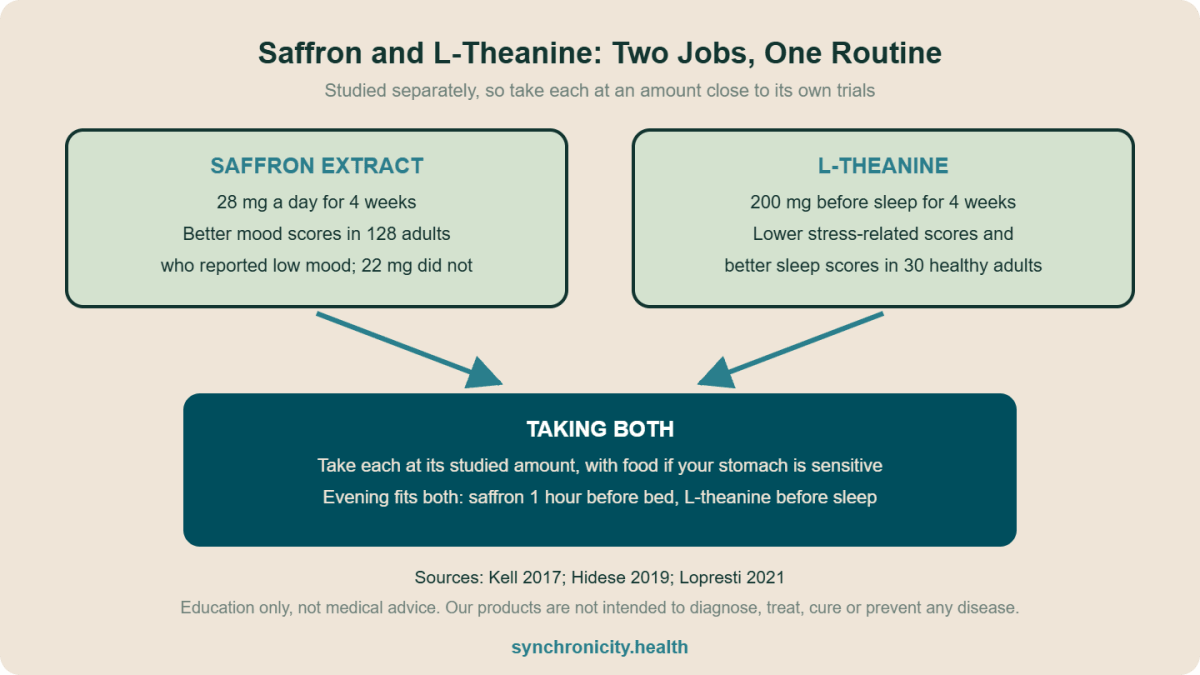
Yes, saffron and L-theanine can be taken together, and they are often paired because they do different jobs. Saffron extract has been studied for mood and sleep over weeks of daily use, with 28 mg a day the amount in the best-known mood trial. L-theanine, an amino acid from tea leaves, is studied for a calm, steady feeling at 200 to 400 mg a day. The two have been studied separately, so the simple way to combine them is to take each at its studied amount.
Key Takeaways
- In a 4-week trial of 128 adults who reported low mood, 28 mg a day of saffron extract improved mood scores compared with placebo, while 22 mg a day did not (Kell et al., 2017).
- In a 4-week trial of 30 healthy adults, 200 mg of L-theanine taken before sleep each night lowered stress-related scores and improved sleep scores (Hidese et al., 2019).
- A review of 9 randomized trials found that 200 to 400 mg a day of L-theanine may help people under stressful conditions manage stress (Williams et al., 2020).
- Saffron was generally well tolerated across 102 clinical trials, most of which used 15 to 30 mg a day (Hasheminasab et al., 2026).
- Both fit an evening routine: saffron sleep trials gave it in the evening, and the L-theanine trial gave it before sleep.

Featured in this article
Saffron Mood and Calm CapsulesSaffron extract 28 mg with L-theanine 200 mg per serving in the planned formula, for a steadier mood and a calmer day.
Join the WaitlistComing soon. Third-party tested ingredients.
Why Pair Saffron and L-Theanine?
Saffron is the dried red stigma of the Crocus sativus flower. Its color comes from crocins, its bitter taste from picrocrocin and its aroma from safranal (Avila-Sosa et al., 2022). Supplements use a standardized extract so each serving carries a steady amount, and the research measures how people feel after several weeks of taking it every day. Our saffron extract ingredient page covers the chemistry in detail.
L-theanine is an amino acid found in tea leaves. It is caffeine-free, and its research centers on stress, calm and sleep quality. You can read more on our L-theanine ingredient page and in our guide to L-theanine dosage.
Put simply, saffron is studied for a steadier mood that builds over weeks, and L-theanine for a calmer feel from day to day. That is why the pair shows up in mood and calm formulas.
What Studies Found for Each
Saffron: mood and sleep
In a double-blind trial, 128 adults who reported low mood, but had no diagnosis, took 28 mg or 22 mg of a saffron extract a day, or a placebo, for 4 weeks. The 28 mg dose lowered negative mood and stress-related scores compared with placebo. The 22 mg dose did not, which suggests the amount matters, and the authors reported no side effects (Kell et al., 2017).
Saffron has sleep trials too. In 120 adults with unsatisfying sleep, 14 mg or 28 mg of saffron extract taken 1 hour before bed for 28 days improved sleep quality ratings and mood on waking compared with placebo, and both doses worked about equally well (Lopresti et al., 2021).
L-theanine: stress, sleep and focus
In a 4-week crossover trial, 30 healthy adults took 200 mg of L-theanine or a placebo before sleep each night. Stress-related scores and sleep scores fell during the L-theanine weeks, and verbal fluency and executive function improved. Compared with placebo, the clearest gains were in how long it took to fall asleep and in sleep disturbance (Hidese et al., 2019).
A systematic review of 9 randomized trials concluded that 200 to 400 mg a day may help people exposed to stressful conditions manage stress, and called for longer and larger studies (Williams et al., 2020). Our guide to L-theanine for sleep goes deeper on the sleep side.
Saffron vs L-Theanine: Side by Side
| Saffron extract | L-theanine | |
|---|---|---|
| What it is | Extract of the red stigmas of Crocus sativus | An amino acid found in tea leaves |
| Main focus in studies | Mood and sleep quality | Stress, calm and sleep quality |
| Daily amounts studied | Mostly 15 to 30 mg; 28 mg in the mood trial above | 200 to 400 mg |
| Trial length above | 28 days to 4 weeks | 4 weeks |
| Timing in trials | Daily; sleep trials used the evening | Before sleep in the 4-week trial |
| In our range | 28 mg per serving in Saffron Mood and Calm Capsules (coming soon) | 200 mg in the same capsules; 36 mg per 2 sprays in Theanine Nasal Spray |
If you are weighing saffron against another calm-and-mood ingredient, our guide to saffron vs ashwagandha compares the two, and saffron supplement benefits covers saffron on its own.
Taking Saffron and L-Theanine Together
Because the two have been studied separately, the practical approach is to take each at an amount close to its own trials:
- Saffron: about 28 mg of a standardized extract a day, the amount that improved mood scores in the 4-week trial (Kell et al., 2017).
- L-theanine: about 200 mg a day, the amount in the 4-week trial in healthy adults (Hidese et al., 2019).
- Daytime or evening: for mood, the saffron trial measured steady daily use, so pick a time you will remember. For sleep, saffron was given 1 hour before bed in the 28-day trial and L-theanine before sleep, so an evening dose of both fits well.
- With food: the most common saffron complaint across trials was mild stomach upset, which was minor and short-lived in most cases (Hasheminasab et al., 2026). Taking it with a meal or snack is an easy way to stay comfortable.
- Medicines: if you take prescription medicine, check with your clinician before adding either one.
Saffron, L-Theanine and Magnesium
Magnesium is the third ingredient people often ask about, especially for evenings. Adults need about 400 to 420 mg a day (men) or 310 to 320 mg a day (women) from all sources, and the upper limit for magnesium from supplements is 350 mg a day; going over it can cause diarrhea, nausea and cramping (NIH Office of Dietary Supplements).
Saffron, L-theanine and magnesium are different kinds of ingredients, so they can sit side by side in a routine. The one thing to watch is the total magnesium across all your supplements. For how L-theanine and magnesium compare, see L-theanine vs magnesium glycinate. Our coming soon Melatonin-Free Sleep Powder gives 200 mg of magnesium from two gentle forms with tart cherry, 3 g of glycine, myo-inositol and apigenin, taken 30 to 60 minutes before bed; join the waitlist to hear when it launches.
Who Might Choose Which
- Saffron first if a steadier mood over the coming weeks is your main goal and you are happy to take something every day.
- L-theanine first if you want a caffeine-free way to feel calmer, or you want to pair it with coffee or tea.
- Both if you want mood support that builds over time plus day-to-day calm, which is the idea behind formulas that combine them.
For a wider view of the options, see best supplements for stress and mood and our stress, mood and nervous system guide.
Where Our Saffron Mood and Calm Capsules Fit
Our Saffron Mood and Calm Capsules pair saffron extract 28 mg with L-theanine 200 mg per serving in the planned formula, the same amounts used in the saffron mood trial and the L-theanine trial above. They are coming soon: join the waitlist on the product page to hear when they launch, and no payment is taken now. Directions will be on the label at launch.
If you want L-theanine on its own today, our Theanine Nasal Spray gives 36 mg of L-theanine in every 2-spray serving, with alkaline water as the only other ingredient. It is caffeine-free, made with third-party tested ingredients, and part of our Focus Stack and Sleep Stack. It is absorbed through the lining of the nose, so some of each dose skips digestion.
Saffron's benefits build with consistent daily use. Months 1 to 2 can bring early changes, and 3 months and beyond is where the full benefit builds, so give a daily routine time before you judge it.

Featured in this article
Theanine Nasal Spray36 mg of L-theanine per serving, caffeine-free, to pair with your coffee or tea.
Shop Theanine Nasal SprayThird-party tested ingredients. Vegan, non-GMO, made in the USA.
Frequently Asked Questions
Can saffron and L-theanine be taken together?
Yes. They are different kinds of ingredients and many formulas pair them. They have been studied separately, so take each at an amount close to its trials, and check with your clinician first if you take prescription medicine.
What are the benefits of saffron and L-theanine together?
Saffron is studied for a steadier mood and better sleep quality over weeks, and L-theanine for stress, calm and sleep quality. Together they cover both a longer-term and a day-to-day side of feeling calm.
Are saffron and L-theanine good for sleep?
Both have sleep data. Saffron extract taken 1 hour before bed for 28 days improved sleep quality ratings, and 200 mg of L-theanine before sleep improved sleep scores in healthy adults.
How much saffron and L-theanine should I take?
The trials used about 28 mg of saffron extract a day for mood and 200 to 400 mg of L-theanine a day. Follow the label of the product you use.
Should I take saffron and L-theanine in the morning or at night?
For mood, any consistent time works, since the trials measured daily use. For sleep, the evening fits the research, as saffron was given 1 hour before bed and L-theanine before sleep.
Can I take saffron, L-theanine and magnesium together?
Many people do, as they are different kinds of ingredients. Keep magnesium from all supplements at or under 350 mg a day unless your clinician advises more.
Saffron vs L-theanine: which is better?
Neither is better overall; they do different jobs. Choose saffron for mood support that builds over weeks, L-theanine for day-to-day calm, or both if you want each.
How long do saffron and L-theanine take to work?
The trials measured changes after 4 weeks of daily use. Give a daily routine at least a few months for the full benefit to build.
Sources
- Kell G, et al. affron, a novel saffron extract (Crocus sativus L.), improves mood in healthy adults over 4 weeks in a double-blind, parallel, randomized, placebo-controlled clinical trial. Complementary Therapies in Medicine, 2017. https://pubmed.ncbi.nlm.nih.gov/28735826/
- Lopresti AL, Smith SJ, Drummond PD. An investigation into an evening intake of a saffron extract (affron) on sleep quality, cortisol, and melatonin concentrations in adults with poor sleep: a randomised, double-blind, placebo-controlled, multi-dose study. Sleep Medicine, 2021. https://pubmed.ncbi.nlm.nih.gov/34438361/
- Hidese S, et al. Effects of L-theanine administration on stress-related symptoms and cognitive functions in healthy adults: a randomized controlled trial. Nutrients, 2019. https://pubmed.ncbi.nlm.nih.gov/31623400/
- Williams JL, et al. The effects of green tea amino acid L-theanine consumption on the ability to manage stress and anxiety levels: a systematic review. Plant Foods for Human Nutrition, 2020. https://pubmed.ncbi.nlm.nih.gov/31758301/
- Hasheminasab FS, Hajimonfarednejad M, Najibi SM, Hashempur MH. Adverse events of saffron (Crocus sativus L.): systematic review of current evidence. Health Science Reports, 2026. https://pubmed.ncbi.nlm.nih.gov/42057871/
- Avila-Sosa R, et al. Detection of saffron's main bioactive compounds and their relationship with commercial quality. Foods, 2022. https://pubmed.ncbi.nlm.nih.gov/37430993/
- NIH Office of Dietary Supplements. Magnesium: Fact Sheet for Consumers. https://ods.od.nih.gov/factsheets/Magnesium-Consumer/
These statements have not been evaluated by the Food and Drug Administration. This content is for education and is not medical advice. Our products are not intended to diagnose, treat, cure or prevent any disease. Talk with a healthcare provider before starting a new supplement if you are pregnant, breastfeeding or taking medication.

Leave a comment
All comments are moderated before being published.
This site is protected by hCaptcha and the hCaptcha Privacy Policy and Terms of Service apply.