
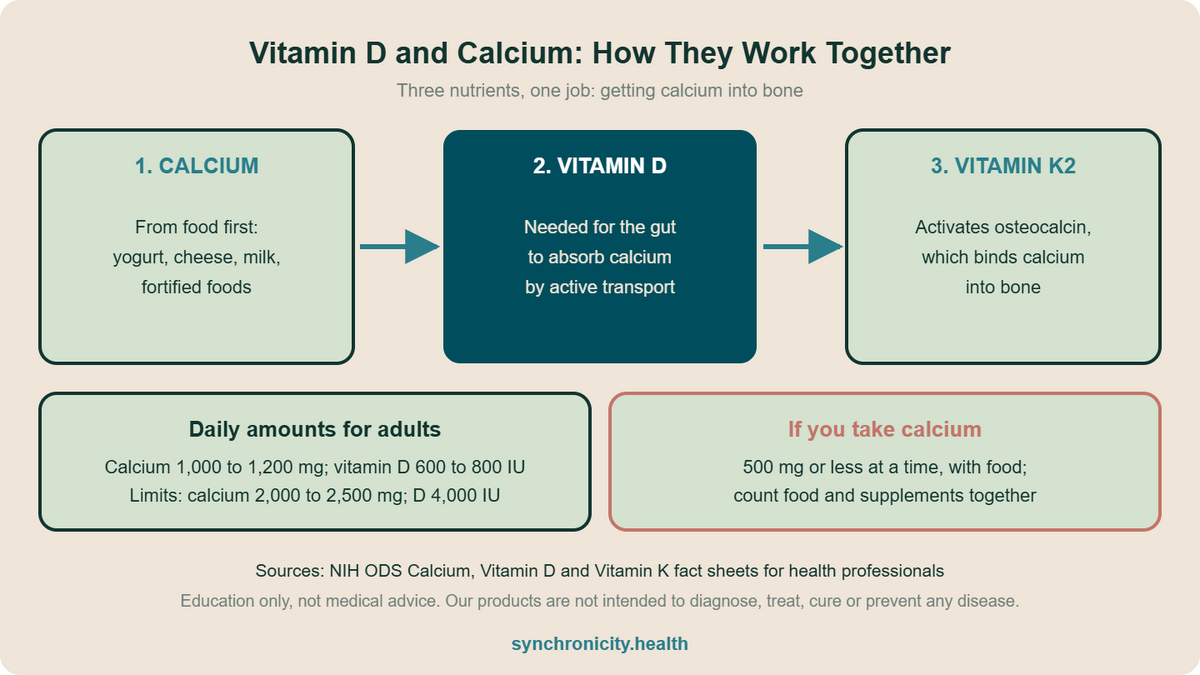
Vitamin D and calcium work as a pair: your gut needs vitamin D to absorb calcium, and calcium is one of the main building blocks of bone. Most people can get their calcium from food and take vitamin D as a supplement. If you do take calcium too, keep each dose to 500 mg or less and take it with food. Vitamin K2 is the third partner, helping put that calcium to work.
Key Takeaways
- Vitamin D is required for calcium to be absorbed in the gut by active transport (NIH ODS: Calcium).
- Adults need 1,000 mg of calcium a day, rising to 1,200 mg for women from 51 and men from 71. American men already average about 1,083 mg a day from food and women about 842 mg (NIH ODS: Calcium).
- Calcium supplements absorb best in doses of 500 mg or less, and usually better with food (NIH ODS: Calcium).
- Adults need 600 IU of vitamin D a day (800 IU over 70), with an upper limit of 4,000 IU (NIH ODS: Vitamin D).
- Vitamin K2 activates osteocalcin, the protein that binds calcium into bone (NIH ODS: Vitamin K).

Featured in this article
Vitamin D3 + K2 DropsVegan vitamin D3 from lichen with vitamin K2 as MK-4 and MK-7 in an MCT oil base, one drop a day with a meal.
Shop Vitamin D3 + K2 DropsThird-party tested ingredients. Vegan, gluten free, non-GMO.
How Vitamin D and Calcium Work Together
Calcium is the mineral; vitamin D is the key that lets it in. The NIH notes that vitamin D is required for calcium to be absorbed in the gut by active transport, and that low vitamin D status reduces how much calcium you absorb from food (NIH ODS: Calcium). In other words, you can eat plenty of calcium and still absorb less of it if your vitamin D is low.
Once calcium is in, vitamin K steps in. Vitamin K activates calcium-binding proteins, including osteocalcin in bone and matrix Gla protein in soft tissues (NIH ODS: Vitamin K). That is why many people take vitamin D3 with K2; our guide to vitamin D3 and K2 covers the pairing.
| Nutrient | Its job with calcium |
|---|---|
| Calcium | One of the main building blocks of bone |
| Vitamin D | Needed for the gut to absorb calcium |
| Vitamin K2 | Activates osteocalcin, which binds calcium into bone |
| Magnesium | Needed to activate vitamin D; see vitamin D and magnesium |
How Much Calcium and Vitamin D Do You Need?
| Adults | Calcium a day | Vitamin D a day |
|---|---|---|
| 19 to 50 | 1,000 mg | 600 IU (15 mcg) |
| Women 51 to 70 | 1,200 mg | 600 IU (15 mcg) |
| Men 51 to 70 | 1,000 mg | 600 IU (15 mcg) |
| Over 70 | 1,200 mg | 800 IU (20 mcg) |
| Upper limit | 2,500 mg to age 50; 2,000 mg from 51 | 4,000 IU (100 mcg) |
Sources: NIH ODS: Calcium and NIH ODS: Vitamin D. Calcium amounts are from food and supplements combined.
Calcium From Food First
Many people already get much of their calcium from food: American men average about 1,083 mg a day and women about 842 mg (NIH ODS: Calcium). Dairy supplies about 72 percent of calcium intake in the United States. A few servings go a long way:
- Plain low-fat yogurt, 8 oz: about 415 mg
- Part-skim mozzarella, 1.5 oz: about 333 mg
- Nonfat milk, 1 cup: about 299 mg
- Whole milk, 1 cup: about 276 mg
If you avoid dairy, fortified plant milks such as soy and almond drinks, tofu, fortified juices and fortified cereals all supply calcium (NIH ODS: Calcium). Vitamin D is harder to get from food, which is why it is the one most people supplement; see foods high in vitamin D.
Should You Take Vitamin D With Calcium?
You do not need to take them in the same pill. Vitamin D works on the calcium from all your meals, so a daily vitamin D with food plus calcium from your diet covers both. If your diet falls short and you add a calcium supplement:
- Keep doses to 500 mg or less. Absorption from supplements is highest at that size, so split larger amounts across the day.
- Take it with food. Calcium supplements are generally absorbed better with a meal. Calcium citrate depends less on stomach acid than calcium carbonate, so it can be taken without food.
- Count every source. Add your food, any multivitamin and any calcium supplement so you stay within the upper limit.
Source: NIH ODS: Calcium.
Where Vitamin K2 Fits
Vitamin D increases the calcium you absorb; vitamin K2 activates osteocalcin, the protein that binds calcium into the bone matrix, and matrix Gla protein in soft tissues (NIH ODS: Vitamin K). Taking D3 with K2 covers both steps. For the two forms of K2, see vitamin K2: MK-4 vs MK-7, and for food sources, vitamin K2 foods.
Safety and Who Should Check First
- Stay within the limits: 4,000 IU of vitamin D a day, and 2,000 to 2,500 mg of calcium a day depending on age, from all sources.
- Kidney stones: the calcium upper limit was set partly on a large study that linked higher supplemental calcium with kidney stones, though two later systematic reviews found no such link (NIH ODS: Calcium). If you have had kidney stones, ask your clinician before taking calcium supplements.
- Medicines: thiazide diuretics reduce the calcium lost in urine, so ask your clinician before adding vitamin D or calcium (NIH ODS: Vitamin D).
- Blood thinners: if you take warfarin, talk with your clinician before starting vitamin K2.
For the nutrients that help vitamin D work, see vitamin D cofactors, our vitamin D3 supplement guide and our vitamin D3 ingredient guide. More guides are in our Learn hub.
Where Our Vitamin D3 + K2 Drops Fit
Our Vitamin D3 + K2 Drops supply the two vitamins that work with calcium, not the calcium itself, so you keep getting calcium from food. Each drop gives 2,000 IU (50 mcg) of vegan vitamin D3 from lichen and 300 mcg of vitamin K2 as MK-7 200 mcg and MK-4 100 mcg, in MCT oil from coconut. Take one drop a day with a meal that contains some fat; a calcium-rich meal such as yogurt works well. Each bottle holds about 180 drops. For the magnesium that helps activate vitamin D, our Vitamin D Cofactor Capsules are coming soon.
Featured in this article
Vitamin D3 + K2 DropsVegan vitamin D3 from lichen with vitamin K2 as MK-4 and MK-7 in an MCT oil base, one drop a day with a meal.
Shop Vitamin D3 + K2 DropsThird-party tested ingredients. Vegan, gluten free, non-GMO.
More vitamin D guides: vitamin D side effects, the best time to take vitamin D, vitamin D for women and vitamin D in winter.
Frequently Asked Questions
Do you need vitamin D to absorb calcium?
Yes. Vitamin D is required for calcium to be absorbed in the gut by active transport, and low vitamin D reduces how much calcium you absorb from food.
Should I take calcium and vitamin D together?
They do not need to be in the same pill. Vitamin D works on the calcium from all your meals. If you also take calcium, keep each dose to 500 mg or less and take it with food.
How much calcium and vitamin D should I take a day?
Adults need 1,000 to 1,200 mg of calcium a day from food and supplements, and 600 to 800 IU of vitamin D, with upper limits of 2,000 to 2,500 mg of calcium and 4,000 IU of vitamin D.
What is the best calcium to take with vitamin D?
Calcium from food first. If you use a supplement, calcium carbonate absorbs best with food, and calcium citrate can be taken with or without food.
Does vitamin K2 help calcium go to the bones?
Vitamin K2 activates osteocalcin, the protein that binds calcium into bone, and matrix Gla protein in soft tissues.
Can you take too much calcium?
Yes. Stay within 2,500 mg a day up to age 50 and 2,000 mg from age 51, counting food and supplements together.
Does your Vitamin D3 + K2 Drops product contain calcium?
No. The drops give vitamin D3 and vitamin K2, the two vitamins that work with calcium, so you keep getting calcium from food.
Sources
- National Institutes of Health, Office of Dietary Supplements. Calcium: Fact Sheet for Health Professionals. https://ods.od.nih.gov/factsheets/Calcium-HealthProfessional/
- National Institutes of Health, Office of Dietary Supplements. Vitamin D: Fact Sheet for Health Professionals. https://ods.od.nih.gov/factsheets/VitaminD-HealthProfessional/
- National Institutes of Health, Office of Dietary Supplements. Vitamin K: Fact Sheet for Health Professionals. https://ods.od.nih.gov/factsheets/VitaminK-HealthProfessional/
These statements have not been evaluated by the Food and Drug Administration. This content is for education and is not medical advice. Our products are not intended to diagnose, treat, cure or prevent any disease. Talk with a healthcare provider before starting a new supplement if you are pregnant, breastfeeding or taking medication.

Leave a comment
All comments are moderated before being published.
This site is protected by hCaptcha and the hCaptcha Privacy Policy and Terms of Service apply.