
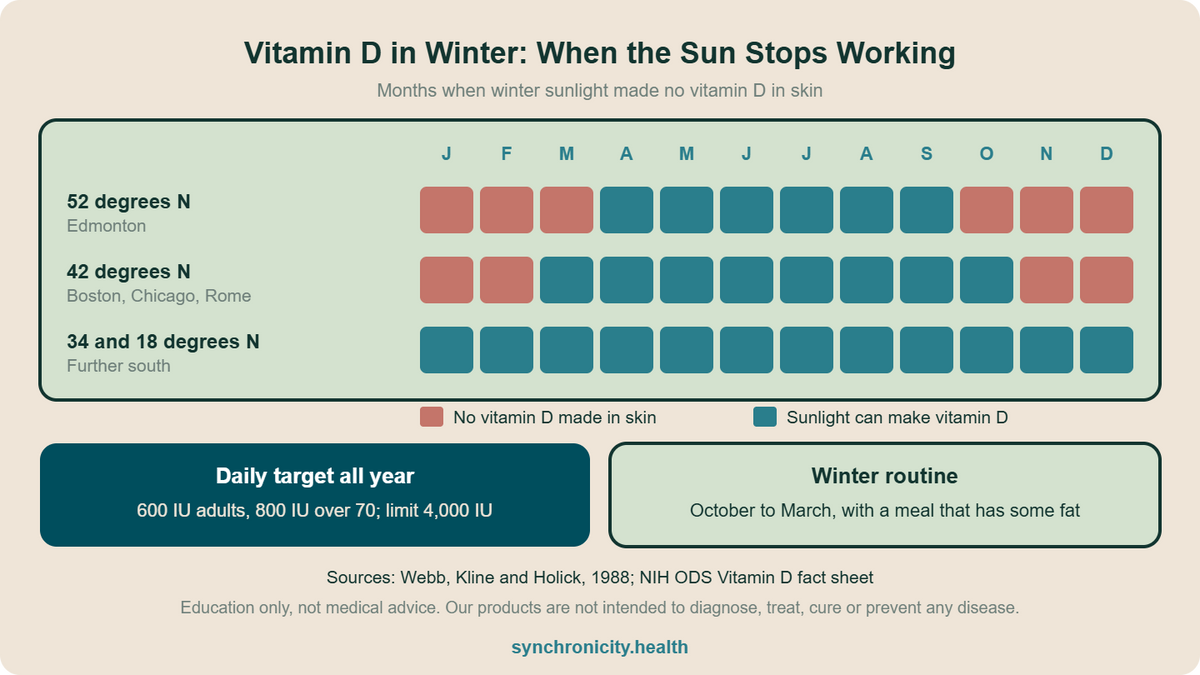
In winter, the sun sits too low in much of the northern United States, Canada and Europe for your skin to make vitamin D. In a classic study, winter sunlight in Boston made no vitamin D precursor in skin from November through February, and in Edmonton the gap ran from October through March. That leaves food and supplements to cover the daily target of 600 IU (15 mcg), or 800 IU (20 mcg) after age 70, through the colder months.
Key Takeaways
- Skin makes vitamin D from UVB light. At about 42 degrees north (Boston), winter sunlight made none from November through February; at 52 degrees north (Edmonton), none from October through March (Webb et al., 1988).
- Further south, at 34 and 18 degrees north, sunlight still made vitamin D in the middle of winter.
- UVB does not pass through glass, so sun through a window does not count (NIH ODS: Vitamin D).
- The daily target stays the same all year: 600 IU for adults, 800 IU over 70, with an upper limit of 4,000 IU (100 mcg).
- In winter, oily fish, UV-exposed mushrooms, fortified foods and a supplement taken with a meal are the practical sources.

Featured in this article
Vitamin D3 + K2 DropsVegan vitamin D3 from lichen with vitamin K2 as MK-4 and MK-7 in an MCT oil base, one drop a day with a meal.
Shop Vitamin D3 + K2 DropsThird-party tested ingredients. Vegan, gluten free, non-GMO.
Why Your Skin Stops Making Vitamin D in Winter
Your skin makes vitamin D when UVB rays from the sun reach it. In winter the sun stays lower in the sky, so its light passes through more atmosphere and far less UVB reaches the ground. Far enough from the equator, the amount drops so low that the skin makes little or none, however long you stay outside.
A 1988 study measured this directly by exposing skin samples and the vitamin D precursor in skin to sunlight in different cities through the year (Webb et al., 1988):
| Latitude | Example | Months with no vitamin D made in skin |
|---|---|---|
| 52 degrees north | Edmonton, Canada | October through March |
| 42 degrees north | Boston, United States | November through February |
| 34 and 18 degrees north | Further south | Still made in midwinter |
Boston sits at roughly the same latitude as Chicago and Rome, so a large share of North America and most of Europe have a winter stretch when the sun cannot keep vitamin D topped up. The authors concluded that supplements may be worth considering during those months.
Other Things That Cut Winter Vitamin D
Even where winter sun still works, several everyday factors reduce how much vitamin D the skin makes (NIH ODS: Vitamin D):
- Short days and time of day: less time outdoors in daylight, and early morning or late afternoon sun carries little UVB.
- Cloud cover: grey skies cut UV further.
- Glass: UVB does not pass through windows, so a sunny office or car makes no vitamin D.
- Clothing: coats, hats and gloves leave little skin exposed.
- Skin tone and age: darker skin and older skin both make less vitamin D from the same light.
How Much Vitamin D to Take in Winter
The official daily targets do not change with the seasons: 600 IU (15 mcg) for adults up to 70 and 800 IU (20 mcg) after 70, from food and supplements combined. The upper limit is 4,000 IU (100 mcg) a day from all sources (NIH ODS: Vitamin D). What changes is where it comes from: in summer, sunlight can supply a good share; in winter, food and supplements have to do most of the work.
Common supplements give 1,000 to 2,000 IU a day, which sits well within the upper limit. Our vitamin D3 supplement guide compares 1,000, 2,000 and 5,000 IU, and our guide to vitamin D vs D3 explains why most supplements use D3.
Does summer sun carry you through?
Vitamin D is fat-soluble, and some of what you make in summer is stored in body fat. Stores can carry you part of the way, but with four to six months of little or no skin production, many people find their level drifts down by late winter. A blood test in February or March is the clearest way to see where you stand: 20 ng/mL or more is adequate for most people, and above 50 ng/mL is higher than needed.
Winter Food Sources of Vitamin D
Few foods are rich in vitamin D, but these help (NIH ODS: Vitamin D):
| Food | Vitamin D |
|---|---|
| Cod liver oil, 1 tablespoon | 1,360 IU |
| Trout, farmed, cooked, 3 oz | 645 IU |
| Salmon, sockeye, cooked, 3 oz | 570 IU |
| White mushrooms exposed to UV light, half cup | 366 IU |
| Milk, 2 percent, fortified, 1 cup | 120 IU |
| Egg, 1 large, scrambled | 44 IU |
Two servings of oily fish a week help, but on most winter days food alone will fall short of 600 IU. See our full list of foods high in vitamin D.
A Simple Winter Vitamin D Routine
- Start in autumn: begin in October, before your summer stores run low, and continue through March.
- Take it with a meal that has some fat: vitamin D is fat-soluble, so a meal with eggs, yogurt, nuts, olive oil or fish helps you absorb it.
- Same time every day: tie it to the meal you never skip.
- Add the partners: vitamin K2 directs calcium into bone and magnesium helps activate vitamin D; see vitamin D3 and K2 and vitamin D and magnesium.
- Count every source: multivitamins and fortified foods add up toward the 4,000 IU limit.
- Choose a format you will use: see vitamin D drops vs pills, or vegan vitamin D3 if you avoid animal ingredients.
Our vitamin D3 ingredient guide covers the basics, and our immune system guide covers daily immune support through the year.
Where Our Vitamin D3 + K2 Drops Fit
Our Vitamin D3 + K2 Drops give 2,000 IU (50 mcg) of vegan vitamin D3 from lichen and 300 mcg of vitamin K2 as MK-7 200 mcg and MK-4 100 mcg in each drop, in MCT oil from coconut. Take one drop a day with a meal. Each bottle holds about 180 drops, about 6 months at one drop a day, which covers October through March in one bottle. If you also want the minerals that help vitamin D work, our Vitamin D Cofactor Capsules are coming soon.
Featured in this article
Vitamin D3 + K2 DropsVegan vitamin D3 from lichen with vitamin K2 as MK-4 and MK-7 in an MCT oil base, one drop a day with a meal.
Shop Vitamin D3 + K2 DropsThird-party tested ingredients. Vegan, gluten free, non-GMO.
More vitamin D guides: vitamin D side effects, the best time to take vitamin D, vitamin D and calcium and vitamin D for women.
Frequently Asked Questions
Can you get vitamin D from the sun in winter?
It depends on where you live. At about 42 degrees north, roughly Boston or Chicago, winter sunlight made no vitamin D in skin from November through February in one study. Further south, sunlight still worked in midwinter.
Should I take vitamin D in winter?
If you live far from the equator and do not eat oily fish most days, a supplement is the simplest way to reach the daily target of 600 IU (800 IU over 70) through the colder months.
How much vitamin D should I take in winter?
The target is the same all year: 600 IU for adults and 800 IU after 70. Common supplements give 1,000 to 2,000 IU a day. Stay within the 4,000 IU upper limit from all sources.
When should I start taking vitamin D for winter?
October is a sensible start, before summer stores run low, continuing through March.
Does sunlight through a window give you vitamin D?
No. UVB does not pass through glass, so sitting by a sunny window makes no vitamin D.
Do you need vitamin D in summer too?
The daily target applies all year. In summer some people get enough from sunlight, but sunscreen, time indoors and darker skin all reduce what the skin makes, so many people take vitamin D year round.
Can I take vitamin D with my winter multivitamin?
Yes, but add up the vitamin D in both so your total stays within 4,000 IU a day.
When is the best time to test vitamin D levels?
Late winter, around February or March, shows your level at its usual low point. Recheck about 3 months after you start or change a dose.
Sources
- National Institutes of Health, Office of Dietary Supplements. Vitamin D: Fact Sheet for Health Professionals. https://ods.od.nih.gov/factsheets/VitaminD-HealthProfessional/
- Webb AR, Kline L, Holick MF. Influence of season and latitude on the cutaneous synthesis of vitamin D3. Journal of Clinical Endocrinology and Metabolism, 1988. https://europepmc.org/article/MED/2839537
These statements have not been evaluated by the Food and Drug Administration. This content is for education and is not medical advice. Our products are not intended to diagnose, treat, cure or prevent any disease. Talk with a healthcare provider before starting a new supplement if you are pregnant, breastfeeding or taking medication.

Leave a comment
All comments are moderated before being published.
This site is protected by hCaptcha and the hCaptcha Privacy Policy and Terms of Service apply.