
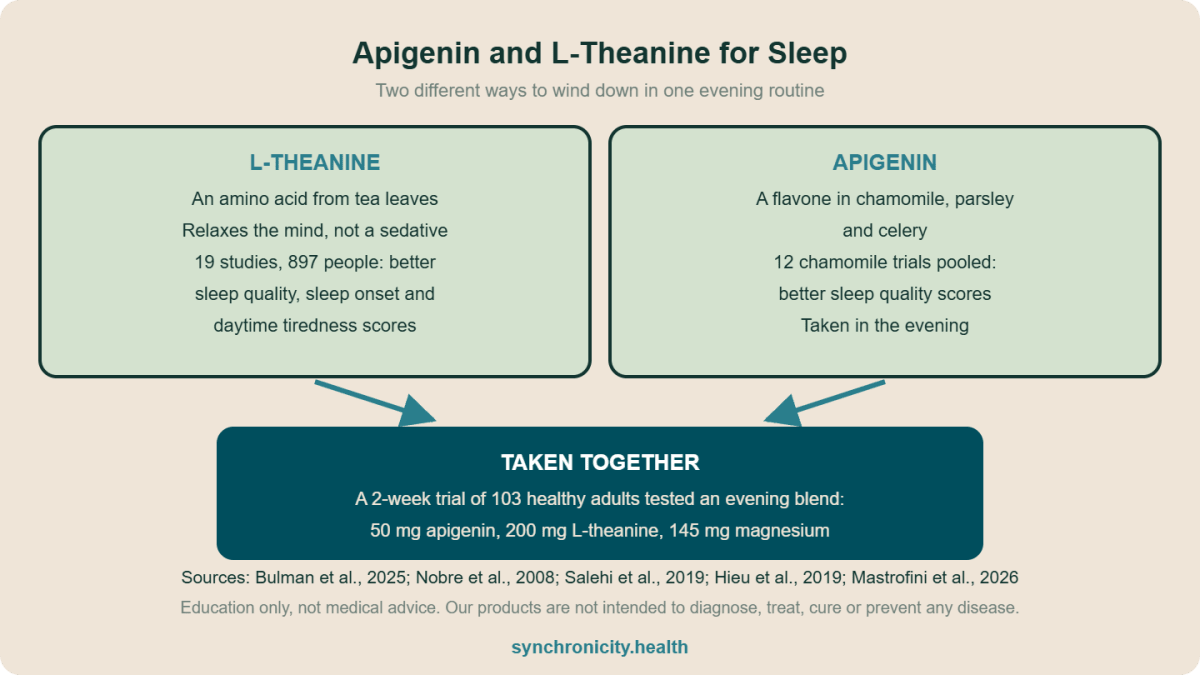
Yes, you can take apigenin and L-theanine together, and they are often paired in an evening routine because they come at winding down from different directions. L-theanine is an amino acid from tea that supports a calmer mind and better sleep quality scores, backed by a 2025 meta-analysis of 19 studies. Apigenin is a plant flavone best known from chamomile, and its sleep research in people comes mostly from chamomile trials. One two-week trial has tested the two together, with magnesium, in healthy, active adults.
Key Takeaways
- L-theanine supports sleep quality: a 2025 meta-analysis of 19 studies with 897 people found better scores for falling asleep, daytime tiredness and overall sleep quality (Bulman et al., 2025).
- Apigenin is a flavone found in chamomile, parsley, celery and other plants (Salehi et al., 2019). A meta-analysis of 12 chamomile trials found better sleep quality scores (Hieu et al., 2019).
- L-theanine is not a sedative: at 50 mg it increased alpha brain wave activity compared with placebo, and researchers describe it as relaxing the mind without drowsiness (Nobre et al., 2008).
- A 2026 trial of 103 healthy, active adults tested an evening blend of 50 mg apigenin, 200 mg L-theanine and magnesium for two weeks; the clearest changes were in a morning adaptogen group, and the authors noted that a short trial in healthy people may show limited effects (Mastrofini et al., 2026).
- Both are well tolerated by most adults; a review of 31 L-theanine trials reported no serious adverse events (Gerolymos et al., 2026).

Featured in this article
Theanine Nasal Spray36 mg of L-theanine per serving, caffeine-free, to pair with your coffee or tea.
Shop Theanine Nasal SprayThird-party tested ingredients. Vegan, non-GMO, made in the USA.
Two Different Ways to Wind Down
L-theanine is a non-protein amino acid found in tea leaves. It does not knock you out. In a study of healthy young adults, 50 mg of L-theanine, a realistic dietary amount, increased alpha activity on brain recordings, measured up to 105 minutes after taking it, more than placebo did. The researchers describe L-theanine as relaxing the mind without causing drowsiness (Nobre et al., 2008). That is why people use it both during the day and at bedtime. Our L-theanine ingredient page explains where it comes from.
Apigenin is a flavonoid from the flavone subclass and one of the most widely spread in the plant kingdom. It is found in vegetables such as parsley, celery and onions, in oranges, and in herbs such as chamomile, thyme, oregano and basil (Salehi et al., 2019). Chamomile tea is the classic bedtime source, which is why apigenin is so closely tied to sleep. Our apigenin ingredient page and our full apigenin guide cover it in depth.
Apigenin vs L-Theanine at a Glance
| Apigenin | L-theanine | |
|---|---|---|
| What it is | A plant flavone | An amino acid from tea leaves |
| Best known source | Chamomile, parsley, celery | Tea leaves |
| Sleep research in people | Mainly chamomile trials: 12 trials pooled, better sleep quality scores | 19 studies pooled: better sleep quality, sleep onset and daytime tiredness scores |
| Amounts in trials | 50 mg in the combination trial below | 200 mg a day in the trials below |
| Makes you drowsy? | Used as part of a wind-down routine | Not a sedative; also used during the day |
What the Research Shows for Each
L-theanine
A 2025 meta-analysis of 19 randomized studies with 897 people found that L-theanine improved how quickly people felt they fell asleep (10 studies), daytime tiredness (9 studies) and overall sleep quality scores (12 studies) compared with placebo. The authors noted that few of the studies used L-theanine on its own (Bulman et al., 2025).
In one trial, 30 healthy adults with an average age of 48 took 200 mg of L-theanine a day or a placebo for 4 weeks each. With L-theanine, sleep quality scores improved, and time to fall asleep, sleep disturbance and use of sleep medication all scored better than with placebo (Hidese et al., 2019). Our guide to L-theanine for sleep covers these studies in more detail.
Apigenin
Most research on apigenin itself has been done in cell and animal studies (Salehi et al., 2019). In people, the sleep research comes mainly from chamomile, its best known source. A 2019 meta-analysis of 12 randomized chamomile trials found significantly better sleep quality scores after chamomile, with only mild side effects reported (Hieu et al., 2019).
Taking Apigenin and L-Theanine Together
Apigenin and L-theanine are a natural pair: L-theanine supports a quieter mind, and apigenin brings the chamomile tradition into a measured amount.
The combination trial
One randomized, double-blind, placebo-controlled trial has tested the pair directly. It enrolled 103 healthy, physically active adults with an average age of about 35. An evening product gave 50 mg of apigenin, 200 mg of L-theanine and 2 g of magnesium L-threonate (145 mg of magnesium); a morning product gave 600 mg of ashwagandha and 300 mg of rhodiola. People took the morning product, the evening product, both, or placebos for two weeks, and researchers tracked stress and sleep questionnaires along with nightly sleep from a wearable device (Mastrofini et al., 2026).
The clearest changes over the two weeks were in the morning adaptogen group, which improved perceived stress, sleep quality and mood scores. The authors noted that the smaller effects elsewhere may reflect limited benefit in healthy people over a short period, and they called for longer studies in people with more stress and poorer sleep. It is an early result, and a useful picture of the amounts people use: 50 mg of apigenin with 200 mg of L-theanine.
Practical tips
- Take them together in the evening. A steady time in the last hour before bed fits the job of both.
- Pair them with the basics. A regular bedtime, a dim room and fewer late screens do a lot of the work. Our guide to why quality rest matters explains why.
Benefits build with consistent nightly use: months 1 to 2 can bring early changes, and 3 months and beyond is where the full benefit builds. For how much apigenin to take and when, see our guide to apigenin dosage.
Apigenin, L-Theanine and Magnesium
Magnesium is the third ingredient people most often add, and the combination trial above included it. Magnesium is a cofactor in more than 300 enzyme systems. The recommended intake for adults is 310 to 420 mg a day from all sources, depending on age and sex, and good food sources include green leafy vegetables, legumes, nuts, seeds and whole grains. The upper limit for magnesium from supplements is 350 mg a day for adults, and high doses from supplements can cause diarrhea, nausea and cramping (NIH Office of Dietary Supplements).
For how magnesium fits into sleep, see our guides to magnesium glycinate for sleep and magnesium vs melatonin, plus apigenin.
Who Might Choose Which
- Your mind will not switch off at bedtime: L-theanine is the better first step, and it is melatonin-free.
- You like a chamomile-style wind-down: apigenin brings that tradition in a measured amount.
- Both: take them together in one evening routine, with magnesium as an easy third. If you also want a timing signal, see melatonin and L-theanine.
Is It Safe to Take Them Together?
For most healthy adults, both are well tolerated. A 2026 meta-analysis of 31 randomized L-theanine trials with 1,168 people reported no serious adverse events and described L-theanine as safe (Gerolymos et al., 2026). Chamomile, apigenin's best known source, is likely safe in the amounts found in teas and foods, and side effects are uncommon. People allergic to related plants such as ragweed, chrysanthemums, marigolds or daisies are more likely to react to chamomile (NCCIH).
Talk with a clinician first if you are pregnant or breastfeeding, and if you take prescription medicine, check with your clinician before adding either one. Our guide to L-theanine side effects covers the details for that ingredient.
Where Our Products Fit
Our Theanine Nasal Spray gives 36 mg of L-theanine in every 2-spray serving, with alkaline water as the only other ingredient, made with third-party tested ingredients. It is caffeine-free and part of our Sleep Stack and Focus Stack. It is absorbed through the lining of the nose, so some of each dose skips digestion. The trials above used capsules at higher amounts, so they describe the ingredient rather than our spray.
Our Melatonin-Free Sleep Powder is coming soon and contains apigenin, along with tart cherry, 3 g of glycine, 200 mg of magnesium from two gentle forms and myo-inositol, mixed in water 30 to 60 minutes before bed. It has no added melatonin, no 5-HTP and no added sugar or sweeteners. Join the waitlist to hear when it is ready, and pair it with the Theanine Nasal Spray for apigenin, L-theanine and magnesium in one evening routine.

Featured in this article
Melatonin-Free Sleep PowderTart cherry powder and tart cherry extract with glycine, magnesium and apigenin in an unsweetened drink that helps you wind down at night, with no added melatonin.
Join the WaitlistComing soon. Third-party tested ingredients.
Frequently Asked Questions
Can you take apigenin and L-theanine together?
Yes. They come from different plants and are often taken together in the evening, and one trial combined 50 mg of apigenin with 200 mg of L-theanine. Check with your clinician first if you take prescription medicine.
Apigenin vs L-theanine: which is better for sleep?
L-theanine has the larger body of sleep research, with a meta-analysis of 19 studies. Apigenin's sleep research in people comes mainly from chamomile trials. Many people simply take both.
Can you take apigenin, L-theanine and magnesium together?
Yes. The combination trial used all three: 50 mg of apigenin, 200 mg of L-theanine and 145 mg of magnesium. Keep supplemental magnesium at or below 350 mg a day unless your clinician advises otherwise.
Does L-theanine make you sleepy?
Not usually. Researchers describe it as relaxing the mind without causing drowsiness, which is why people also take it during the day.
When should I take apigenin and L-theanine?
In the evening, at a steady time before bed. Our upcoming Sleep Powder is designed to be mixed in water 30 to 60 minutes before bed.
Is apigenin the same as chamomile?
No. Apigenin is one compound found in chamomile, and it is also in parsley, celery, onions, oranges and other herbs.
Can I take L-theanine every night?
Trials have given it daily for weeks at a time, and a review of 31 trials reported no serious adverse events. Check with a clinician if you are pregnant or breastfeeding.
Sources
- Bulman A, et al. The effects of L-theanine consumption on sleep outcomes: a systematic review and meta-analysis. Sleep Medicine Reviews, 2025. https://pubmed.ncbi.nlm.nih.gov/40056718/
- Hidese S, et al. Effects of L-theanine administration on stress-related symptoms and cognitive functions in healthy adults: a randomized controlled trial. Nutrients, 2019. https://pubmed.ncbi.nlm.nih.gov/31623400/
- Nobre AC, Rao A, Owen GN. L-theanine, a natural constituent in tea, and its effect on mental state. Asia Pacific Journal of Clinical Nutrition, 2008. https://pubmed.ncbi.nlm.nih.gov/18296328/
- Salehi B, et al. The therapeutic potential of apigenin. International Journal of Molecular Sciences, 2019. https://doi.org/10.3390/ijms20061305
- Hieu TH, et al. Therapeutic efficacy and safety of chamomile for state anxiety, generalized anxiety disorder, insomnia, and sleep quality: a systematic review and meta-analysis of randomized trials and quasi-randomized trials. Phytotherapy Research, 2019. https://pubmed.ncbi.nlm.nih.gov/31006899/
- Mastrofini GF, et al. Modulating stress and sleep through a multi-compound dietary supplement: a randomized, double-blind, placebo-controlled trial. Journal of the International Society of Sports Nutrition, 2026. https://pubmed.ncbi.nlm.nih.gov/42829807/
- Gerolymos C, et al. Cognitive and affective effects of L-theanine: a systematic review and meta-analysis of 31 randomized trials. Molecular Psychiatry, 2026. https://pubmed.ncbi.nlm.nih.gov/42410082/
- NIH Office of Dietary Supplements. Magnesium: Fact Sheet for Health Professionals. https://ods.od.nih.gov/factsheets/Magnesium-HealthProfessional/
- National Center for Complementary and Integrative Health. Chamomile. https://www.nccih.nih.gov/health/chamomile
These statements have not been evaluated by the Food and Drug Administration. This content is for education and is not medical advice. Our products are not intended to diagnose, treat, cure or prevent any disease. Talk with a healthcare provider before starting a new supplement if you are pregnant, breastfeeding or taking medication.


Leave a comment
All comments are moderated before being published.
This site is protected by hCaptcha and the hCaptcha Privacy Policy and Terms of Service apply.