
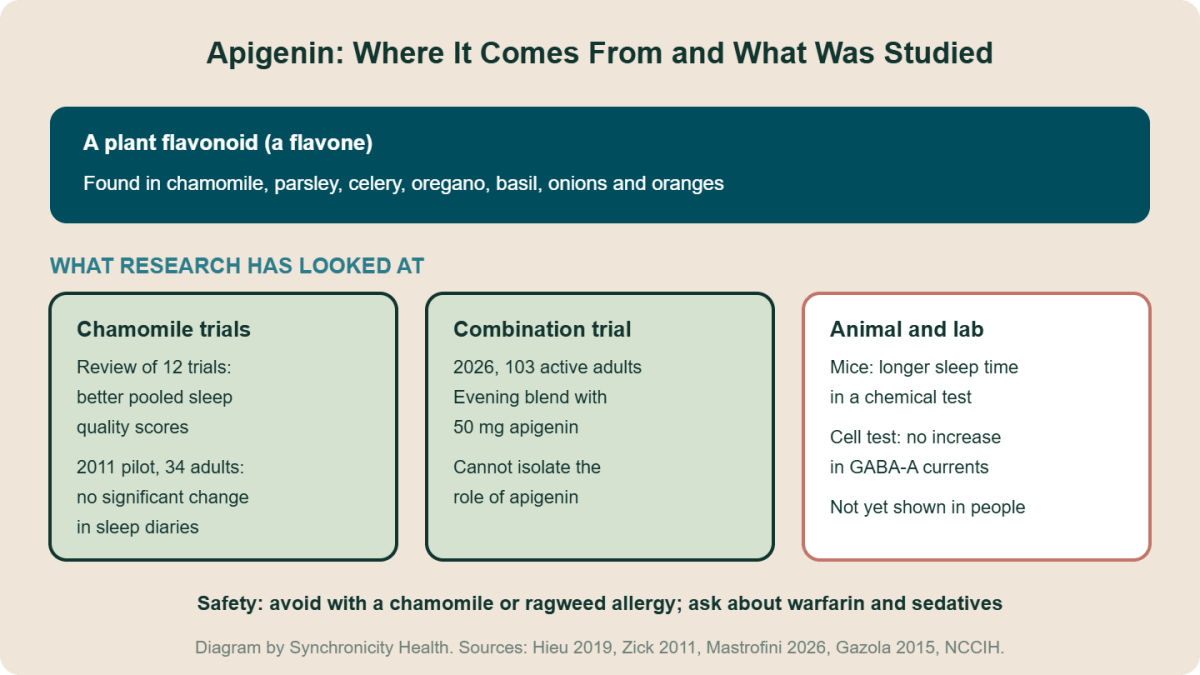
The main apigenin benefits researchers have studied relate to sleep and relaxation. In human trials of chamomile, one of apigenin's richest dietary sources, pooled sleep quality scores were better, and animal and lab studies have looked at how apigenin interacts with GABA, a chemical messenger that quiets nerve activity. Apigenin is a plant flavonoid found in chamomile, parsley, celery and several other herbs and vegetables. Below we describe what each study measured, plus amounts, timing, side effects and interactions.
Key Takeaways
- Apigenin is a flavone, a type of flavonoid, found in chamomile, parsley, celery, oregano, basil, onions and oranges.
- A 2019 review of 12 chamomile trials reported better pooled sleep quality scores; a small 2011 trial found no significant differences in sleep diary measures.
- Animal and lab studies have looked at how apigenin interacts with GABA receptors.
- A 2026 trial used 50 mg in an evening combination; our Melatonin-Free Sleep Powder has 50 mg per scoop.
- Chamomile can cause allergic reactions in people sensitive to ragweed and related plants, and interactions with warfarin have been reported.

Featured in this article
Melatonin-Free Sleep Powder50 mg of apigenin from chamomile flower in every scoop, alongside glycine, tart cherry, myo-inositol and magnesium, with no added melatonin.
Join the WaitlistComing soon. Third-party tested ingredients.
What Is Apigenin?
Apigenin belongs to the flavones, a subgroup of the flavonoids, the largest family of plant polyphenols. A 2026 review lists parsley, chamomile, oregano, basil, celery, onions and oranges as major dietary sources and calls chamomile tea one of the richest dietary sources (Kumar et al., 2026).
The same review notes that apigenin dissolves poorly in water, which reduces how much is absorbed by mouth, that the body processes it quickly, and that human studies on its absorption are still few (Kumar et al., 2026).
Apigenin Benefits: What Research Has Looked At
Most interest in apigenin benefits centers on sleep and relaxation. The research falls into a few areas:
- Sleep quality: a 2019 review of 12 trials of chamomile, one of apigenin's richest dietary sources, reported better pooled sleep quality scores (Hieu et al., 2019).
- Calming signals in the brain: animal and lab studies have looked at how apigenin interacts with GABA-A receptors, the targets of a chemical messenger that quiets nerve activity (Gazola et al., 2015).
- Cell health: a 2026 review describes lab and animal research on apigenin's antioxidant activity, including the Nrf2 pathway that cells use to switch on their own antioxidant enzymes, and on inflammation markers (Kumar et al., 2026).
The sections below give the details of each sleep study, including who took part, how much they took and what was measured.
Apigenin for Sleep: What Research Has Looked At
This research falls into three groups: human chamomile trials, a few human trials that include apigenin in a combination, and animal or lab studies of apigenin itself.
Chamomile trials in people
A 2019 systematic review and meta-analysis included 12 randomized or quasi-randomized chamomile trials. Pooled sleep quality scores were significantly better with chamomile. Only one included trial looked at people with insomnia, and it found no significant change in insomnia severity. For state anxiety, meaning how tense people felt in the moment, three trials showed no significant difference from control. Side effects reported were mild, and the authors called for larger trials (Hieu et al., 2019).
In that one insomnia trial, a 2011 randomized, double-blind pilot study, 34 adults aged 18 to 65 with chronic primary insomnia lasting at least six months took 270 mg of chamomile extract or a placebo twice a day for 28 days. Sleep diaries showed no significant differences between groups in total sleep time, time to fall asleep, night waking or sleep quality, and daytime functioning improved modestly but not significantly. Capsule analysis found 3.9 mg of apigenin per 90 mg, so each 270 mg dose carried roughly 12 mg. Side effects were mild and similar to placebo (Zick et al., 2011).
Apigenin in a combination formula
A 2026 double-blind, placebo-controlled trial in 103 healthy, active adults tested a morning product (ashwagandha and rhodiola) and an evening product containing magnesium L-threonate, 200 mg L-theanine and 50 mg apigenin, alone or together, for two weeks. Researchers tracked stress questionnaires, the Pittsburgh Sleep Quality Index and wearable sleep data. The clearer changes were in the morning-only group, and other effects were described as minimal (Mastrofini et al., 2026). Because apigenin was combined with other ingredients, the trial can't isolate its role.
Animal and lab studies on GABA receptors
GABA is a chemical messenger that quiets nerve activity, and researchers have asked whether apigenin interacts with its GABA-A receptors. In a 2015 study in mice, apigenin given by mouth lengthened sleep time in a chemically induced sleep test, and that effect was blocked by flumazenil, a benzodiazepine blocker, which pointed the authors toward the GABA system. But when the same team tested apigenin directly on GABA-A receptors expressed in frog egg cells, it did not increase GABA-driven currents (Gazola et al., 2015). A 2026 review also describes mild sedation and muscle relaxation in animals at high doses of 100 and 200 mg per kilogram of body weight, far above what a person would take in a supplement (Kumar et al., 2026).
| Study | Who or what was studied | What was measured | What was reported |
|---|---|---|---|
| Hieu et al., 2019 | 12 chamomile trials in people | Sleep quality, insomnia severity, state anxiety | Better pooled sleep quality scores; no significant change in the one insomnia trial or in state anxiety |
| Zick et al., 2011 | 34 adults, 270 mg chamomile extract (about 12 mg apigenin) twice daily, 28 days | Sleep diaries, daytime functioning | No significant differences in sleep diary measures |
| Mastrofini et al., 2026 | 103 adults; evening blend with 50 mg apigenin, 2 weeks | Stress, sleep questionnaires, wearable sleep data | Clearer changes in the morning-only group; other effects minimal |
| Gazola et al., 2015 | Mice and frog egg cells | Sleep time in a chemical test; GABA-A receptor currents | Longer sleep time in mice; no increase in receptor currents in the lab test |
If you would rather have it in a cup, our guide to chamomile tea benefits covers how to brew it, what the chamomile studies measured and who should check with a clinician first.
Apigenin Supplement Amounts
There's no established daily intake for apigenin, and products vary widely. Look for the apigenin amount in milligrams on the label, since chamomile extracts differ in how much they carry. The 2026 combination trial above used 50 mg, and our Melatonin-Free Sleep Powder contains 50 mg of apigenin from chamomile flower per scoop: 1 scoop in 8 oz of water, not more than 1 scoop a day. For amounts by goal and how much apigenin chamomile tea provides, see our guide to apigenin dosage.
When to Take Apigenin
Apigenin is usually taken in the evening as part of a wind-down routine. Our sleep powder's directions are 30 to 60 minutes before bed. Pair it with the basics: a consistent bedtime, a dim room and fewer late screens. Our guide on how to fall asleep fast covers those habits, and our hub on why quality rest matters explains why they count.
Side Effects and Interactions
The National Center for Complementary and Integrative Health (NCCIH) says chamomile is likely safe in food and tea amounts and that side effects are uncommon, but may include nausea, dizziness and allergic reactions, including severe reactions such as anaphylaxis (NCCIH, 2024).
- Allergy: People allergic to related plants such as ragweed, chrysanthemums, marigolds or daisies may be more likely to react to chamomile (NCCIH, 2024). A 2026 review also notes reactions in people sensitive to Asteraceae (daisy family) plants such as chamomile (Kumar et al., 2026).
- Warfarin and other medicines: NCCIH notes that chamomile has been reported to interact with warfarin, a blood thinner, and with some drugs processed by the liver, and that combining it with sedatives is a theoretical concern. It may also reduce the effect of birth control pills (NCCIH, 2024).
- Drowsiness: Our sleep powder may cause drowsiness; avoid it with alcohol.
- Very high doses: A 2026 review reports liver damage in animals at about 100 mg per kilogram of body weight, far above supplement amounts, and notes human data are sparse (Kumar et al., 2026).
- Pregnancy: NCCIH says little is known about chamomile during pregnancy or breastfeeding. Our powder is not for pregnant or nursing women or anyone under 18.
If you take any medication, especially blood thinners such as warfarin, sedatives or prescription sleep medicines, ask your healthcare provider before using apigenin or chamomile products.
Apigenin vs Melatonin vs Magnesium
These three are very different. Melatonin is a hormone your body makes to signal nighttime (see our melatonin ingredient page and melatonin guide). Magnesium is an essential mineral (see magnesium glycinate for sleep and magnesium glycerophosphate). Apigenin is a plant flavonoid. We compare all three side by side in apigenin vs magnesium vs melatonin. For apigenin with L-theanine, see apigenin and L-theanine.
Where Our Products Fit
Our Melatonin-Free Sleep Powder is coming soon (join the waitlist). Each 9.5 g scoop has 50 mg of apigenin from chamomile flower, 3,000 mg of glycine, 2,000 mg of tart cherry (Prunus cerasus) fruit powder, 500 mg of tart cherry fruit extract, 2,000 mg of myo-inositol and 200 mg of magnesium (48% DV) split between magnesium bisglycinate and magnesium glycerophosphate. It's an unsweetened tart cherry drink with no added sugar or sweeteners and no added melatonin, made to support restful sleep and help you wind down at night. It's $59 for 30 servings.
For the other ingredients, see glycine for sleep, tart cherry for sleep and sleep supplements without melatonin. You might also like our take on the sleepy girl mocktail.
For a different format, our Theanine Nasal Spray delivers 36 mg of L-theanine per serving (one spray in each nostril), absorbed through the lining of the nose.
Featured in this article
Melatonin-Free Sleep Powder50 mg of apigenin from chamomile flower in every scoop, alongside glycine, tart cherry, myo-inositol and magnesium, with no added melatonin.
Join the WaitlistComing soon. Third-party tested ingredients.
Frequently Asked Questions
Does apigenin help you sleep?
Human research has mostly tested chamomile rather than apigenin alone: better pooled sleep quality scores in a 2019 review, and no significant sleep diary differences in a 2011 trial. Studies of apigenin alone are mostly animal or lab work.
How much apigenin is in chamomile tea?
There isn't one fixed figure; it depends on the flowers, how much you use and how long you steep. A product that lists apigenin in milligrams is easier to track.
How much apigenin should I take?
There's no established daily intake. A 2026 trial used 50 mg in an evening combination, and our sleep powder has 50 mg per scoop. Follow your product's label.
Is apigenin safe to take every night?
NCCIH describes chamomile as likely safe in food and tea amounts, with uncommon side effects. Long-term studies of apigenin supplements in people are few, so follow the label and ask your healthcare provider if unsure.
Can I take apigenin with warfarin or other medications?
Ask your healthcare provider first. NCCIH notes reported interactions between chamomile and warfarin and some drugs processed by the liver.
Who should avoid apigenin?
Anyone allergic to chamomile, ragweed, chrysanthemums, marigolds or daisies. Our sleep powder is also not for pregnant or nursing women or anyone under 18.
Does your sleep powder contain melatonin?
It has no added melatonin, though tart cherries naturally contain trace melatonin. See our guide to foods with melatonin.
What are the benefits of apigenin?
Research on apigenin benefits has focused on sleep and relaxation. A 2019 review of 12 chamomile trials, chamomile being one of apigenin's richest sources, reported better pooled sleep quality scores, and animal and lab studies have looked at how apigenin interacts with GABA receptors. Lab and animal research has also looked at its antioxidant activity.
What foods are high in apigenin?
A 2026 review lists parsley, chamomile, oregano, basil, celery, onions and oranges as major dietary sources and calls chamomile tea one of the richest. Amounts in food and tea vary, so if you want a known amount, a supplement that lists apigenin in milligrams on the label is easier to track.
Is apigenin the same as chamomile?
No. Chamomile is a plant, and apigenin is one of the flavonoids it contains. Most human sleep studies connected to apigenin used chamomile extract or tea; for example, a 2011 trial used an extract with roughly 12 mg of apigenin in each 270 mg dose. A label that lists apigenin in milligrams tells you how much of the flavonoid itself you are getting.
When should I take apigenin, morning or night?
Apigenin is usually taken in the evening as part of a wind-down routine, and the 2026 combination trial included it in an evening product. Our Melatonin-Free Sleep Powder's directions are 30 to 60 minutes before bed. Pair it with a consistent bedtime, a dim room and fewer late screens.
Sources
- Hieu TH, Dibas M, Surya Dila KA, et al. Therapeutic efficacy and safety of chamomile for state anxiety, generalized anxiety disorder, insomnia, and sleep quality: a systematic review and meta-analysis of randomized trials and quasi-randomized trials. Phytotherapy Research. 2019;33(6):1604-1615. PMID 31006899
- Zick SM, Wright BD, Sen A, Arnedt JT. Preliminary examination of the efficacy and safety of a standardized chamomile extract for chronic primary insomnia: a randomized placebo-controlled pilot study. BMC Complementary and Alternative Medicine. 2011;11:78. PMID 21939549
- Mastrofini GF, et al. Modulating stress and sleep through a multi-compound dietary supplement: a randomized, double-blind, placebo-controlled trial. Journal of the International Society of Sports Nutrition. 2026. PMID 42829807
- Gazola AC, Costa GM, Castellanos L, et al. Involvement of GABAergic pathway in the sedative activity of apigenin, the main flavonoid from Passiflora quadrangularis pericarp. Revista Brasileira de Farmacognosia. 2015;25:158-163. doi:10.1016/j.bjp.2015.03.009
- Kumar A, Singh H, Verma R, et al. Pharmacological potential of apigenin: a dietary flavonoid with emerging synergistic interactions in therapeutics. Exploration of Foods and Foodomics. 2026;4:1010174. doi:10.37349/eff.2026.1010174
- National Center for Complementary and Integrative Health. Chamomile. Last updated November 2024. nccih.nih.gov/health/chamomile
Our products are not intended to diagnose, treat, cure or prevent any disease. This article is for education only and is not medical advice.

Leave a comment
All comments are moderated before being published.
This site is protected by hCaptcha and the hCaptcha Privacy Policy and Terms of Service apply.