
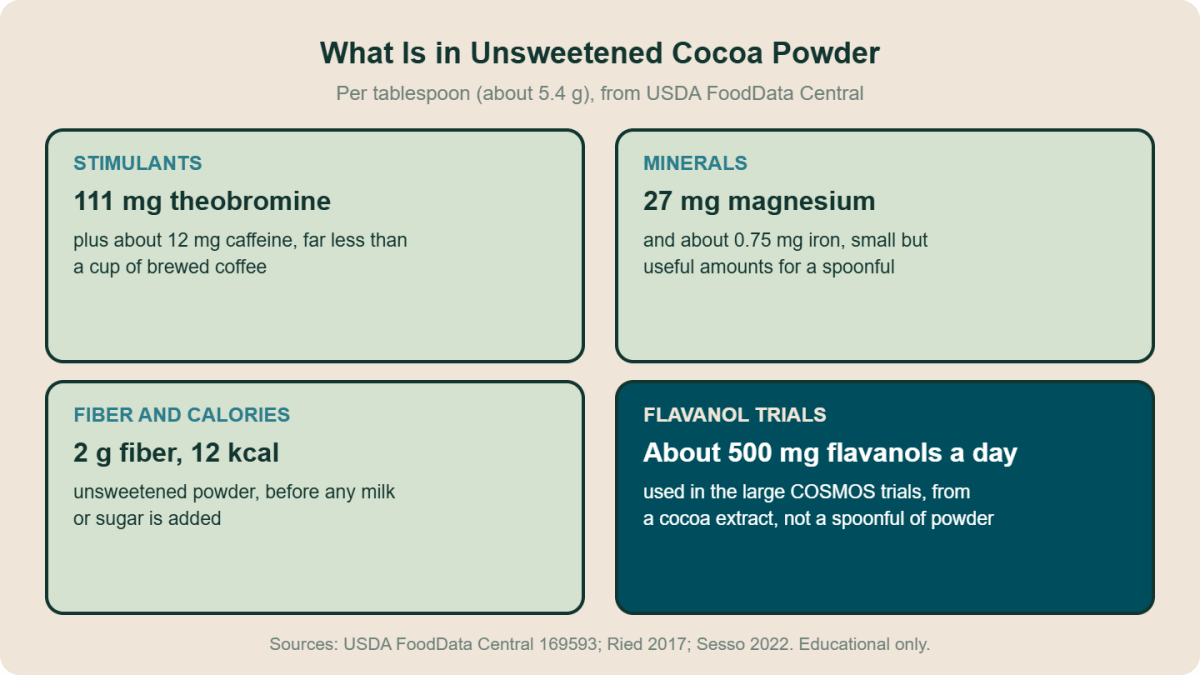
Cacao's main benefits come from its flavanols, its gentle stimulant theobromine and minerals such as magnesium and iron. One tablespoon of unsweetened cocoa powder holds about 111 mg of theobromine, 27 mg of magnesium and 2 g of fiber, with only about 12 mg of caffeine (USDA FoodData Central). In trials, flavanol-rich cocoa products produced a small drop in blood pressure in mostly healthy adults (Ried et al., 2017). This guide covers what is in cacao, what the human studies measured, how much to have and how to pick a cleaner product.
It is educational, not medical advice.
Key Takeaways
- Theobromine, not much caffeine: a tablespoon of unsweetened cocoa powder has about 111 mg of theobromine and 12 mg of caffeine (USDA FoodData Central).
- Minerals and fiber: the same spoonful gives about 27 mg of magnesium, 0.75 mg of iron and 2 g of fiber for about 12 calories (USDA FoodData Central).
- Blood pressure: across 35 trials, flavanol-rich cocoa lowered blood pressure by about 2 mmHg on average in the short term (Ried et al., 2017).
- Memory: in a 3 year trial, 500 mg of cocoa flavanols a day did not improve memory overall, but did in people whose diets were lower in quality and in flavanols (Brickman et al., 2023).
- Check for metals: in tests of 72 US cocoa and dark chocolate products, 43% were above a strict California limit for lead and 35% for cadmium per serving (Hands et al., 2024).

Featured in this article
Mushroom CacaoA mushroom hot chocolate made with cocoa and cacao, with 500 mg each of lion's mane and cordyceps per serving and 0g sugar.
Shop Mushroom CacaoThird-party tested ingredients. 15 calories per serving.

What Is in Cacao?
Cacao and cocoa come from the same bean. Cacao usually means less processed products such as raw cacao powder and nibs, while cocoa usually means roasted powder; our guide to cacao vs cocoa explains the difference. USDA data for unsweetened cocoa powder gives a good picture of what a spoonful holds (USDA FoodData Central).
| Nutrient | Per 100 g | Per tablespoon (about 5.4 g) |
|---|---|---|
| Theobromine | 2,060 mg | About 111 mg |
| Caffeine | 230 mg | About 12 mg |
| Magnesium | 499 mg | About 27 mg |
| Iron | 13.9 mg | About 0.75 mg |
| Fiber | 37 g | About 2 g |
| Calories | 228 kcal | About 12 kcal |
The per tablespoon figures are calculated from the USDA values per 100 g (USDA FoodData Central). Sweetened drinking chocolate and milk chocolate hold far less cacao per serving and much more sugar.
Theobromine is the main reason cacao gives a gentle, steady lift; our guide to theobromine benefits covers what studies show.
Cacao Benefits: What Human Studies Measured
Blood pressure and blood vessels
A Cochrane review pooled 35 trials of chocolate or cocoa products, providing 30 to 1,218 mg of flavanols a day for 2 to 18 weeks. Flavanol-rich products lowered systolic and diastolic blood pressure by about 1.8 mmHg each compared with control products, a small short-term effect in mainly healthy adults. Cocoa products were generally well tolerated (Ried et al., 2017).
The largest long-term trial, COSMOS, gave 21,442 older adults a cocoa extract with 500 mg of flavanols a day or a placebo for a median of 3.6 years. The extract did not significantly change the trial's main heart outcome, while some secondary results pointed in a favorable direction (Sesso et al., 2022). These trials used a concentrated extract, which is different from a spoonful of powder; our guide to cocoa extract benefits covers the extract.
Memory and the aging brain
In 3,562 older adults in a related trial, 500 mg of cocoa flavanols a day did not improve memory in the whole group after a year. Memory did improve in the people whose usual diets were lower in quality or lower in flavanols (Brickman et al., 2023). In that trial, the benefit showed up mainly in people whose diets were low in flavanols to begin with.
Gentle energy from theobromine
Theobromine is the main stimulant in cacao, with only a small amount of caffeine alongside it (USDA FoodData Central). Our guide to theobromine vs caffeine compares how they feel and how long they last.
How Much Cacao Should You Have a Day?
There is no official daily amount for cacao. A practical range is 1 to 2 tablespoons of unsweetened powder or a small handful of nibs a day, which keeps caffeine low while adding fiber and minerals. Keep in mind that the trial amount of 500 mg of flavanols came from a standardized extract (Sesso et al., 2022), and flavanol content varies widely between powders.
Heavy Metals in Cacao: What to Know
Cacao can carry lead and cadmium. In tests of 72 US cocoa and dark chocolate products bought between 2014 and 2022, 43% exceeded California's strict Prop 65 limit for lead and 35% for cadmium per serving, while 97% were below FDA lead reference levels. Median levels were below the strict limits, and products labeled organic were more likely to have higher levels (Hands et al., 2024). The authors suggested that a single serving a day is unlikely to pose a meaningful risk for most people, but several servings plus other sources could add up.
- Look for third-party testing for heavy metals; see what third-party tested means.
- Stick to a serving or two a day rather than several.
- Take extra care in pregnancy and for children, and ask your provider.
Side Effects and Who Should Be Careful
Most people tolerate cacao well; in the Cochrane trials, stomach upset and nausea were reported by about 1% of people taking cocoa (Ried et al., 2017). Because cacao contains theobromine and some caffeine, people sensitive to stimulants may prefer it earlier in the day. Our guide on how long caffeine lasts helps with timing.
Easy Ways to Use Cacao
- Hot cacao: stir powder into warm milk or water, unsweetened or lightly sweetened.
- Breakfast: add powder or nibs to oatmeal, yogurt or a smoothie.
- Coffee swap: a cacao drink is a lower-caffeine morning option; see coffee alternatives.
For a warm cacao drink with lion’s mane and cordyceps, see our guide to mushroom hot chocolate.
Where Our Products Fit
Mushroom Cacao is a mushroom hot chocolate made with cocoa, cacao and a high polyphenol, high theobromine cocoa extract, with 500 mg each of lion's mane and cordyceps 8:1 fruiting body extracts per serving, 15 calories and 0g sugar. Stir one rounded teaspoon into 6 to 8 oz of hot water or warm milk, ideally in the morning or early afternoon. For a broader daily routine, the Energy Stack combines NAD+ Nasal Spray, Forage and Methyl B-12 Nasal Spray. Learn more on our theobromine ingredient page and the Non-Stimulant Energy and Focus hub.

Featured in this article
Energy StackNAD+ Nasal Spray, Forage and Methyl B-12 Nasal Spray together in one daily energy routine.
Shop Energy StackThird-party tested ingredients.
Frequently Asked Questions
What does cacao do for your body?
It provides theobromine, a little caffeine, magnesium, iron, fiber and flavanols (USDA FoodData Central). Flavanol-rich cocoa produced a small short-term drop in blood pressure in trials (Ried et al., 2017).
Is cacao healthier than cocoa?
They come from the same bean; processing is the main difference. See cacao vs cocoa.
How much cacao should I have a day?
There is no official amount. One to two tablespoons of unsweetened powder a day keeps caffeine low, about 12 mg per tablespoon (USDA FoodData Central).
Does cacao have caffeine?
Yes, a small amount: about 12 mg per tablespoon of unsweetened powder, alongside about 111 mg of theobromine (USDA FoodData Central).
Is cacao good for the brain?
In a 3 year trial, cocoa flavanols improved memory only in older adults whose diets were lower in quality or flavanols (Brickman et al., 2023).
Is it safe to eat cacao every day?
For most adults, a serving a day is reasonable. Choose products tested for heavy metals, since many cocoa products carry lead and cadmium (Hands et al., 2024).
Can cacao help you sleep?
Cacao contains stimulants, so it is better earlier in the day for people who are sensitive.
Sources
- U.S. Department of Agriculture, FoodData Central. Cocoa, dry powder, unsweetened (FDC 169593). USDA FoodData Central
- Ried K, Fakler P, Stocks NP. Effect of cocoa on blood pressure. Cochrane Database Syst Rev. 2017. PubMed 28439881
- Sesso HD, Manson JE, Aragaki AK, et al. Effect of cocoa flavanol supplementation for the prevention of cardiovascular disease events: the COSMOS randomized clinical trial. Am J Clin Nutr. 2022. PubMed 35294962
- Brickman AM, Yeung LK, Alschuler DM, et al. Dietary flavanols restore hippocampal-dependent memory in older adults with lower diet quality and lower habitual flavanol consumption. Proc Natl Acad Sci U S A. 2023. PubMed 37252983
- Hands JM, Anderson ML, Cooperman T, Balsky JE, Frame LA. A multi-year heavy metal analysis of 72 dark chocolate and cocoa products in the USA. Front Nutr. 2024. PubMed 39144282
Our products are not intended to diagnose, treat, cure or prevent any disease. This article is for education only and is not medical advice.


Leave a comment
All comments are moderated before being published.
This site is protected by hCaptcha and the hCaptcha Privacy Policy and Terms of Service apply.