
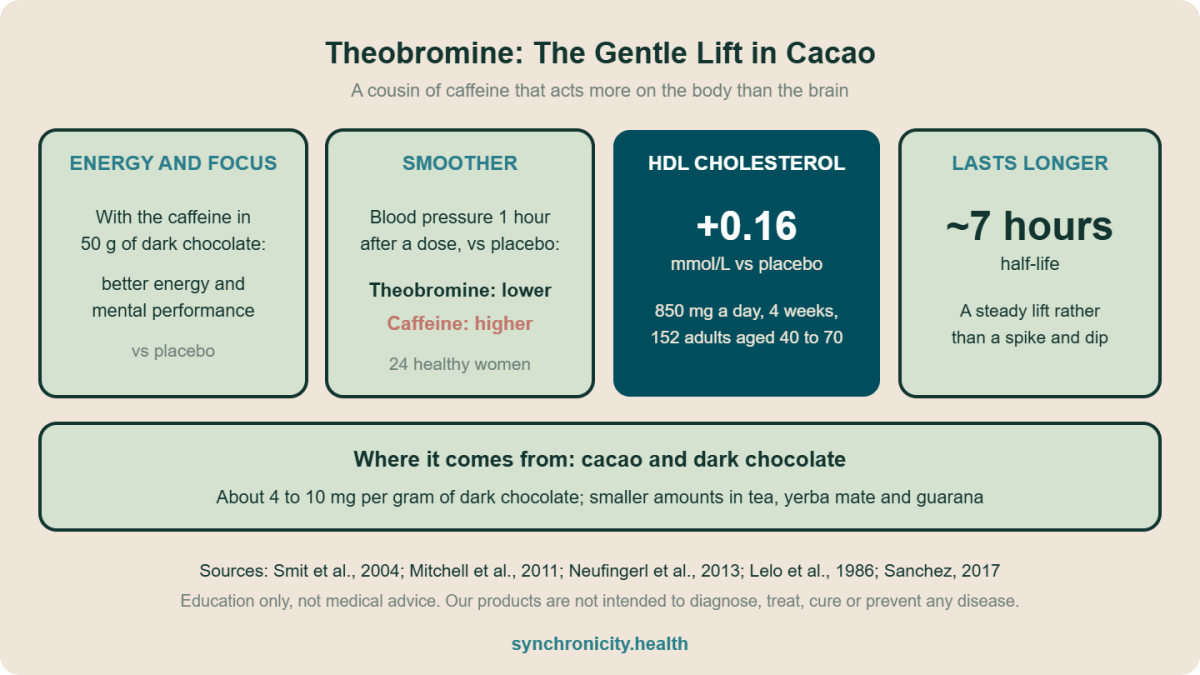
Theobromine is the gentle, long-lasting compound in cacao that gives chocolate its mild lift. Alongside a little caffeine, the amounts in a serving of dark chocolate improved energy and mental performance in placebo-controlled studies, and theobromine on its own works more on the body than the brain, so it feels smoother than coffee. It also stays in the body longer, with a half-life of about 7 hours.
Key Takeaways
- Theobromine is a natural methylxanthine, a cousin of caffeine, found mainly in cacao. Dark chocolate holds about 4 to 10 mg per gram (Sanchez, 2017).
- The caffeine and theobromine in a 50 g bar of dark chocolate improved energetic arousal and cognitive function compared with placebo, just as cocoa powder did (Smit et al., 2004).
- Unlike caffeine, theobromine on its own did not raise blood pressure; it lowered it compared with placebo an hour after a dose (Mitchell et al., 2011).
- In 152 adults aged 40 to 70, 850 mg of theobromine a day for 4 weeks raised HDL cholesterol, the "good" kind, compared with placebo (Neufingerl et al., 2013).
- Theobromine lasts longer than caffeine, with a half-life of about 7 hours, which is why cacao feels gentle but steady (Lelo et al., 1986).

Featured in this article
Mushroom CacaoA mushroom hot chocolate with 500 mg each of lion's mane and cordyceps 8:1 fruiting body extracts in every serving.
Shop Mushroom CacaoThird-party tested ingredients. 15 calories per serving.
What Is Theobromine?
Theobromine is a bitter natural compound found mainly in the cacao bean, with smaller amounts in tea, yerba mate and guarana. Its name comes from Theobroma cacao, the cacao tree, and it has nothing to do with the element bromine. Chemically, it belongs to the same family as caffeine, the methylxanthines, and differs by just one small group of atoms. That small difference changes a lot: theobromine acts on the same receptors as caffeine but far more weakly, so most of its effect is on the heart and blood vessels rather than the brain (Martinez-Pinilla et al., 2015).
Cacao is by far the richest food source. Dark chocolate holds about 4 to 10 mg per gram, so a 50 g serving supplies roughly 200 to 500 mg (Sanchez, 2017). For more on the ingredient itself, see our theobromine ingredient guide.
Theobromine Benefits: What Studies Show
A Gentle Lift for Energy and Focus
In two double-blind, placebo-controlled studies, researchers gave people either cocoa powder or the amounts of caffeine and theobromine found in a 50 g bar of dark chocolate. Both produced the same improvements in energetic arousal, a measure of feeling energized, and in cognitive function compared with placebo. The researchers concluded that a normal portion of chocolate has real effects, and that they come from the caffeine and theobromine working together (Smit et al., 2004).
Smoother Than Coffee
Theobromine and caffeine feel different because they act in different places. In a study of 24 healthy women, caffeine raised alertness and blood pressure, while theobromine on its own lowered blood pressure compared with placebo an hour after the dose. Taken together, the pair had caffeine's effects on mood without the rise in blood pressure. The researchers concluded that caffeine acts more on the brain, while theobromine acts mainly on the body (Mitchell et al., 2011). That is a big part of why a cacao drink feels calmer than a cup of coffee. Our guide to theobromine vs caffeine compares the two side by side.
Healthy Cholesterol Levels
In a 4-week randomized trial, 152 healthy men and women aged 40 to 70 drank a daily drink with cocoa, pure theobromine (850 mg), both, or neither. Theobromine raised HDL cholesterol, the "good" kind, by 0.16 mmol/L compared with placebo (Neufingerl et al., 2013). Reviews suggest theobromine may be one of the reasons cocoa is linked with heart health, alongside its flavanols (Martinez-Pinilla et al., 2015). For the flavanol side of the story, see our guide to cocoa extract benefits.
Steady, Long-Lasting Effects
Theobromine stays in the body longer than caffeine, with a half-life of about 7 hours (Lelo et al., 1986). Combined with its gentler action, that gives cacao drinks their steady, unhurried feel rather than a quick spike and dip.
| Theobromine | Caffeine | |
|---|---|---|
| Main source | Cacao and dark chocolate | Coffee, tea, energy drinks |
| Where it acts most | Heart and blood vessels | Brain |
| Blood pressure in the 2011 study | Lower than placebo at 1 hour | Higher than placebo at 1 hour |
| Feel | Gentle and steady | Quick and sharp |
How Much Theobromine Is in Cacao, and How Much to Have
There is no official daily amount. The research above used amounts you could get from food or a cacao drink: the methylxanthines in a 50 g bar of dark chocolate (Smit et al., 2004), up to 850 mg of pure theobromine a day for 4 weeks (Neufingerl et al., 2013). In the widest dose study, 250 mg had a mild effect people barely noticed, while 500 to 1,000 mg in one go produced less pleasant mood effects and a higher heart rate (Baggott et al., 2013). Food-sized servings are the comfortable range.
- Enjoy it earlier in the day. Because theobromine lasts about 7 hours, a cacao drink in the morning or afternoon is a good fit.
- Count your coffee too. Cacao also contains a little caffeine, so add it to your daily total. Our guide to does chocolate have caffeine? has the numbers.
- Choose cacao over sugary chocolate. A cacao drink gives you the theobromine without the sugar of a candy bar; see cacao benefits and cacao vs cocoa.
Is Theobromine Safe?
At food amounts, theobromine is a mild compound. Reviews describe its effects as considerably weaker than caffeine's (Stavric, 1988) and its unwanted effects as fewer (Martinez-Pinilla et al., 2015). Very large single amounts, 500 mg and above, raised heart rate and made some people feel less pleasant in a lab study (Baggott et al., 2013), which is why everyday cacao servings are the sweet spot. If you are pregnant, have a heart condition or take prescription medication, check with your clinician first.
Where Our Mushroom Cacao Fits
Our Mushroom Cacao is a mushroom hot chocolate made with cocoa, cacao and a high-polyphenol, high-theobromine cocoa extract, plus 500 mg each of our 8:1 fruiting body extracts of lion's mane and cordyceps in every serving. Stir one rounded teaspoon into hot water or milk for a creamy cup with 15 calories and 0 g sugar, sweetened with stevia. Many people drink it as a coffee alternative: cocoa's theobromine brings a gentler lift than a cup of coffee, while lion's mane supports focus and cordyceps supports energy and endurance. Every ingredient is third-party tested.
Read more in our guides to mushroom hot chocolate and cacao vs coffee, our lion's mane ingredient guide, and our non-stimulant energy and focus guide. If you pair coffee with L-theanine for calm focus, our Theanine Nasal Spray delivers L-theanine through the nose; see L-theanine and caffeine.
Featured in this article
Mushroom CacaoA mushroom hot chocolate with 500 mg each of lion's mane and cordyceps 8:1 fruiting body extracts in every serving.
Shop Mushroom CacaoThird-party tested ingredients. 15 calories per serving.
Frequently Asked Questions
What does theobromine do in the body?
It gently widens blood vessels and acts mostly on the heart and blood vessels rather than the brain. Together with the small amount of caffeine in cacao, it gives chocolate its mild lift.
Is theobromine a stimulant?
Only mildly. It acts on the same receptors as caffeine but far more weakly, so it has little stimulant effect on the brain.
Is theobromine better than caffeine?
They do different jobs. Caffeine is quicker and sharper; theobromine is gentler and lasts longer. In one study, theobromine lowered blood pressure while caffeine raised it.
How long does theobromine last?
Its half-life is about 7 hours, longer than caffeine's, which is why a cacao drink feels steady rather than spiky.
Which foods are highest in theobromine?
Cacao and dark chocolate, at about 4 to 10 mg per gram of dark chocolate. Tea, yerba mate and guarana contain smaller amounts.
Does theobromine help with focus?
The caffeine and theobromine in a 50 g bar of dark chocolate improved cognitive function and energetic arousal compared with placebo.
Is theobromine good for your heart?
In a 4-week trial, 850 mg a day raised HDL, the "good" cholesterol, and in another study theobromine lowered blood pressure an hour after a dose compared with placebo.
How much theobromine is too much?
Food-sized servings are comfortable. Single amounts of 500 mg or more raised heart rate in a lab study, so enjoy cacao in everyday portions.
Sources
- Smit HJ, Gaffan EA, Rogers PJ. Methylxanthines are the psycho-pharmacologically active constituents of chocolate. Psychopharmacology, 2004. https://pubmed.ncbi.nlm.nih.gov/15549276/
- Mitchell ES, Slettenaar M, et al. Differential contributions of theobromine and caffeine on mood, psychomotor performance and blood pressure. Physiology and Behavior, 2011. https://pubmed.ncbi.nlm.nih.gov/21839757/
- Neufingerl N, Zebregs YE, Schuring EA, et al. Effect of cocoa and theobromine consumption on serum HDL-cholesterol concentrations: a randomized controlled trial. American Journal of Clinical Nutrition, 2013. https://pubmed.ncbi.nlm.nih.gov/23595874/
- Baggott MJ, et al. Psychopharmacology of theobromine in healthy volunteers. Psychopharmacology, 2013. https://pubmed.ncbi.nlm.nih.gov/23420115/
- Martinez-Pinilla E, Onatibia-Astibia A, Franco R. The relevance of theobromine for the beneficial effects of cocoa consumption. Frontiers in Pharmacology, 2015. https://pubmed.ncbi.nlm.nih.gov/25750625/
- Lelo A, et al. Comparative pharmacokinetics of caffeine and its primary demethylated metabolites paraxanthine, theobromine and theophylline in man. British Journal of Clinical Pharmacology, 1986. https://pubmed.ncbi.nlm.nih.gov/3756065/
- Sanchez JM. Methylxanthine content in commonly consumed foods in Spain and determination of its intake during consumption. Foods, 2017. https://pubmed.ncbi.nlm.nih.gov/29207513/
- Stavric B. Methylxanthines: toxicity to humans. 3. Theobromine, paraxanthine and the combined effects of methylxanthines. Food and Chemical Toxicology, 1988. https://pubmed.ncbi.nlm.nih.gov/3058562/
These statements have not been evaluated by the Food and Drug Administration. This content is for education and is not medical advice. Our products are not intended to diagnose, treat, cure or prevent any disease. Talk with a healthcare provider before starting a new supplement if you are pregnant, breastfeeding or taking medication.

Leave a comment
All comments are moderated before being published.
This site is protected by hCaptcha and the hCaptcha Privacy Policy and Terms of Service apply.