
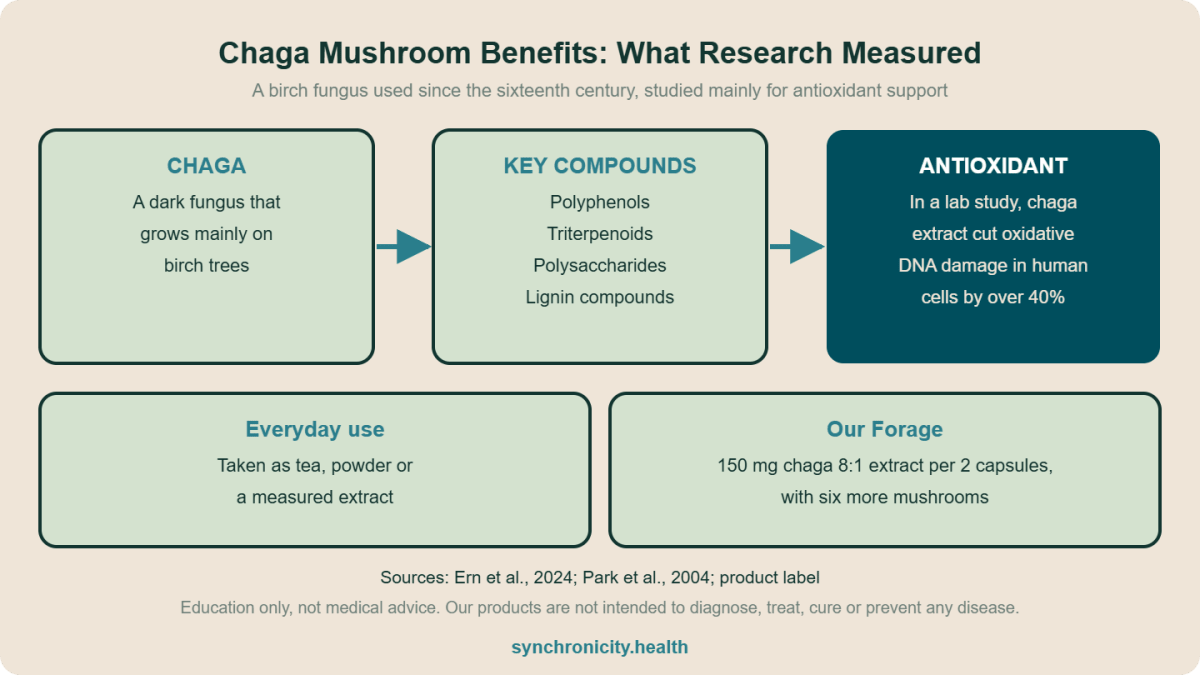
Chaga mushroom benefits center on antioxidant support. Chaga is a dark fungus that grows on birch trees, rich in polyphenols, triterpenoids and polysaccharides, and it has been used in traditional practice since the sixteenth century. In lab studies, chaga extract protected human cells from oxidative DNA damage, and in mice its polysaccharides lengthened swimming time before exhaustion. Most people use it in small daily amounts, as a tea or an extract in a mushroom blend.
Key Takeaways
- Chaga (Inonotus obliquus) contains polysaccharides, triterpenoids, polyphenols and lignin compounds, and has a long history of traditional use (Ern et al., 2024).
- In a lab study, human white blood cells pretreated with chaga extract showed more than 40% less DNA damage from an oxidant (Park et al., 2004).
- Most chaga research so far has been in the lab, where its compounds showed antioxidant activity; it fits best as steady daily antioxidant support.
- Most people tolerate chaga well in measured amounts, like the 150 mg of chaga extract in each serving of our Forage.
- Talk with your clinician first if you have kidney concerns, take prescription medicine, or are pregnant or breastfeeding.

Featured in this article
ForageSeven functional mushroom fruiting body extracts, including lion's mane, plus Himalayan shilajit and ashwagandha root extract for everyday energy and resilience.
Shop ForageThird-party tested ingredients. Vegan capsules.
What Is Chaga Mushroom?
Chaga is a fungus that grows mainly on birch trees in cold northern forests. It looks like a lump of burnt charcoal on the outside. People have used it since the sixteenth century, and a 2024 review lists its main compounds as polysaccharides, triterpenoids, polyphenols and lignin metabolites (Ern et al., 2024).
Those compounds are why chaga gets attention. Polyphenols are the same family of plant compounds found in tea, berries and cocoa. Polysaccharides are the long sugar chains that functional mushrooms are known for, and triterpenoids are a large family of plant and fungal compounds. For how chaga sits next to another well known mushroom, see chaga vs reishi. To compare it with the energy and exercise mushroom, read our guide to cordyceps vs chaga.
Chaga Mushroom Benefits: What Research Has Measured
Chaga research is younger than research on lion's mane or reishi. A 2024 review describes studies of chaga's antioxidant, liver, kidney, anti-fatigue and metabolic activity (Ern et al., 2024). Most of this work has been done in cells and in animals. Here is what the key studies looked at.
Antioxidant support
This is chaga's best known benefit. In a lab study, researchers soaked human white blood cells (lymphocytes) in a water extract of chaga at 10 to 500 micrograms per milliliter for an hour, then exposed them to hydrogen peroxide, an oxidant. Cells pretreated with chaga showed more than 40% less DNA damage than cells exposed to hydrogen peroxide alone (Park et al., 2004). It was a cell study, so it shows how chaga's compounds behave rather than what a daily dose does in your body, and it is the reason chaga is known as an antioxidant mushroom.
Energy and endurance
In a study in mice, animals given chaga polysaccharides at 100, 200 or 300 mg per kg of body weight for 14 days swam longer before exhaustion than control mice. They also stored more glycogen, the body's stored carbohydrate fuel, in the liver and muscles, and had lower blood lactate after exercise. The researchers saw no signs of harm to the liver or other major organs (Yue et al., 2015). Results in mice do not translate directly to people, but they point to why chaga is often paired with energy mushrooms such as cordyceps.
Immune support
Like other functional mushrooms, chaga contains polysaccharides, and its effects on the immune system are among the activities reviewers list from lab research (Camilleri et al., 2024). For a mushroom with human research on immune support, see our guide to turkey tail mushroom benefits, and for the bigger picture, our immune system guide. To see how the two mushrooms differ, our guide to chaga vs turkey tail compares them side by side.
Chaga Tea, Powder and Extract
| Form | What to know |
|---|---|
| Tea from chunks | The traditional way; a mild, earthy drink. Our chaga tea guide covers brewing and oxalates |
| Raw ground powder | Easy to take in large amounts; the reported kidney problem involved grams of raw powder daily |
| Concentrated extract | Extraction concentrates the compounds, so a small amount goes further |
| In a mushroom blend | A modest daily amount alongside other mushrooms, as in our Forage |
Our guide to mushroom extracts vs powders explains why extraction matters for mushrooms in general.
How Much Chaga per Day?
There is no official daily amount for chaga, and human research has not yet settled on one. Supplements list chaga extract in milligrams, often within a mushroom blend. Our Forage gives 150 mg of chaga 8:1 extract in a 2-capsule serving.
How much is too much? The clearest warning comes from a case report: a 69-year-old man who took 10 to 15 g of chaga powder a day, along with 500 mg of vitamin C, for 3 months developed a kidney problem caused by oxalate crystals. His kidney function recovered after hospital care (Kwon et al., 2022). That is far more than the chaga in a mushroom blend. The practical rule: keep chaga modest and steady, and do not take spoonfuls of raw powder every day.
Can You Take Chaga Every Day, and at Night?
Daily use in modest amounts is the usual way to take chaga, often as part of a morning routine. It is a daily antioxidant habit rather than something you feel from a single dose. Benefits build with consistent daily use: months 1 to 2 can bring early changes, and 3 months and beyond is where the full benefit builds.
Can you take chaga at night, and does chaga make you sleepy? Sleep has not been a focus of chaga research, and chaga is not known as a sedating mushroom, so timing comes down to your routine. Many people take it in the morning with other mushrooms. If an evening wind-down is your goal, reishi is the mushroom studied for that; see reishi mushroom benefits.
Chaga Side Effects and Who Should Check First
Chaga has a long history as a tea, and published reports of problems are few. The ones on record involved large amounts of raw chaga powder taken daily for months, like the case above. That case was caused by oxalate, a natural compound in chaga, which is why the amount matters (Kwon et al., 2022).
Talk with your clinician before taking chaga if you have a history of kidney stones or kidney concerns, take prescription medicine, or are pregnant or breastfeeding. Skip it if you are allergic to mushrooms. Otherwise, a small daily amount in a blend is a simple way to include it.
Where Our Forage Fits
Our Forage includes 150 mg of chaga 8:1 extract in every 2-capsule serving, alongside lion's mane 200 mg, cordyceps 200 mg, reishi 200 mg, maitake 150 mg, turkey tail 150 mg and shiitake 150 mg (8:1 fruiting body extracts), plus Himalayan shilajit extract 100 mg and ashwagandha root extract 100 mg, with ginger extract in vegan capsules. Take 2 capsules daily in the morning, with or without food. It is made with third-party tested ingredients. Learn more on our chaga ingredient page and in our guide to adaptogenic mushrooms.
If you like a warm mushroom drink but want a change from chaga tea, our Mushroom Cacao is a mushroom hot chocolate with 500 mg each of lion's mane and cordyceps 8:1 fruiting body extracts per serving, 15 calories and 0 g sugar. Cocoa and cacao naturally contain a small amount of caffeine, so it is not caffeine free; its lift comes mainly from theobromine.

Featured in this article
Mushroom CacaoA mushroom hot chocolate made with cocoa and cacao, with 500 mg each of lion's mane and cordyceps per serving and 0g sugar.
Shop Mushroom CacaoThird-party tested ingredients. 15 calories per serving.
Frequently Asked Questions
What are the benefits of chaga mushroom?
Chaga is best known for antioxidant support from its polyphenols, along with polysaccharides and triterpenoids. Lab and animal studies have looked at its antioxidant, immune and energy effects.
Can I take chaga every day?
Yes, in modest amounts, which is how most people use it. Keep to small daily servings rather than large amounts of raw powder.
How much chaga per day?
There is no official amount. Supplements list chaga extract in milligrams; our Forage gives 150 mg of chaga extract per 2-capsule serving.
How much chaga is too much?
The reported kidney problem involved 10 to 15 g of raw chaga powder a day for 3 months. Stay well below that and talk with your clinician if you have kidney concerns.
Can you take chaga at night?
You can. Chaga is not known as a sedating or stimulating mushroom, so take it whenever fits your routine; many people take it in the morning.
Does chaga make you sleepy?
Chaga is not known for causing drowsiness. If you want a mushroom for the evening, reishi is the one studied for winding down.
What are the side effects of chaga?
Reported problems are few and involved large amounts of raw powder taken for months. Because chaga contains oxalate, people with kidney concerns should check with a clinician first.
Is chaga tea or chaga extract better?
Both work as a daily habit. Tea is the traditional way to enjoy chaga, while an extract in capsules gives a measured amount every day.
Sources
- Ern PTY, Quan TY, Yee FS, Yin ACY. Therapeutic properties of Inonotus obliquus (Chaga mushroom): a review. Mycology, 2024. https://pubmed.ncbi.nlm.nih.gov/38813471/
- Park YK, Lee HB, Jeon EJ, Jung HS, Kang MH. Chaga mushroom extract inhibits oxidative DNA damage in human lymphocytes as assessed by comet assay. BioFactors, 2004. https://pubmed.ncbi.nlm.nih.gov/15630179/
- Yue Z, Xiuhong Z, Shuyan Y, Zhonghua Z. Effect of Inonotus obliquus polysaccharides on physical fatigue in mice. Journal of Traditional Chinese Medicine, 2015. https://pubmed.ncbi.nlm.nih.gov/26427119/
- Camilleri E, Blundell R, Baral B, et al. A brief overview of the medicinal and nutraceutical importance of Inonotus obliquus (chaga) mushrooms. Heliyon, 2024. https://pubmed.ncbi.nlm.nih.gov/39170453/
- Kwon O, Kim Y, Paek JH, et al. Chaga mushroom-induced oxalate nephropathy that clinically manifested as nephrotic syndrome: a case report. Medicine (Baltimore), 2022. https://pubmed.ncbi.nlm.nih.gov/35451393/
These statements have not been evaluated by the Food and Drug Administration. This content is for education and is not medical advice. Our products are not intended to diagnose, treat, cure or prevent any disease. Talk with a healthcare provider before starting a new supplement if you are pregnant, breastfeeding or taking medication.


Leave a comment
All comments are moderated before being published.
This site is protected by hCaptcha and the hCaptcha Privacy Policy and Terms of Service apply.