
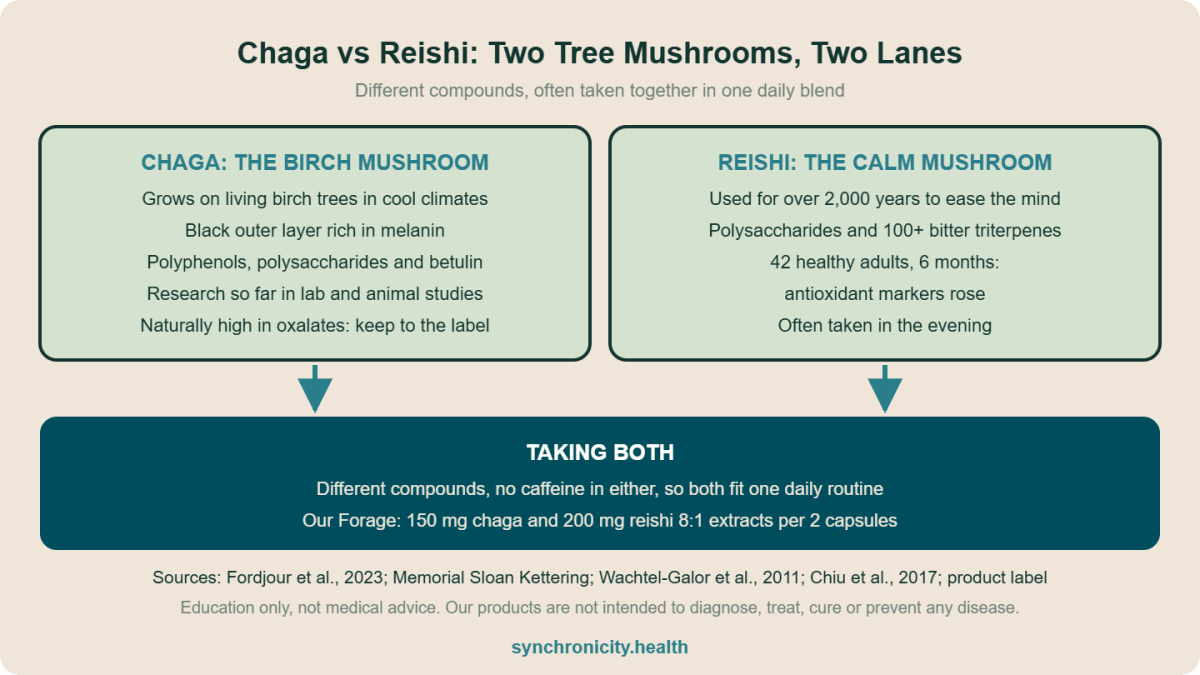
Chaga and reishi are both functional mushrooms that grow on trees, but they are valued for different things. Chaga is a dark, woody growth on birch trees, rich in melanin and other compounds studied for antioxidant activity, and traditionally brewed as a tea. Reishi is a glossy, bitter mushroom with more than 2,000 years of use to ease the mind, and it has been studied for antioxidant status in healthy adults. You can take chaga and reishi together, and many daily blends, including our Forage, contain both.
Key Takeaways
- Chaga (Inonotus obliquus) grows on living birch trees in cool climates; its black outer layer comes from melanin, and it also carries polyphenols, polysaccharides and betulin (Fordjour et al., 2023).
- Reishi (Ganoderma lucidum) has been valued for over 2,000 years, and China's official pharmacopoeia describes it as able to "ease the mind" (Wachtel-Galor et al., 2011).
- In 42 healthy adults, 6 months of a reishi extract raised total antioxidant capacity and antioxidant enzyme activity (Chiu et al., 2017).
- Most people tolerate both well. Chaga is rich in oxalates, and the cases on record involved many grams of chaga powder a day for months, far more than the 150 mg of chaga extract in a serving of Forage (Memorial Sloan Kettering).
- You can take both. Our Forage has 150 mg of chaga and 200 mg of reishi extract per 2 capsules.

Featured in this article
ForageSeven functional mushroom fruiting body extracts, including lion's mane, plus Himalayan shilajit and ashwagandha root extract for everyday energy and resilience.
Shop ForageThird-party tested ingredients. Vegan capsules.
Chaga vs Reishi at a Glance
| Chaga | Reishi | |
|---|---|---|
| Latin name | Inonotus obliquus | Ganoderma lucidum (also called lingzhi) |
| What it looks like | A hard, black mass on living birch trees, golden and cork-like inside | A large, dark, glossy mushroom with a woody texture |
| Key compounds | Melanin, polyphenols, polysaccharides, betulin and inotodiol | Polysaccharides and more than 100 triterpenes |
| Traditional use | Folk tea in Siberia, Russia and northern Europe | Over 2,000 years in China, Japan and other Asian countries |
| Main focus of research | Antioxidant activity and immune signaling, in lab and animal studies | Antioxidant status in healthy adults; calm and sleep |
Chaga: The Birch Antioxidant Mushroom
Chaga is not a cap-and-stem mushroom. The Inonotus obliquus fungus grows on the trunks of living birch trees and forms a hard, black mass with a golden, cork-like inside. It is found mainly in cooler parts of North America, Asia and central and northern Europe, and its black color comes from a high concentration of melanin in the outer layer (Fordjour et al., 2023).
The Khanty people of Western Siberia may have been the first to use chaga, perhaps as early as the 12th century, and it has long been brewed as a folk tea in Russia and northern Europe (Fordjour et al., 2023; Memorial Sloan Kettering). Researchers are interested in its mix of compounds:
- Melanin: the dark pigment, which shows antioxidant activity in lab studies (Fordjour et al., 2023).
- Polyphenols: phenolic acids such as gallic and protocatechuic acid (Memorial Sloan Kettering).
- Betulin and betulinic acid: one review reports betulin at up to 30% of the chaga mass (Fordjour et al., 2023).
- Polysaccharides, including beta-glucan: compounds studied for immune modulation (Fordjour et al., 2023).
- Inotodiol: a triterpenoid linked to antioxidant activity in lab studies (Memorial Sloan Kettering).
Chaga research so far has been done in cells and animals, where extracts showed antioxidant activity and changes in immune signaling (Memorial Sloan Kettering). A 2023 review described chaga's potential as largely untapped and looked ahead to clinical trials (Fordjour et al., 2023). Our chaga tea guide covers brewing, and our chaga ingredient page covers the basics. For more on chaga by itself, see our guide to chaga mushroom benefits.
Reishi: The Calm, Evening Mushroom
Reishi has been recognized as a medicinal mushroom for over 2,000 years in China, Japan and other Asian countries. Its main active compounds are polysaccharides and more than 100 triterpenes, mostly ganoderic and lucidenic acids, which give it its bitter taste. China's official pharmacopoeia describes reishi as able to "ease the mind", which is the root of its reputation as a calming mushroom (Wachtel-Galor et al., 2011).
Reishi has also been tested in healthy people:
- In a double-blind, placebo-controlled crossover study, 18 healthy adults aged 22 to 52 took 1.44 g a day of reishi, equal to 13.2 g of fresh mushroom, for 4 weeks. Antioxidant capacity in their urine rose, and there was no sign of liver, kidney or DNA toxicity (Wachtel-Galor et al., 2004).
- In a 6-month double-blind crossover trial, 42 healthy adults took 225 mg a day of a reishi extract enriched in triterpenes and polysaccharide peptides, and a placebo in turn. On reishi, total antioxidant capacity and antioxidant enzyme activity rose (Chiu et al., 2017).
For sleep, the research is in animals: in rats, 3 days of a reishi fruiting body extract increased total sleep time and non-REM sleep (Cui et al., 2012). Our guides to reishi mushroom benefits and reishi for sleep go deeper, and our reishi ingredient page covers the basics.
Chaga vs Reishi: The Real Differences
The simplest way to tell them apart is by what each is known for:
- Chaga is the birch antioxidant mushroom. Its melanin, polyphenols and betulin are what draw interest, and it is usually taken as a tea or extract.
- Reishi is the calm mushroom. Its traditional use is to ease the mind, its human studies measured antioxidant status in healthy adults, and its animal research points toward sleep. Many people take it in the evening.
- Both carry polysaccharides. That is why both turn up in blends for immune system function, alongside mushrooms such as turkey tail and maitake.
- Neither is a stimulant. Caffeine is not among the compounds of either mushroom, so both fit any time of day.
For a wider view of how these fit with lion's mane, cordyceps and the rest, see our guide to adaptogenic mushrooms and our comparison of lion's mane vs reishi. For chaga next to an energy mushroom, our guide to cordyceps vs chaga compares the two and how to take them together. If you are weighing reishi against maitake instead, our guide to maitake vs reishi covers the differences and taking them together.
Taking Chaga and Reishi Together
Yes, you can take chaga and reishi together. The studies above looked at each one on its own, so there is no measured result for the pair, but they bring different compounds: chaga's polyphenols, melanin and betulin, and reishi's triterpenes. That is why so many mushroom blends include both.
Most people tolerate both well. In the 4-week reishi study, healthy adults showed no sign of liver, kidney or DNA toxicity (Wachtel-Galor et al., 2004). With chaga, the one point to know is oxalate, a natural compound it is rich in. The kidney cases on record involved people taking large amounts of chaga powder, such as 10 to 15 g a day for 3 months, which is many times the 150 mg of chaga extract in a serving of Forage (Memorial Sloan Kettering). If you have had kidney stones or kidney concerns, check with your clinician before taking chaga. Skip both if you have a mushroom allergy, and talk with your clinician first if you are pregnant or breastfeeding or take prescription medicine.
Extract form matters too. A concentrated extract gives you a measured amount in each serving, while brewed chunks vary from cup to cup. Our guide to mushroom extracts vs powders explains the difference.
Who Might Choose Which
| Your main goal | A good fit |
|---|---|
| Antioxidant support | Reishi, which raised antioxidant markers in healthy adults, with chaga for its melanin and polyphenols |
| An evening wind-down | Reishi |
| A traditional mushroom tea | Chaga |
| Immune system function | Both, ideally in a blend with other polysaccharide mushrooms |
| One simple daily routine | Both, in a measured daily blend |
Our immune system guide covers the everyday habits that support immune system function.
Where Our Forage Fits
Our Forage gives you chaga and reishi in one capsule routine. Each 2-capsule serving has 200 mg each of reishi, lion's mane and cordyceps and 150 mg each of chaga, maitake, turkey tail and shiitake, all as 8:1 fruiting body extracts, plus 100 mg of Himalayan shilajit extract, 100 mg of ashwagandha root extract and ginger extract in vegan capsules. Take 2 capsules daily in the morning, with or without food. It is made with third-party tested ingredients.
If you like the idea of a warm mushroom drink, our Mushroom Cacao is a mushroom hot chocolate with 500 mg each of lion's mane and cordyceps 8:1 fruiting body extracts per serving, 15 calories and 0 g sugar. Stir one rounded teaspoon into 6 to 8 oz of hot water or milk. Cocoa and cacao naturally contain a small amount of caffeine, so it is not caffeine free; its lift comes mainly from theobromine.
Benefits build with consistent daily use. Months 1 to 2 can bring early changes, and 3 months and beyond is where the full benefit builds.

Featured in this article
Mushroom CacaoA mushroom hot chocolate made with cocoa and cacao, with 500 mg each of lion's mane and cordyceps per serving and 0g sugar.
Shop Mushroom CacaoThird-party tested ingredients. 15 calories per serving.
Frequently Asked Questions
What is the difference between chaga and reishi?
Chaga is a black growth on birch trees known for melanin, polyphenols and betulin. Reishi is a glossy, bitter mushroom traditionally used to ease the mind, with human studies on antioxidant status.
Can you take reishi and chaga together?
Yes. They bring different compounds, and many daily mushroom blends, including our Forage, contain both.
Reishi or chaga: which is better?
It depends on your goal. Reishi suits calm and evening routines and has been studied in healthy adults; chaga suits people who want its polyphenols and melanin, often as a tea.
What are the benefits of reishi and chaga mushrooms?
Reishi raised total antioxidant capacity in healthy adults over 6 months. Chaga showed antioxidant activity and immune signaling changes in lab and animal studies, and both contain polysaccharides studied for immune system function.
Is chaga or reishi better for sleep?
Reishi. A reishi extract increased total and non-REM sleep in rats, and its traditional use is to ease the mind. Chaga is not known for sleep.
Do chaga and reishi have caffeine?
No. Caffeine is not among the compounds of either mushroom, so you can take them at any time of day.
Is chaga safe to take every day?
Yes, most people do well with a measured amount. Chaga is rich in oxalates, and the cases on record involved many grams of powder a day for months, so stick to the serving on the label and ask your clinician first if you have had kidney stones.
Should I take reishi in the morning or at night?
Either works. Many people save reishi for the evening, while a morning blend that includes it keeps everything in one routine.
Sources
- Fordjour E, Manful CF, Javed R, Galagedara LW, Cuss CW, Cheema M, Thomas R. Chaga mushroom: a super-fungus with countless facets and untapped potential. Frontiers in Pharmacology, 2023. https://www.frontiersin.org/journals/pharmacology/articles/10.3389/fphar.2023.1273786/full
- Memorial Sloan Kettering Cancer Center. Chaga Mushroom (About Herbs). https://www.mskcc.org/cancer-care/integrative-medicine/herbs/chaga-mushroom
- Wachtel-Galor S, Yuen J, Buswell JA, Benzie IFF. Ganoderma lucidum (Lingzhi or Reishi): a medicinal mushroom. In: Herbal Medicine: Biomolecular and Clinical Aspects, 2nd edition, 2011. https://www.ncbi.nlm.nih.gov/books/NBK92757/
- Wachtel-Galor S, Tomlinson B, Benzie IFF. Ganoderma lucidum ("Lingzhi"), a Chinese medicinal mushroom: biomarker responses in a controlled human supplementation study. British Journal of Nutrition, 2004. https://doi.org/10.1079/BJN20041039
- Chiu HF, Fu HY, Lu YY, Han YC, Shen YC, Venkatakrishnan K, Golovinskaia O, Wang CK. Triterpenoids and polysaccharide peptides-enriched Ganoderma lucidum: a randomized, double-blind placebo-controlled crossover study of its antioxidation and hepatoprotective efficacy in healthy volunteers. Pharmaceutical Biology, 2017. https://doi.org/10.1080/13880209.2017.1288750
- Cui XY, Cui SY, Zhang J, et al. Extract of Ganoderma lucidum prolongs sleep time in rats. Journal of Ethnopharmacology, 2012. https://europepmc.org/article/MED/22207209
These statements have not been evaluated by the Food and Drug Administration. This content is for education and is not medical advice. Our products are not intended to diagnose, treat, cure or prevent any disease. Talk with a healthcare provider before starting a new supplement if you are pregnant, breastfeeding or taking medication.


Leave a comment
All comments are moderated before being published.
This site is protected by hCaptcha and the hCaptcha Privacy Policy and Terms of Service apply.