
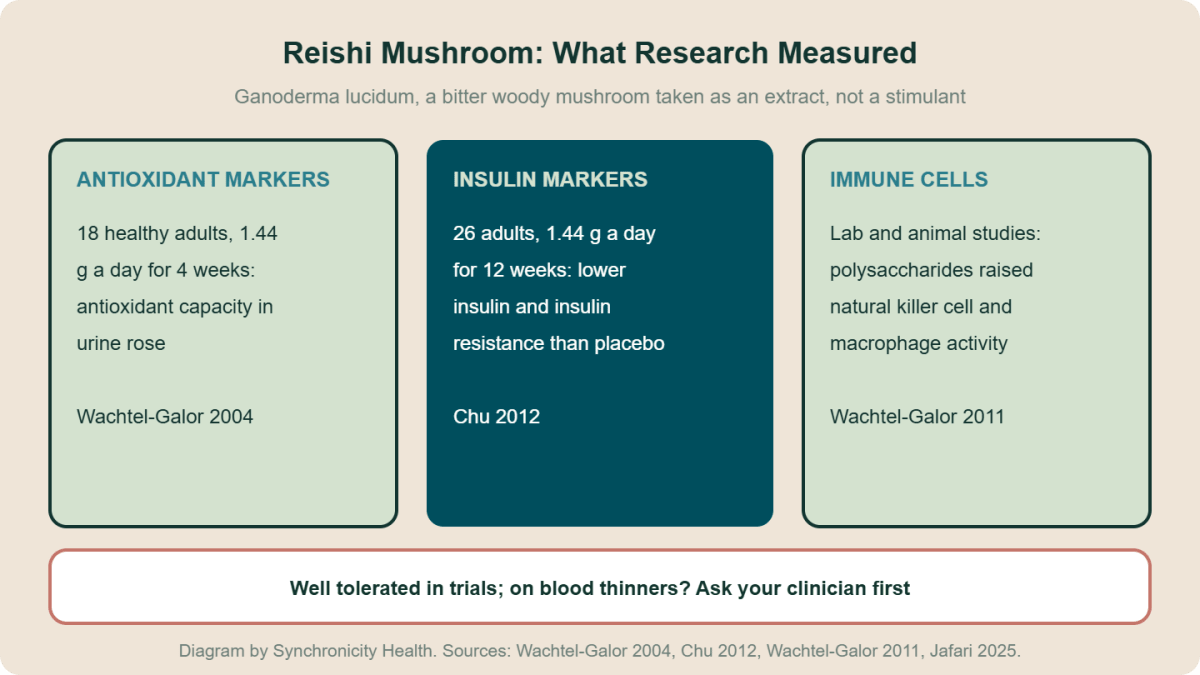
Reishi (Ganoderma lucidum) is a bitter, woody mushroom taken as an extract, and the benefits research has measured are antioxidant markers in healthy adults, insulin markers in a 12-week trial, immune cell activity in the lab, longer sleep in animal studies and fitness in a mushroom blend trial.
This guide covers what reishi is, what each study measured, how much was used, forms, safety and where our Forage capsules fit. It is educational, not medical advice.
Key Takeaways
- Reishi is valued for its compounds rather than as food: mainly polysaccharides, including beta-glucans, and more than 100 bitter triterpenes (Wachtel-Galor et al., 2011).
- In 18 healthy adults, 1.44 g a day for 4 weeks raised antioxidant capacity in urine, with no sign of liver, kidney or DNA toxicity (Wachtel-Galor et al., 2004).
- A 2025 review of 17 randomized trials in 971 people found higher levels of glutathione peroxidase, one of the body's own antioxidant enzymes (Jafari et al., 2025).
- In 26 adults with borderline blood pressure or cholesterol, 1.44 g a day for 12 weeks lowered insulin and insulin resistance compared with placebo (Chu et al., 2012).
- Reishi is not a stimulant; it is usually taken daily for weeks, and people on blood thinners should check with a clinician first.

Featured in this article
ForageSeven mushroom fruiting body extracts, including 200 mg of reishi 8:1 extract per 2-capsule serving, with Himalayan shilajit and 100 mg of ashwagandha root extract.
Shop ForageThird-party tested ingredients. Vegan capsules.
What Is Reishi Mushroom?
Reishi, also called lingzhi, is a large, glossy, reddish-brown mushroom with a fan-shaped cap that grows on hardwood. It has a long history in Chinese and East Asian traditions. Unlike culinary mushrooms, it is tough and bitter, so it is taken as a tea, powder or extract rather than eaten.
Its two best-studied groups of compounds are polysaccharides, including beta-glucans and protein-bound peptidoglycans, and triterpenes. More than 100 triterpenes have been identified in reishi, mostly ganoderic and lucidenic acids, and they give it its bitter taste. Products are made from the fruiting body, the mycelium or the spores (Wachtel-Galor et al., 2011). Our reishi ingredient guide covers the basics.
Reishi Mushroom Benefits: What Research Has Measured
| Area | Who and how long | What was found |
|---|---|---|
| Antioxidant markers | 18 healthy adults, 1.44 g a day, 4 weeks | Antioxidant capacity in urine rose; no liver, kidney or DNA toxicity |
| Antioxidant enzymes | 17 trials, 971 people, 1 to 24 weeks | Higher glutathione peroxidase |
| Longer term markers | 42 healthy adults, 225 mg enriched extract, 6 months | Antioxidant markers rose; liver enzymes fell |
| Insulin markers | 26 adults with borderline blood pressure or cholesterol, 12 weeks | Lower insulin and insulin resistance than placebo |
| Fitness (blend) | Young adults, a blend of reishi, lion's mane and cordyceps, 1 to 3 weeks | VO2 max rose more than on placebo after 3 weeks |
| Sleep (animals) | Rats, 3 days | More total and non-REM sleep |
Antioxidant Support
In a double-blind, placebo-controlled crossover study, 18 healthy adults aged 22 to 52 took 1.44 g of reishi a day for 4 weeks. Antioxidant capacity in their urine rose, lipids trended slightly lower, and there was no sign of liver, kidney or DNA toxicity (Wachtel-Galor et al., 2004). In a 6-month trial, 42 healthy adults took 225 mg a day of an extract enriched in triterpenes and polysaccharides; antioxidant markers rose and the liver enzymes GOT and GPT fell during the trial (Chiu et al., 2017).
Pooling the research, a 2025 review of 17 randomized trials in 971 people, using 200 to 11,200 mg a day for 1 to 24 weeks, found higher levels of glutathione peroxidase, one of the antioxidant enzymes the body makes (Jafari et al., 2025). For more on the body's antioxidant systems, see our guide to glutathione benefits.
Immune Support
Reishi's polysaccharides, including beta-glucans, are best known for immune effects. In lab and animal studies, reishi components increased the activity of immune cells such as natural killer cells and macrophages (Wachtel-Galor et al., 2011). This is why reishi is described as immune supporting, and why it is often paired with other functional mushrooms such as turkey tail.
Insulin and Metabolic Markers
In a 12-week controlled trial, 26 adults with borderline high blood pressure or cholesterol took 1.44 g of reishi a day or placebo. Reishi was well tolerated; body weight and blood pressure did not change, while plasma insulin and insulin resistance were lower than on placebo (Chu et al., 2012). Results in this group may not apply to everyone.
Sleep and Calm
Reishi is often taken in the evening. In rats, 3 days of a reishi fruiting body extract increased total sleep time and non-REM sleep without changing REM sleep, and the effect was linked to the immune messenger TNF-alpha (Cui et al., 2012). That is animal research; our guide to reishi for sleep covers what it means for people and when to take it.
Fitness in a Mushroom Blend
In a double-blind trial, 28 young adults took 4 g a day of a mushroom blend containing reishi, lion's mane and Cordyceps militaris, or placebo, for 1 week, and 10 of them continued for 2 more weeks. There was no difference after 1 week; after 3 weeks, VO2 max rose by 4.8 ml/kg/min on the blend compared with 0.9 on placebo (Hirsch et al., 2017). Because the blend combined three mushrooms, the trial cannot say how much came from reishi. See our guide to lion's mane vs cordyceps for the other two.
Maitake is another Forage mushroom with trials in healthy adults; see our guide to maitake mushroom benefits for what they measured. To see how reishi compares with lion's mane, read lion's mane vs reishi. For maitake and reishi side by side, including taking them together, see our guide to maitake vs reishi.
How Much Reishi to Take
There is no official daily amount. Trials in healthy adults used 1.44 g a day of reishi for 4 to 12 weeks, or 225 mg a day of an enriched extract for 6 months (Wachtel-Galor et al., 2004; Chu et al., 2012; Chiu et al., 2017). Reishi's effects build over time, so consistent daily use matters more than any single dose. If you use a product, follow its label.
Reishi Tea, Powder and Extract
- Tea is a hot water extract. Hot water draws out reishi's polysaccharides, while its bitter triterpenes are mostly extracted with alcohol (Wachtel-Galor et al., 2011). Our guide to reishi tea explains how to make it.
- Extracts concentrate the mushroom and make a consistent daily amount easier. "Dual extracts" use water and alcohol to capture both groups of compounds.
- Raw powder is ground mushroom. Reishi is too tough to digest well as a food, which is why extracts are more common.
Our guide to mushroom extracts vs powders explains the difference in more detail. For how reishi compares with other ingredients, see chaga vs reishi, reishi vs turkey tail, cordyceps vs reishi and ashwagandha vs reishi.
Reishi Side Effects and Safety
Reishi was well tolerated in the trials above, with no rise in side effects compared with placebo (Chu et al., 2012). The US National Institutes of Health LiverTox database describes it as well tolerated and not linked to liver enzyme rises during use, but implicated in rare single cases of acute liver injury, most of which did not rule out other causes (LiverTox, NIH). Reported side effects include digestive discomfort, dry mouth or throat and headache.
- Blood thinners. This is the most important interaction to raise with your clinician.
- Blood pressure and blood sugar. Reishi may lower both, so check first if you take medication for either.
- Liver. Stop and see a clinician if you notice unusual tiredness, dark urine or yellowing of the skin.
- Pregnancy, breastfeeding and surgery. Talk with your provider first.
Where Our Forage Fits
Our Forage capsules contain 200 mg of an 8:1 reishi extract per 2-capsule serving, alongside lion's mane, cordyceps, chaga, maitake, turkey tail and shiitake extracts, Himalayan shilajit and 100 mg of ashwagandha root extract. Every ingredient is third-party tested for purity, potency, microbiological content, residual solvents and heavy metals. Each bottle holds 30 servings; follow the directions on the label.
Forage is an everyday mushroom blend, so its reishi amount is not directly comparable with the single-ingredient trials above. For how reishi sits among other functional mushrooms, see our guide to adaptogenic mushrooms, and our sleep health guide covers the evening routine it often fits into. Reishi also appears in our Lithium Orotate Supplement, alongside low-dose lithium orotate, lemon balm, zinc and vitamin B6, to support everyday calm and a balanced mood.
Featured in this article
ForageSeven mushroom fruiting body extracts, including 200 mg of reishi 8:1 extract per 2-capsule serving, with Himalayan shilajit and 100 mg of ashwagandha root extract.
Shop ForageThird-party tested ingredients. Vegan capsules.
Frequently Asked Questions
What are the benefits of reishi mushroom?
Research has measured higher antioxidant markers in healthy adults, lower insulin and insulin resistance in a 12-week trial, immune cell activity in the lab, longer sleep in animals and higher VO2 max in a mushroom blend trial.
What does reishi do for the body?
Reishi's polysaccharides interact with immune cells, and its triterpenes are studied for stress response and liver pathways. In people, trials tracked antioxidant, insulin and liver markers over weeks to months.
Does reishi help you sleep?
In rats, a reishi extract increased total and non-REM sleep. Many people take it in the evening; our reishi for sleep guide covers timing.
Is reishi good for the immune system?
In lab and animal studies, reishi components increased the activity of natural killer cells and macrophages, which is why it is described as immune supporting.
How long does reishi take to work?
Trials measured changes after 4 weeks to 6 months of daily use. Reishi works gradually, so give it several weeks of daily use.
Is it safe to take reishi every day?
Trials gave reishi daily for up to 6 months and it was well tolerated. Check with a clinician first if you take blood thinners, blood pressure or blood sugar medication.
Is reishi a stimulant?
No. Reishi contains no caffeine and is often used in the evening or as part of a recovery routine.
Can you take reishi with other mushrooms?
Yes. Reishi is often combined with lion's mane, cordyceps and turkey tail, and one trial used a blend of reishi, lion's mane and cordyceps.
How much reishi is in Forage?
Forage contains 200 mg of an 8:1 reishi extract per 2-capsule serving, along with six other mushroom extracts, Himalayan shilajit and 100 mg of ashwagandha root extract.
Sources
- Wachtel-Galor S, et al. Ganoderma lucidum (Lingzhi or Reishi): a medicinal mushroom. Herbal Medicine: Biomolecular and Clinical Aspects, 2011. https://pubmed.ncbi.nlm.nih.gov/22593926/
- Wachtel-Galor S, et al. Ganoderma lucidum ("Lingzhi"), a Chinese medicinal mushroom: biomarker responses in a controlled human supplementation study. British Journal of Nutrition, 2004. https://pubmed.ncbi.nlm.nih.gov/14756912/
- Chu TT, et al. Study of potential cardioprotective effects of Ganoderma lucidum (Lingzhi): results of a controlled human intervention trial. British Journal of Nutrition, 2012. https://pubmed.ncbi.nlm.nih.gov/21801467/
- Chiu HF, et al. Triterpenoids and polysaccharide peptides-enriched Ganoderma lucidum: a randomized, double-blind placebo-controlled crossover study of its antioxidation and hepatoprotective efficacy in healthy volunteers. Pharmaceutical Biology, 2017. https://pubmed.ncbi.nlm.nih.gov/28183232/
- Jafari A, et al. The nutritional significance of Ganoderma lucidum on human health: a GRADE-assessed systematic review and meta-analysis of clinical trials. Food Science and Nutrition, 2025. https://doi.org/10.1002/fsn3.70423
- Cui XY, et al. Extract of Ganoderma lucidum prolongs sleep time in rats. Journal of Ethnopharmacology, 2012. https://doi.org/10.1016/j.jep.2011.12.020
- Hirsch KR, et al. Cordyceps militaris improves tolerance to high-intensity exercise after acute and chronic supplementation. Journal of Dietary Supplements, 2017. https://doi.org/10.1080/19390211.2016.1203386
- LiverTox: Clinical and Research Information on Drug-Induced Liver Injury. Lingzhi (Reishi). National Institutes of Health. https://pubmed.ncbi.nlm.nih.gov/39527685/
These statements have not been evaluated by the Food and Drug Administration. This content is for education and is not medical advice. Our products are not intended to diagnose, treat, cure or prevent any disease. Talk with a healthcare provider before starting a new supplement if you are pregnant, breastfeeding or taking medication.


Leave a comment
All comments are moderated before being published.
This site is protected by hCaptcha and the hCaptcha Privacy Policy and Terms of Service apply.