
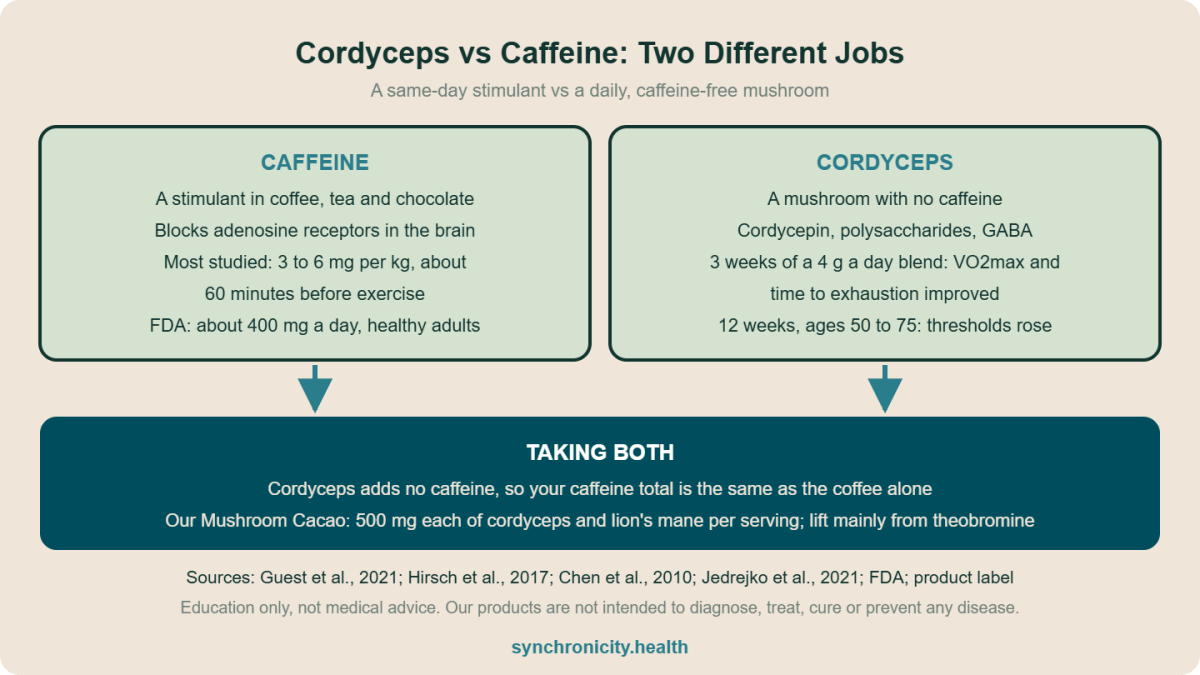
Cordyceps and caffeine are not the same kind of thing. Caffeine is a stimulant that blocks adenosine receptors in the brain, and it is usually taken about an hour before you need it, for example before exercise. Cordyceps is a mushroom with no caffeine; it is studied over weeks of daily use for how well people handle hard exercise. Many people take the two together, for example cordyceps in coffee or in a cocoa drink.
Key Takeaways
- Cordyceps has no caffeine. Its main compounds are cordycepin, polysaccharides, GABA and ergothioneine (Jędrejko et al., 2021).
- Caffeine acts mainly on the brain by blocking adenosine receptors, and 3 to 6 mg per kg of body weight about 60 minutes before exercise is the range most studied for performance (Guest et al., 2021).
- In a 3-week trial, young adults taking 4 g a day of a mushroom blend containing Cordyceps militaris improved VO2max and time to exhaustion (Hirsch et al., 2017).
- The FDA cites about 400 mg of caffeine a day as an amount not generally linked to negative effects in healthy adults (FDA).
- Adding cordyceps to coffee does not add caffeine, so your daily caffeine total stays the same as the coffee alone.

Featured in this article
Mushroom CacaoA mushroom hot chocolate made with cocoa and cacao, with 500 mg each of lion's mane and cordyceps per serving and 0g sugar.
Shop Mushroom CacaoThird-party tested ingredients. 15 calories per serving.
Does Cordyceps Have Caffeine?
No. Cordyceps is a fungus, and caffeine is not one of its compounds. A 2021 review of Cordyceps militaris lists its main active compounds as cordycepin, polysaccharides, GABA (gamma-aminobutyric acid) and ergothioneine, and notes its traditional use in Asia as a tonic for energy and stamina (Jędrejko et al., 2021). Caffeine comes from foods such as coffee, tea and chocolate (FDA).
So if a cordyceps product contains caffeine, it comes from something added to it, such as coffee beans, tea or cocoa. Plain cordyceps capsules or extracts are caffeine free. For a closer look at the mushroom itself, see our cordyceps ingredient page.
Cordyceps vs Caffeine at a Glance
| Caffeine | Cordyceps | |
|---|---|---|
| What it is | A stimulant found in coffee, tea and chocolate | A mushroom; no caffeine |
| How it works | Blocks adenosine receptors in the brain | Compounds such as cordycepin and polysaccharides; not a stimulant |
| How it is studied | A single dose, most often 60 minutes before exercise | Daily use over 1 to 12 weeks |
| What was measured | Endurance, strength and sprinting | VO2max, time to exhaustion and exercise thresholds |
| Daily guide | About 400 mg a day for healthy adults (FDA) | Follow the label of your product |
| Effect on sleep | Too much can cause trouble sleeping | No caffeine, so it adds none to your day |
How Caffeine Works
Caffeine works mainly in the central nervous system. It is believed to act by blocking adenosine receptors, which changes neurotransmitter release, how muscles are signaled to fire and how much effort or discomfort you feel (Guest et al., 2021). That is why it is used as a same-day tool.
For exercise, the International Society of Sports Nutrition says caffeine has consistently improved performance at 3 to 6 mg per kg of body weight, most often taken 60 minutes before exercise. The clearest benefits are in aerobic endurance, with smaller ones for strength, sprinting and jumping. Very high doses, around 9 mg per kg, bring many more side effects without adding performance, and caffeine can also affect sleep (Guest et al., 2021).
Most healthy adults handle caffeine well at normal amounts. The FDA cites about 400 mg a day, roughly two to three 12-ounce cups of coffee, as an amount not generally associated with negative effects. Signs of too much include a racing heart, nervousness, shakiness, an upset stomach, headaches and trouble sleeping, and people differ a lot in how sensitive they are (FDA). Our guides on how much caffeine is too much and the caffeine crash go into the details.
What Cordyceps Studies Measured
Cordyceps research looks at exercise over weeks of daily use rather than a quick lift. Two trials stand out:
- Young adults, high-intensity exercise. In a double-blind trial, 28 young adults took 4 g a day of a mushroom blend containing Cordyceps militaris or a placebo. In the mushroom group, time to exhaustion improved at 1 week and at 3 weeks, and VO2max, a measure of how much oxygen the body can use during hard effort, improved at 3 weeks, which the placebo group did not show (Hirsch et al., 2017).
- Healthy older adults. In a 12-week pilot, 20 healthy adults aged 50 to 75 took 333 mg of a cordyceps extract (Cs-4) three times a day or a placebo. The metabolic threshold rose 10.5 percent and the ventilatory threshold rose 8.5 percent in the cordyceps group, with no change on placebo; VO2max did not change (Chen et al., 2010).
These are small trials, and both point the same way: cordyceps is studied for how the body handles hard effort, and the changes showed up after days to weeks of steady use. For more on doses and timing for training, see cordyceps for athletes and how to pick the best cordyceps supplement.
Cordyceps With Coffee: Taking Them Together
Yes, you can take cordyceps with coffee or other caffeine, and many people do. The trials above tested cordyceps on its own, so they do not tell us how the pair works together. What we do know is simple: cordyceps adds no caffeine, so your caffeine total is whatever is in your coffee, tea or chocolate, and the FDA's 400 mg figure still applies.
The two also run on different clocks. Caffeine is a same-day tool, most often taken an hour before a workout. Cordyceps is a daily habit, measured over weeks. So a common routine is cordyceps every morning, with caffeine when you want it. If you mix cordyceps into a drink, it suits coffee, tea or a cocoa drink equally well. Our guide to mushroom coffee vs regular coffee compares the coffee options. If you take cordyceps later in the day, see our guide to cordyceps and sleep. For pairing your coffee with NAD+ instead, see our guide to taking NAD+ with coffee.
Who Might Choose Which
| If you want | A good fit |
|---|---|
| A lift you feel the same morning | Caffeine |
| A pre-workout boost for one session | Caffeine, about 60 minutes before |
| A daily, caffeine-free habit for training | Cordyceps |
| To cut back on coffee without losing your ritual | Cordyceps in a cocoa drink with less caffeine |
| Both | Cordyceps daily, caffeine within the 400 mg guide |
If you are sensitive to caffeine, a cocoa drink is a middle ground. Cocoa gives some caffeine, and also theobromine, a related compound; in our Mushroom Cacao, the lift comes mainly from theobromine. Our guide to theobromine vs caffeine and our non-stimulant energy and focus guide explain the difference. If you want an evening mushroom too, see cordyceps vs reishi. For cordyceps next to ashwagandha, an herb studied more for stress, our guide to cordyceps vs ashwagandha compares the two.
Where Our Mushroom Cacao and Forage Fit
Our Mushroom Cacao is a mushroom hot chocolate made with cocoa, cacao and a high polyphenol, high theobromine cocoa extract, plus 500 mg each of lion's mane and cordyceps 8:1 fruiting body extracts per serving. Stir one rounded teaspoon (5 g) into 6 to 8 oz of hot water or milk. Each serving has 15 calories and 0 g sugar, sweetened with stevia, and a jar holds 28 servings. Cocoa and cacao naturally contain a small amount of caffeine, so it is not caffeine free, but its lift comes mainly from theobromine. That makes it a good swap for a second coffee, or a partner to your first.
If you want cordyceps with no caffeine at all, our Forage capsules give 200 mg of cordyceps per 2 capsules, alongside lion's mane, reishi, chaga, maitake, turkey tail and shiitake 8:1 fruiting body extracts, Himalayan shilajit and ashwagandha root extract. Take 2 capsules daily in the morning, with or without food, and keep your coffee as it is. Both are made with third-party tested ingredients.
Benefits build with consistent daily use. Months 1 to 2 can bring early changes, and 3 months and beyond is where the full benefit builds. If you take prescription medicine or are pregnant or breastfeeding, check with your clinician before starting.

Featured in this article
ForageSeven functional mushroom fruiting body extracts, including lion's mane, plus Himalayan shilajit and ashwagandha root extract for everyday energy and resilience.
Shop ForageThird-party tested ingredients. Vegan capsules.
Frequently Asked Questions
Does cordyceps have caffeine?
No. Cordyceps is a mushroom, and its main compounds are cordycepin, polysaccharides, GABA and ergothioneine. Any caffeine in a cordyceps product comes from added coffee, tea or cocoa.
Is cordyceps a stimulant like caffeine?
No. Caffeine blocks adenosine receptors in the brain. Cordyceps is studied over weeks of daily use for exercise measures such as VO2max and time to exhaustion.
Can I take cordyceps with coffee?
Yes. Cordyceps adds no caffeine, so your caffeine total is the same as the coffee alone. Keep your total caffeine within the FDA's guide of about 400 mg a day.
Is cordyceps better than caffeine for energy?
They do different jobs. Caffeine gives a same-day lift; cordyceps is a daily habit studied for how well people handle hard exercise over weeks.
Can cordyceps replace coffee?
It will not feel the same, because it is not a stimulant. If you are cutting back on coffee, a mushroom cocoa drink keeps the warm-mug ritual with a little caffeine, and its lift comes mainly from theobromine.
When should I take cordyceps?
Most people take it in the morning, every day. In trials, changes showed up after 1 to 12 weeks of daily use, so consistency matters more than the hour.
How much caffeine is safe per day?
The FDA cites about 400 mg a day for healthy adults, roughly two to three 12-ounce cups of coffee. Sensitivity varies, and pregnant or breastfeeding women should ask their provider.
Does mushroom hot chocolate have caffeine?
A little, from the cocoa. Our Mushroom Cacao is not caffeine free, but its lift comes mainly from theobromine.
Sources
- Jędrejko KJ, Lazur J, Muszyńska B. Cordyceps militaris: an overview of its chemical constituents in relation to biological activity. Foods, 2021. https://europepmc.org/article/MED/34828915
- Guest NS, VanDusseldorp TA, Nelson MT, et al. International Society of Sports Nutrition position stand: caffeine and exercise performance. Journal of the International Society of Sports Nutrition, 2021. https://europepmc.org/article/MED/33388079
- Hirsch KR, Smith-Ryan AE, Roelofs EJ, Trexler ET, Mock MG. Cordyceps militaris improves tolerance to high-intensity exercise after acute and chronic supplementation. Journal of Dietary Supplements, 2017. https://europepmc.org/article/MED/27408987
- Chen S, Li Z, Krochmal R, Abrazado M, Kim W, Cooper CB. Effect of Cs-4 (Cordyceps sinensis) on exercise performance in healthy older subjects: a double-blind, placebo-controlled trial. Journal of Alternative and Complementary Medicine, 2010. https://europepmc.org/article/MED/20804368
- U.S. Food and Drug Administration. Spilling the Beans: How Much Caffeine Is Too Much? https://www.fda.gov/consumers/consumer-updates/spilling-beans-how-much-caffeine-too-much
These statements have not been evaluated by the Food and Drug Administration. This content is for education and is not medical advice. Our products are not intended to diagnose, treat, cure or prevent any disease. Talk with a healthcare provider before starting a new supplement if you are pregnant, breastfeeding or taking medication.


Leave a comment
All comments are moderated before being published.
This site is protected by hCaptcha and the hCaptcha Privacy Policy and Terms of Service apply.