
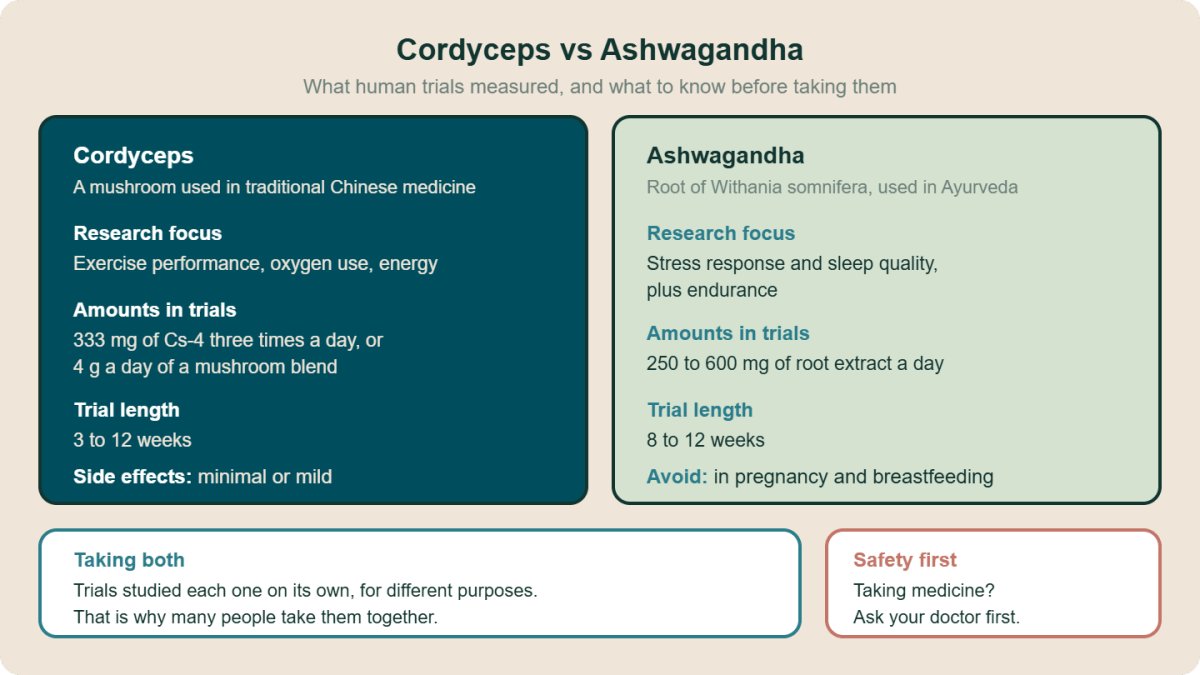
Cordyceps and ashwagandha are both taken for steady daily energy, but research has looked at them for different jobs. Cordyceps is a mushroom studied mostly for exercise performance and oxygen use, while ashwagandha is a root studied mostly for a healthy stress response and sleep quality, with some endurance research too. Many people take them together; here is what the trials found for each.
Key Takeaways
- In 20 healthy adults aged 50 to 75, a cordyceps extract (Cs-4) at 333 mg three times a day for 12 weeks raised two exercise thresholds on a bike test by about 10.5 and 8.5 percent (Chen et al., 2010).
- In 64 adults with a history of chronic stress, ashwagandha root extract at 300 mg twice a day for 60 days lowered scores on every stress scale used and lowered serum cortisol compared with placebo (Chandrasekhar et al., 2012).
- Ashwagandha has exercise research of its own: in healthy athletic adults, 300 mg twice a day for 12 weeks raised VO2 max more than placebo (Choudhary et al., 2015).
- Trials have studied each one on its own, for different purposes, which is why they are often paired.
- Cordyceps has a mild side effect record. Ashwagandha has rare reports of liver injury and should be avoided in pregnancy and while breastfeeding (NCCIH, 2023).

Featured in this article
ForageCordyceps 200 mg and ashwagandha root extract 100 mg in every 2-capsule serving, with six more 8:1 mushroom fruiting body extracts and Himalayan shilajit.
Shop ForageThird-party tested ingredients. Vegan capsules, made in the USA.
Cordyceps vs Ashwagandha at a Glance
| Cordyceps | Ashwagandha | |
|---|---|---|
| What it is | A mushroom used in traditional Chinese medicine for over 1,500 years | The root of Withania somnifera, an evergreen shrub used in Ayurveda |
| Main research focus | Exercise performance, oxygen use and energy | Stress response and sleep quality, plus endurance |
| Amounts in trials | 333 mg of Cs-4 three times a day; 4 g a day of a mushroom blend | 250 to 600 mg a day of root extract |
| Trial length | 3 to 12 weeks | 8 to 12 weeks |
| Reported side effects | Minimal or mild: stomach discomfort, diarrhea, dry mouth | Drowsiness, stomach upset, diarrhea, vomiting in some people |
| Key cautions | Talk to your doctor if you take prescription medicine | Avoid in pregnancy and breastfeeding; rare liver injury; several medicine interactions |
What Cordyceps Is and What Research Shows
Cordyceps is a fungus with a long history in traditional Chinese medicine (LiverTox, 2026). Supplements use extracts of Cordyceps militaris or of cultured Cordyceps sinensis strains, such as the Cs-4 extract in the first trial below. More is on our cordyceps ingredient page.
The human research centers on exercise. In a 12-week double-blind pilot trial, 20 healthy adults aged 50 to 75 took 333 mg of Cs-4 or placebo three times a day. On a bike test, the cordyceps group's metabolic threshold rose about 10.5 percent and its ventilatory threshold about 8.5 percent, two markers of aerobic fitness; the placebo group showed no significant change (Chen et al., 2010).
In younger adults, 28 people with an average age of about 23 took 4 g a day of a mushroom blend containing Cordyceps militaris or placebo. Ten of them continued for 3 weeks, and in that group VO2 max rose by 4.8 ml/kg/min with the mushroom blend compared with 0.9 on placebo, along with a longer time to exhaustion and a higher ventilatory threshold (Hirsch et al., 2017). See cordyceps for athletes and cordyceps vs caffeine for more.
What Ashwagandha Is and What Research Shows
Ashwagandha, also called Indian ginseng, is the root of an evergreen shrub found in parts of India, Africa and the Middle East, and it has been used for thousands of years in Ayurvedic medicine (NCCIH, 2023). It is classed as an adaptogen. More on the root is on our ashwagandha root extract ingredient page.
Most ashwagandha trials measure stress. In the 60-day trial of 64 adults with a history of chronic stress, 300 mg of root extract twice a day lowered scores on all the stress scales used and lowered serum cortisol, a marker of the stress response, compared with placebo; side effects were mild and similar in both groups (Chandrasekhar et al., 2012). In an 8-week trial of 60 stressed but healthy adults, both 250 mg and 600 mg a day lowered perceived stress scores and serum cortisol, and sleep quality improved compared with placebo (Salve et al., 2019).
Ashwagandha has also been studied for endurance. In about 50 healthy athletic men and women, 300 mg of root extract twice a day for 12 weeks raised VO2 max on a shuttle run test more than placebo at both 8 and 12 weeks, and quality of life scores improved more than with placebo (Choudhary et al., 2015). For another common pairing, see rhodiola vs ashwagandha.
Cordyceps or Ashwagandha for Energy and Exercise
Both have exercise trials behind them:
| Trial | Who and how much | What changed |
|---|---|---|
| Chen et al., 2010 (cordyceps) | 20 healthy adults aged 50 to 75; Cs-4 333 mg three times a day for 12 weeks | Metabolic threshold up about 10.5 percent and ventilatory threshold up about 8.5 percent |
| Hirsch et al., 2017 (cordyceps blend) | Young adults; 4 g a day of a blend with Cordyceps militaris; 10 continued to 3 weeks | At 3 weeks, VO2 max up 4.8 ml/kg/min vs 0.9 on placebo, and longer time to exhaustion |
| Choudhary et al., 2015 (ashwagandha) | Healthy athletic adults; root extract 300 mg twice a day for 12 weeks | Larger rise in VO2 max than placebo at 8 and 12 weeks; better quality of life scores |
Cordyceps research looks at how the body uses oxygen during hard effort, which fits energy for a workout or an active day. Ashwagandha suits people whose low energy feels tied to a stressful week.
Cordyceps or Ashwagandha for Stress
For stress, ashwagandha is the ingredient trials have studied most, measuring stress scores, serum cortisol and sleep quality over 8 to 12 weeks. Cordyceps research has centered on exercise and energy, so it is usually chosen for physical energy rather than for calm. Our hub on stress, mood and nervous system balance covers the wider picture.
Can You Take Ashwagandha and Cordyceps Together?
Yes, and many people do. The trials above studied each one on its own. The reason for pairing them is that research has looked at them for different purposes: cordyceps for energy use and exercise, ashwagandha for the stress response and sleep quality.
This is the idea behind multi-ingredient blends such as Forage, which combines seven mushroom extracts with ashwagandha and Himalayan shilajit. Our guide to mushrooms vs adaptogens explains how the two groups differ, and shilajit and ashwagandha covers the third ingredient in that mix.
Choosing Between Them
- Choose cordyceps if your main goal is energy for workouts, hiking or an active day.
- Choose ashwagandha if your main goal is a calmer response to everyday stress and better sleep quality.
- Take both if you want daytime energy and stress support together, either as two products or in one blend.
- Skip ashwagandha if you are pregnant or breastfeeding, have a thyroid or autoimmune condition, or have surgery coming up, and ask your doctor about cordyceps first.
How to Take Them
Trials split the daily amount into two or three doses, but a single daily serving of a blend is the simplest routine. Both are taken every day rather than only when you need them, and the trials above ran 3 to 12 weeks.
Ashwagandha can cause drowsiness in some people (NCCIH, 2023). If you notice that, take it later in the day; if you do not, morning works well for both.
Safety and Side Effects
Cordyceps
Cordyceps extracts have only minimal or mild side effects, which can include abdominal discomfort, diarrhea and dry mouth. There have been no published reports of liver enzyme rises or clinically apparent liver injury, and LiverTox rates it an unlikely cause of liver injury (LiverTox, 2026).
Ashwagandha
Ashwagandha may cause drowsiness, stomach upset, diarrhea and vomiting in some people, and it may be safe when taken for up to 3 months. It should be avoided during pregnancy and while breastfeeding, is not recommended for people with thyroid or autoimmune conditions or before surgery, and might interact with medicines for diabetes, high blood pressure and thyroid conditions, immunosuppressants, sedatives and anticonvulsants (NCCIH, 2023). Liver injury linked to ashwagandha is rare; in reported cases it appeared 2 to 12 weeks after starting and usually settled within 1 to 4 months of stopping (LiverTox, 2024). Stop and call your doctor if you notice yellowing skin or eyes or itching. Our guide to ashwagandha side effects covers each of these in detail.
Where Our Products Fit
Our Forage gives you both in one capsule routine: cordyceps 200 mg and ashwagandha root extract 100 mg in every 2-capsule serving, alongside six more 8:1 mushroom fruiting body extracts and Himalayan shilajit extract 100 mg, with ginger extract in vegan capsules. The label directs two capsules daily, taken in the morning with or without food. It is made with third-party tested ingredients.
If you would rather drink your cordyceps, our Mushroom Cacao is a mushroom hot chocolate with 500 mg each of cordyceps and lion's mane 8:1 fruiting body extracts per rounded teaspoon, with 15 calories and 0g sugar. Cocoa naturally contains a small amount of caffeine, so it is best enjoyed in the morning or early afternoon.
Featured in this article
ForageSeven 8:1 mushroom fruiting body extracts, including cordyceps, plus ashwagandha root extract and Himalayan shilajit, two capsules each morning.
Shop ForageThird-party tested ingredients. Vegan capsules, made in the USA.
Frequently Asked Questions
Is cordyceps or ashwagandha better for energy?
It depends on the kind of energy you want. Cordyceps trials measured exercise thresholds and VO2 max, so it suits workouts and active days. Ashwagandha trials focused on stress and sleep quality, with one 12-week trial also finding a larger rise in VO2 max than placebo in athletic adults. If low energy feels tied to stress, ashwagandha may fit better.
Can you take ashwagandha and cordyceps together?
Yes. Many people take them together because research has looked at them for different purposes: cordyceps for energy use and exercise, ashwagandha for the stress response and sleep quality. Trials have studied each one on its own. Blends such as Forage combine the two in one daily serving. Check with your doctor first if you take prescription medicine.
Is ashwagandha or cordyceps better for stress?
Ashwagandha. Its trials measured stress directly: 300 mg twice a day for 60 days lowered stress scale scores and serum cortisol compared with placebo, and an 8-week trial found lower perceived stress and better sleep quality. Cordyceps research has centered on exercise and energy, so it is usually chosen for physical energy rather than for calm.
Should I take cordyceps or ashwagandha before a workout?
Daily use matters more than timing. In the trials, people took cordyceps or ashwagandha every day for 3 to 12 weeks, and the changes in exercise thresholds and VO2 max were measured at the end of that time, not after a single dose before exercise. Morning works well for both unless ashwagandha makes you drowsy.
When should I take cordyceps and ashwagandha?
Cordyceps is often taken in the morning or early in the day, ahead of an active routine. Ashwagandha can cause drowsiness in some people, so move it to the evening if you notice that. With a blend, follow its label. Forage, for example, directs two capsules in the morning with or without food.
How long do cordyceps and ashwagandha take to work?
Trials measured results after 3 to 12 weeks of daily use, not after a single dose. The cordyceps blend trial found changes at 3 weeks, and the ashwagandha stress and endurance trials measured results at 8 to 12 weeks. Benefits build with consistent daily use. Months 1 to 2 can bring early changes, and 3 months and beyond is where the full benefit builds.
Who should not take ashwagandha or cordyceps?
Avoid ashwagandha if you are pregnant or breastfeeding, and skip it if you have a thyroid or autoimmune condition or have surgery coming up. It may interact with medicines for diabetes, blood pressure and thyroid conditions, immunosuppressants, sedatives and anticonvulsants. Talk to your doctor before taking either one if you take prescription medicine or have a liver condition.
Sources
- Chen S, Li Z, Krochmal R, Abrazado M, Kim W, Cooper CB. Effect of Cs-4 (Cordyceps sinensis) on exercise performance in healthy older subjects: a double-blind, placebo-controlled trial. Journal of Alternative and Complementary Medicine, 2010. https://pubmed.ncbi.nlm.nih.gov/20804368/
- Hirsch KR, Smith-Ryan AE, Roelofs EJ, Trexler ET, Mock MG. Cordyceps militaris improves tolerance to high-intensity exercise after acute and chronic supplementation. Journal of Dietary Supplements, 2017. https://pubmed.ncbi.nlm.nih.gov/27408987/
- Chandrasekhar K, Kapoor J, Anishetty S. A prospective, randomized double-blind, placebo-controlled study of safety and efficacy of a high-concentration full-spectrum extract of ashwagandha root in reducing stress and anxiety in adults. Indian Journal of Psychological Medicine, 2012. https://pubmed.ncbi.nlm.nih.gov/23439798/
- Salve J, Pate S, Debnath K, Langade D. Adaptogenic and anxiolytic effects of ashwagandha root extract in healthy adults: a double-blind, randomized, placebo-controlled clinical study. Cureus, 2019. https://pubmed.ncbi.nlm.nih.gov/32021735/
- Choudhary B, Shetty A, Langade DG. Efficacy of Ashwagandha (Withania somnifera [L.] Dunal) in improving cardiorespiratory endurance in healthy athletic adults. Ayu, 2015. https://pubmed.ncbi.nlm.nih.gov/26730141/
- National Center for Complementary and Integrative Health. Ashwagandha: Usefulness and Safety, 2023. https://www.nccih.nih.gov/health/ashwagandha
- LiverTox: Clinical and Research Information on Drug-Induced Liver Injury. Cordyceps. National Institute of Diabetes and Digestive and Kidney Diseases, 2026. https://www.ncbi.nlm.nih.gov/books/NBK615916/
- LiverTox: Clinical and Research Information on Drug-Induced Liver Injury. Ashwagandha. National Institute of Diabetes and Digestive and Kidney Diseases, 2024. https://www.ncbi.nlm.nih.gov/books/NBK548536/
These statements have not been evaluated by the Food and Drug Administration. This content is for education and is not medical advice. Our products are not intended to diagnose, treat, cure or prevent any disease. Talk with a healthcare provider before starting a new supplement if you are pregnant, breastfeeding or taking medication.


Leave a comment
All comments are moderated before being published.
This site is protected by hCaptcha and the hCaptcha Privacy Policy and Terms of Service apply.