
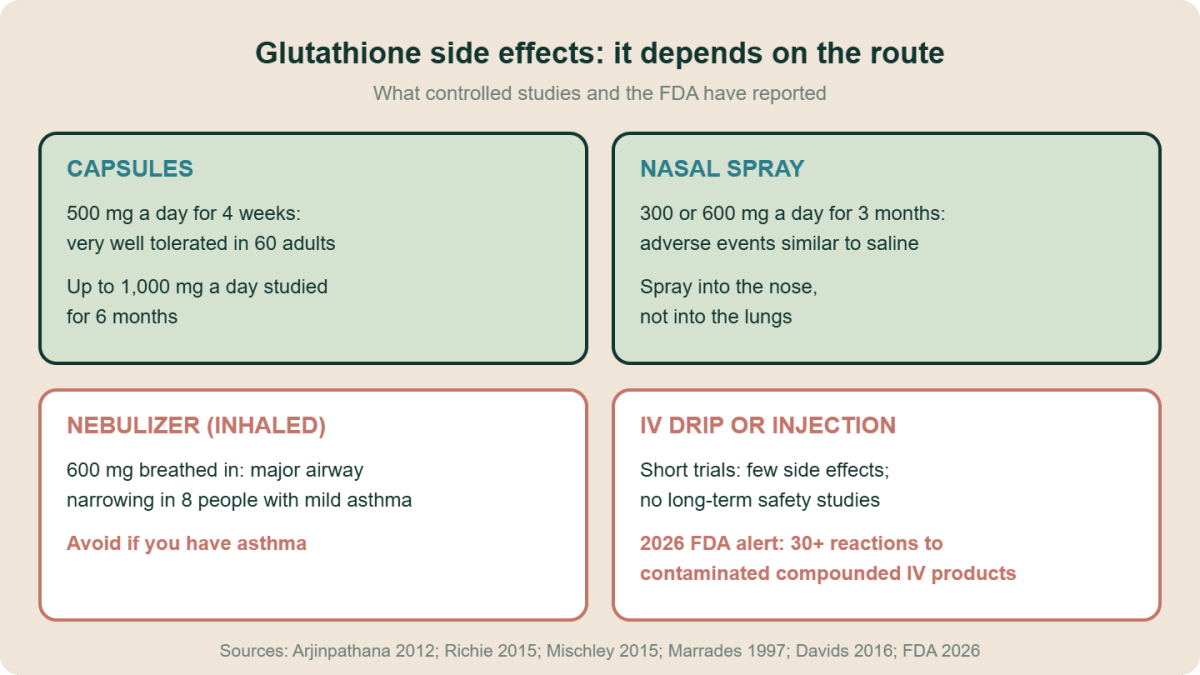
Glutathione side effects are usually mild when it is taken by mouth or as a nasal spray: controlled trials lasting 4 weeks to 3 months reported it was well tolerated. (Arjinpathana and Asawanonda, 2012) (Mischley et al., 2015) The bigger safety questions sit with other routes. Breathing it in through a nebulizer tightened the airways of people with asthma (Marrades et al., 1997), and in 2026 the FDA linked IV glutathione made from the wrong grade of ingredient to fevers, chills and hospital stays (FDA, 2026). This guide walks through what the studies report for each route, who should check with a clinician first, and how to use a glutathione product sensibly.
It is educational, not medical advice.
Key Takeaways
- Oral glutathione: 500 mg a day for 4 weeks was very well tolerated in 60 healthy adults (Arjinpathana and Asawanonda, 2012), and 250 or 1,000 mg a day for 6 months raised glutathione stores in blood and cells (Richie et al., 2015).
- Nasal glutathione: in a 3 month trial of 300 or 600 mg a day, adverse events did not differ meaningfully from a saline spray (Mischley et al., 2015).
- Inhaled glutathione: 600 mg through a nebulizer caused major airway narrowing, cough or breathlessness in people with mild asthma (Marrades et al., 1997). A nasal spray is not meant to be inhaled into the lungs.
- IV glutathione: most trials were short and reported few side effects (Davids et al., 2016), and the 2026 FDA alert involved contaminated compounded IV products (FDA, 2026).
- Check first if: you are pregnant or breastfeeding, have asthma, take prescription medication, or are being treated for a medical condition.

Featured in this article
Glutathione Nasal SprayGlutathione in three strengths, up to 170 mg per two-spray serving, for daily antioxidant support.
Shop Glutathione Nasal SprayThird-party tested ingredients. Vegan, non-GMO, made in the USA.

What Is Glutathione?
Glutathione is a small molecule built from three amino acids: glutamate, cysteine and glycine. Your cells make it themselves, and it is one of the main antioxidants inside them, helping to manage oxidative stress and recycle other antioxidants. Our glutathione ingredient page explains the chemistry, and our guide to glutathione foods covers what supports your own production.
Because the body already makes and uses glutathione every day, the questions about side effects are mostly about how extra glutathione is taken: swallowed, sprayed into the nose, breathed in as a mist, or put into a vein.
For what glutathione does and what studies measured, route by route, see our guide to glutathione benefits.
Glutathione is often confused with glutamine, a separate amino acid; our guide to glutamine vs glutathione explains the difference.
Glutathione Side Effects by Route
| Route | What the studies report | Main caution |
|---|---|---|
| Capsules or tablets | Very well tolerated at 500 mg a day for 4 weeks; 6 months at up to 1,000 mg a day studied | Long-term safety beyond these trials not established |
| Nasal spray | No meaningful difference in adverse events from saline over 3 months | Studied in small groups; spray into the nose, not the lungs |
| Nebulizer (inhaled) | Major airway narrowing, cough and breathlessness in people with mild asthma | Avoid if you have asthma |
| IV drip or injection | Few side effects in short trials; no long-term safety studies | 2026 FDA alert on contaminated compounded IV glutathione |
Oral Glutathione Side Effects
In a randomized, double-blind trial at a hospital in Bangkok, 60 healthy medical students took glutathione capsules (500 mg a day in two doses) or a placebo for 4 weeks. The authors reported that both glutathione and placebo were very well tolerated, and they noted that long-term safety had not been established (Arjinpathana and Asawanonda, 2012).
In a longer trial, 54 non-smoking adults took 250 or 1,000 mg of oral glutathione a day, or a placebo, for 6 months. Glutathione levels in blood, red blood cells, plasma and immune cells rose at both doses, with mean increases of 30 to 35% in several blood compartments in the high-dose group at 6 months (Richie et al., 2015). A separate 4 week trial in 40 healthy volunteers taking 500 mg twice a day found no change in oxidative stress markers or red blood cell glutathione (Allen and Bradley, 2011), and the safety picture in these trials was reassuring.
If you notice stomach upset with any new supplement, taking it with food or stopping it are sensible first steps. For how swallowed glutathione compares with other forms, see glutathione nasal spray vs oral and our guide to the best glutathione supplement by form.
Nasal Glutathione Side Effects
The best safety data for nasal glutathione come from two small trials in people with Parkinson's disease. In the first, 30 people used a saline spray or 300 or 600 mg of glutathione a day, split into three doses, for 3 months. The researchers screened for side effects, blood chemistry changes, sinus irritation and changes in smell, and found no substantial differences between the groups in the number of adverse events; all groups met the tolerability criteria (Mischley et al., 2015).
In the second trial, 45 people used saline or 100 or 200 mg of glutathione three times a day for 3 months. One participant in the high-dose group developed a heart muscle problem (cardiomyopathy) during the study; the abstract does not say whether glutathione caused it (Mischley et al., 2017).
Two points matter for everyday users. These trials used total daily amounts well above a single serving of our spray, and they were run in a specific patient group, so they tell us about tolerability rather than benefits for healthy adults. And a nasal spray is meant to stay in the nose: some of each spray drains to the throat and is swallowed, but it should not be inhaled deeply into the lungs. Our daily-use guide shows the label technique.
Inhaled Glutathione and Asthma
Nebulized glutathione is the one route with a clear warning signal. In a randomized, double-blind crossover study of eight people with mild asthma, 600 mg of glutathione breathed in over 25 minutes caused major airway narrowing compared with a saline mist, and four people coughed while three became breathless. A reliever inhaler taken beforehand blocked the effect, and the authors suspected sulfite formation as the cause (Marrades et al., 1997).
If you have asthma or any other breathing condition, do not breathe glutathione into your lungs, and talk with your clinician before trying any glutathione product.
IV and Injected Glutathione: What to Know
A review of IV glutathione found that most trials reported no or minimal side effects, but they lasted only a few doses or 4 to 12 weeks, and no study had looked at long-term use. The authors also raised a concern that switching skin pigment from brown to red melanin, the basis of skin lightening claims, could change how skin handles sun exposure (Davids et al., 2016). Another review noted that the Philippine FDA warned against IV glutathione for skin lightening because of reported adverse effects (Sonthalia et al., 2016).
In August 2026 the FDA reported at least 30 patients with adverse events after IV glutathione made with a dietary supplement grade ingredient that should not be used in injectable drugs. Reported problems included fever, chills, pain, dizziness and signs of shock, and some people were hospitalized (FDA, 2026). Our glutathione injections and IV guide covers costs, protocols and questions to ask a provider.
Who Should Talk to a Doctor First
- People who are pregnant or breastfeeding, because the trials above did not include them.
- People with asthma or other breathing conditions, given the nebulizer findings.
- Anyone taking prescription medication or being treated for a medical condition, including chemotherapy, where antioxidants may need to be timed with treatment.
- Anyone considering IV or injected glutathione, who should ask how the product was made and whether its ingredients are meant for injection.
- Anyone who has had an allergic reaction to glutathione or to any ingredient in a product.
Stop using any supplement and get medical help if you notice wheezing, swelling, a rash, a high fever or feel faint.
How to Use Glutathione Sensibly
- Pick one form and follow its label. More is not better: the trials above that tracked side effects used set daily amounts.
- Start at the lower strength if a product comes in more than one, and notice how you feel over the first week.
- Keep it out of your lungs. Nasal sprays go into the nose; nebulizers are a different route with a different risk.
- Consider the building blocks too. NAC supplies cysteine, the amino acid that limits how much glutathione your cells can make. Our NAC vs glutathione guide compares the two, and NAC side effects covers its own safety profile.
- Tell your clinician about every supplement you take, especially before surgery or a new prescription.
Where Our Products Fit
Our Glutathione Nasal Spray comes in three strengths, Regular, Extra and Maximum, and the Maximum strength provides 170 mg of glutathione per serving. One serving is one spray in each nostril while gently inhaling through your nose, with your head tilted back slightly, left for at least 60 seconds before blowing your nose. It is absorbed through the lining of the nose instead of being swallowed like a capsule, so some of each dose skips digestion; some also drains to the throat. Each bottle holds 30 servings and is made with third-party tested ingredients.
If you prefer to support your own production, our NAC Nasal Spray provides 50 mg of N-acetylcysteine per serving. Learn more on our glutathione ingredient page, or read the Glutathione Nasal Spray FAQ.

Featured in this article
NAC Nasal Spray50 mg of N-acetylcysteine per serving, the building block your cells use to make their own glutathione.
Shop NAC Nasal SprayThird-party tested ingredients. Vegan, non-GMO, made in the USA.
Frequently Asked Questions
Does glutathione have side effects?
In controlled trials, oral glutathione at 500 mg a day for 4 weeks was very well tolerated (Arjinpathana and Asawanonda, 2012), and a nasal glutathione trial found no meaningful difference in adverse events from saline (Mischley et al., 2015). Inhaled and IV glutathione carry more specific risks, covered above.
Is it safe to take glutathione every day?
Daily oral use at 250 or 1,000 mg was studied for 6 months (Richie et al., 2015), and daily nasal use for 3 months (Mischley et al., 2015). If you plan to use it for longer, follow the label and check with your clinician.
Can glutathione cause stomach problems?
The oral trials we reviewed reported it was well tolerated (Arjinpathana and Asawanonda, 2012). Any new supplement can upset some stomachs; taking it with food or pausing it usually settles this.
Is glutathione bad for people with asthma?
Breathing glutathione in through a nebulizer caused major airway narrowing in people with mild asthma (Marrades et al., 1997). People with asthma should avoid inhaled glutathione and check with their clinician before any glutathione product.
Are glutathione injections safe?
Short trials reported few side effects, but there are no long-term safety studies (Davids et al., 2016), and in 2026 the FDA linked contaminated compounded IV glutathione to serious reactions (FDA, 2026). Ask your provider how the product was made.
Does glutathione lighten skin?
Small oral trials reported modest changes in skin melanin, but long-term safety for this use has not been established (Arjinpathana and Asawanonda, 2012), and regulators have warned against IV glutathione for skin lightening (Sonthalia et al., 2016).
Can I take glutathione while pregnant or breastfeeding?
The trials above did not include pregnant or breastfeeding women, so talk with your doctor first.
Can I take glutathione with NAC?
Many people do. NAC supplies a building block for glutathione and the two act at different points. Speak with your healthcare professional if you take prescription medication. See NAC vs glutathione.
Sources
- Arjinpathana N, Asawanonda P. Glutathione as an oral whitening agent: a randomized, double-blind, placebo-controlled study. Journal of Dermatological Treatment. 2012. PubMed 20524875
- Richie JP, Nichenametla S, Neidig W, et al. Randomized controlled trial of oral glutathione supplementation on body stores of glutathione. Eur J Nutr. 2015. PubMed 24791752
- Allen J, Bradley RD. Effects of oral glutathione supplementation on systemic oxidative stress biomarkers in human volunteers. J Altern Complement Med. 2011. PubMed 21875351
- Mischley LK, Leverenz JB, Lau RC, et al. A randomized, double-blind phase I/IIa study of intranasal glutathione in Parkinson's disease. Mov Disord. 2015. PubMed 26230671
- Mischley LK, Lau RC, Shankland EG, Wilbur TK, Padowski JM. Phase IIb study of intranasal glutathione in Parkinson's disease. J Parkinsons Dis. 2017. PubMed 28436395
- Marrades RM, Roca J, Barbera JA, et al. Nebulized glutathione induces bronchoconstriction in patients with mild asthma. Am J Respir Crit Care Med. 1997. PubMed 9279219
- Davids LM, Van Wyk JC, Khumalo NP. Intravenous glutathione for skin lightening: inadequate safety data. S Afr Med J. 2016. PubMed 27499402
- Sonthalia S, Daulatabad D, Sarkar R. Glutathione as a skin whitening agent: facts, myths, evidence and controversies. Indian J Dermatol Venereol Leprol. 2016. PubMed 27088927
- U.S. Food and Drug Administration. FDA reminds compounders not to use dietary supplement grade glutathione for injectables (August 27, 2026). FDA
Our products are not intended to diagnose, treat, cure or prevent any disease. This article is for education only and is not medical advice.


Leave a comment
All comments are moderated before being published.
This site is protected by hCaptcha and the hCaptcha Privacy Policy and Terms of Service apply.