
Read an NAD+ supplement’s certificate of analysis by matching it to your bottle’s lot number, then checking ingredient identity, measured potency, contaminant results, test methods, and laboratory details. A useful certificate reports what was tested and how the results compare with stated specifications.

Featured in this article
NAD+ Nasal SpraySupports cellular energy, focus and healthy aging. A needle-free alternative to NAD+ IV.
Shop NAD+ Nasal SprayThird-party tested ingredients. Vegan, non-GMO, made in the USA.
- The best NAD supplement certificate of analysis matches your lot and reports identity, potency, methods, and contaminant results.
- A raw-material purity result does not establish the potency or microbiological quality of a finished nasal spray.
- Synchronicity sells NAD+ nasal sprays; assess batch documentation separately from claims about energy, focus, or absorption.
- Third-party testing supports quality assessment.
How do you read an NAD+ supplement’s certificate of analysis?
Use this sequence when reviewing an NAD+ certificate of analysis, or COA, in 2026. Start with traceability, not the largest percentage on the page.
- Match the sample. Compare the product name, ingredient form, lot number, and sample description with the bottle you are considering.
- Check identity. Find the result establishing that the tested material is the stated ingredient, not merely a material with a similar name.
- Read potency with its units. Determine whether the result describes purity, concentration, or the amount in a finished serving.
- Review contaminant testing. Look for named tests, results, units, and acceptance limits rather than an unexplained pass statement.
- Verify the report. Check the laboratory identity, report identifier, dates, and test methods. Request clarification where the document leaves its scope unclear.
If you cannot connect the report to your product’s batch, stop there. A detailed report for a different sample does not answer the question you are asking.
Why this matters
A COA can help you separate measurable product quality from benefit-driven language. That distinction matters when comparing supplements for stimulant-free energy or clearer focus.
Synchronicity sells nasal sprays and capsule supplements. Apply the same documentation standard to any supplier: assess the actual report, not the presence of a testing badge or the strength of the product description.
For a 2026 purchase, the useful question is whether the report represents the relevant batch and formulation. The newest-looking document is not automatically the most informative one.
Match the lot number and sample description
The lot or batch number connects a report to a defined production batch. Find that identifier on the bottle or packaging, then compare it character for character with the report. A product name alone is insufficient because different batches can share the same name.
Next, identify what the laboratory received. Was it a powdered ingredient, a capsule, or a finished liquid? A supplier’s NAD+ powder report can establish information about that powder, but it does not establish everything about the finished spray made from it.
Check these fields together:
- Product identity: The name and ingredient form correspond to the product label.
- Batch identity: The report includes a lot identifier that can be connected to your bottle.
- Sample description: The report specifies raw material or finished product.
- Report dates: Sample receipt, testing, or issue dates are shown clearly.
- Report identifier: A document number helps the laboratory or supplier identify the record.
A missing field calls for a specific question, not an accusation. Ask which batch the report covers and whether separate finished-product testing exists. Do not assume a raw-material certificate is a finished-product certificate.
Distinguish raw-material testing from finished-product testing
Both types of report can be useful, but they answer different questions. Neither should be presented as evidence for a scope it does not cover.
| Report type | Best for | What it can establish | Main limitation |
|---|---|---|---|
| Raw-material COA | Evaluating an ingredient before formulation | Identity, assay, and listed contaminants in the sampled ingredient | Does not establish the finished product’s concentration or microbiological quality |
| Finished-product COA | Evaluating the formulation you intend to use | Listed results for the tested capsule or liquid batch | Establishes only the attributes actually tested |
For capsules, the distinction matters because ingredient purity and ingredient amount per capsule are different measurements. For a nasal spray, formulation introduces another question: what is the measured concentration in the finished liquid?
In 2026, read a finished-product report as a collection of specific findings, not a blanket approval. An identity test, potency assay, and microbial panel each contribute different information.
Separate identity, purity, and potency
These terms often appear together, but they are not interchangeable. Identity asks what the material is; purity describes its composition under a stated measurement; potency asks how much of the specified ingredient is present.
Identity: Is the ingredient actually NAD+?
Check the ingredient name and the identity method. NAD+, NADH, nicotinamide riboside, and nicotinamide mononucleotide are distinct substances; a report for one does not establish the identity of another.
An identity result should refer to the substance on the label. If the report uses an abbreviation or chemical name you do not recognize, request an explanation rather than assuming it means the same thing.
Purity: What does the percentage describe?
A purity percentage needs context. Depending on the method, a percentage can describe chromatographic peak area or a quantified amount relative to the sample; those are not automatically equivalent measurements.
Look for the method name and the basis of reporting. A high purity percentage on a raw-material report does not tell you how much NAD+ is in each capsule, bottle, or spray.
Potency: Does the result support the labeled amount?
Find the assay result, its units, and the specification used to judge it. For a liquid, a concentration expressed in mg/mL means milligrams of ingredient per milliliter of liquid.
An amount per spray also requires the delivered volume per actuation. Concentration alone cannot establish that amount unless the relevant delivery-volume information is available.
Read the units before judging the result
Unit errors can make a reasonable result look alarming, or make an unsuitable comparison look reassuring. Compare the result and its acceptance limit only after confirming that they use compatible units and the same reporting basis.
These are unit conversions, not suggested doses or contaminant limits:
- 1 g equals 1,000 mg. Grams and milligrams describe mass.
- 1 mg equals 1,000 µg. Micrograms are smaller units of mass.
- 1 L equals 1,000 mL. Liters and milliliters describe volume.
Percent, mg/mL, and mg per serving answer different questions. Do not compare them directly. Likewise, a contaminant concentration per gram is not the same as exposure per daily serving; interpreting exposure requires the amount used.
When a result uses ppm, ask what reporting basis applies to that sample. Avoid silently converting a solid-material result into a liquid concentration without the information required for that conversion.
Check contaminant results and acceptance limits
A contaminant panel should identify the tested substances or organisms, report results, and state the applicable specifications. Typical areas of quality assessment include elemental contaminants and microbiological quality; residual solvents are relevant when the manufacturing process warrants testing.
For elemental testing, look for individual analytes rather than a broad statement that heavy metals passed. Lead, arsenic, cadmium, and mercury are distinct analytes, and a combined statement can conceal which results were actually measured.
For microbiological testing, identify the tests performed and their reporting units. A total-count result answers a different question from testing for a specified organism. A nasal formulation also needs assessment appropriate to its intended route; an oral-product panel alone does not answer every nasal-product quality question.
A microbial pass result does not mean sterile. Sterility is a separate claim requiring appropriate evidence. Do not infer it from low microbial counts or from the absence of a named organism.
An acceptance limit also needs context. Ask which specification or standard supports it, rather than assuming every laboratory applies an identical universal cutoff.
Understand pass, not detected, LOD, and LOQ
A pass statement means the reported result met the stated specification. Without the specification, you cannot see what the sample passed against. A numeric result provides more detail, but it still needs units and an appropriate comparison limit.
Not detected does not mean that a substance is absent in every possible amount. It means the test did not detect it under that method’s conditions and detection threshold.
Two abbreviations help explain the boundary:
- LOD: Limit of detection, the level at which the method can detect an analyte under defined conditions.
- LOQ: Limit of quantitation, the level at which the method can quantify it with defined performance.
A result below LOQ is not automatically zero. When a report uses a less-than symbol, retain that qualification instead of rewriting the result as an exact measurement.
For your 2026 comparison, prioritize understandable reporting over a page full of reassuring words. The method’s sensitivity and the specification determine what a result actually tells you.
Why NAD+ certificate quality varies
Differences between reports reflect their scope and reporting choices. These factors determine how much you can conclude:
- Sample scope: Raw material and finished formulations represent different stages of production.
- Test selection: Identity, assay, contaminants, and microbiological tests address different attributes.
- Method suitability: A method must be appropriate for the ingredient and sample matrix.
- Reporting detail: Results, units, limits, and methods make conclusions easier to assess than unexplained pass statements.
- Laboratory scope: Accreditation applies to a defined scope, not automatically to every test a laboratory offers.
- Traceability: Lot numbers, sample descriptions, and report identifiers connect findings to a particular sample.
Third-party testing describes who performed testing; it does not by itself describe every method used or every attribute assessed. If a laboratory cites ISO/IEC 17025 accreditation, check whether the relevant testing falls within its accredited scope.
What should you ask before buying?
Ask for the report that answers your actual question. A focused request is easier to resolve than asking whether a product is generally safe or fully tested.
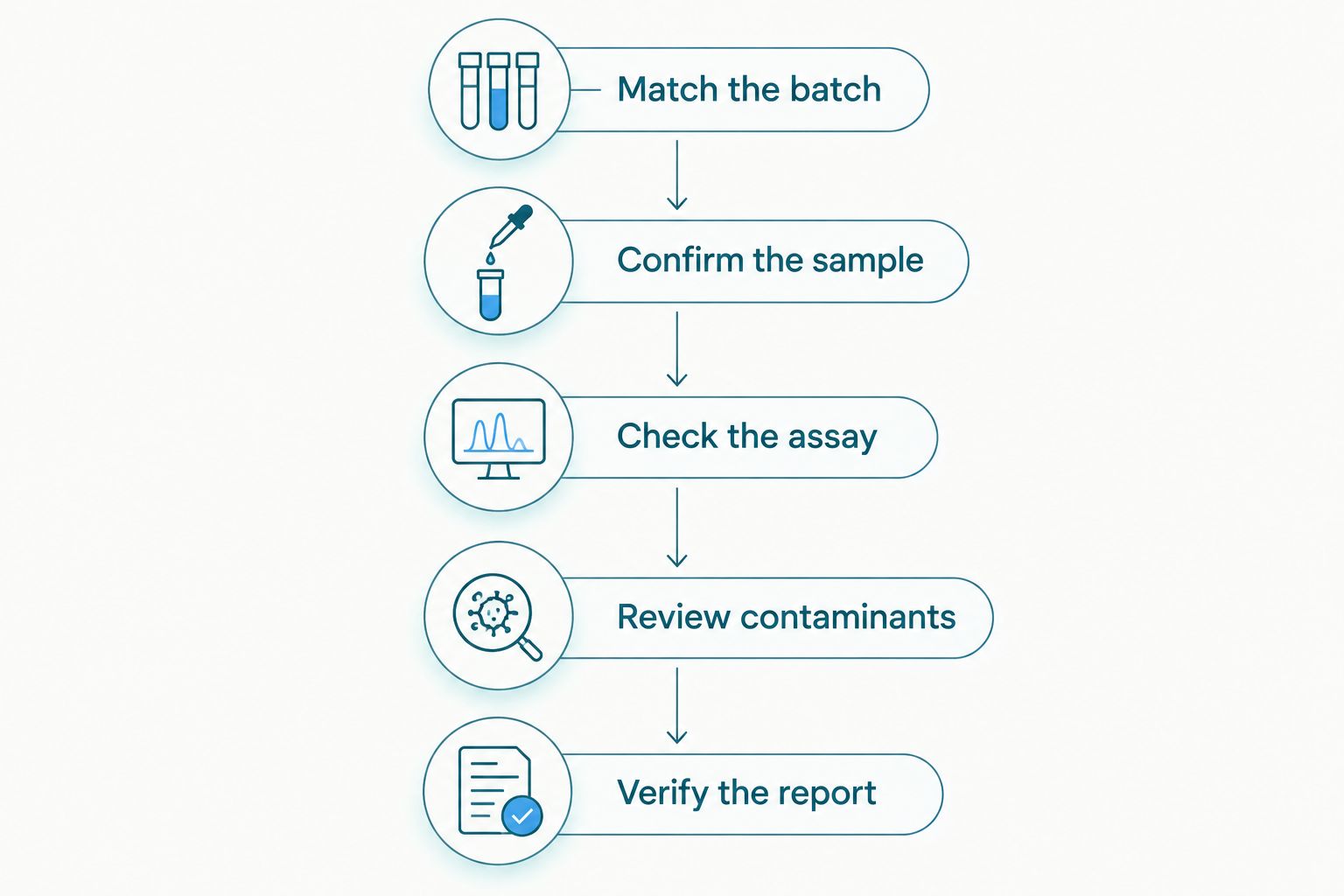
- Match the batch: Request documentation associated with the bottle’s lot number.
- Confirm the sample: Ask whether the report covers the finished formulation or only its ingredients.
- Check the assay: Request the measured potency, units, and specification.
- Review contaminants: Ask which contaminant and microbiological tests were performed.
- Verify the report: Clarify the laboratory, methods, and any ambiguous result notation.
This sequence gives you a practical stopping rule: if the documentation cannot establish the sample, its identity, and the meaning of its results, postpone the purchase until those questions are answered.
How does this apply to an NAD+ nasal spray?
When reviewing Synchronicity’s NAD+ Nasal Spray, apply the finished-liquid questions above: batch correspondence, ingredient identity, concentration, and relevant microbiological testing. When you read ingredient studies, note the delivery route each one used.
Synchronicity is an option for adults comparing NAD+ nasal sprays; batch-specific evidence remains the deciding quality check. A COA can help assess the tested formulation.
Product quality and suitability are separate decisions. Ask a clinician or pharmacist to review use if you take medicines, are pregnant or breastfeeding, or have a medical condition. Stop using a nasal product and seek advice if it causes persistent irritation or other concerning symptoms.
What does an NAD+ COA tell you?
An NAD+ COA reports analytical findings about a sample, such as identity, potency, and contaminant results for the tested batch. Human outcomes are a separate question, studied in human research on a specific formulation, route, and dose.
Does a COA measure absorption?
A COA does not measure absorption. It reports results such as a purity percentage or concentration for the tested sample, while absorption is measured in human studies of exposure.
Can a COA establish shelf life after opening?
A batch COA alone does not establish shelf life after opening. Stability and in-use testing address changes over time under specified storage and handling conditions; a release result is not a substitute for those studies.
Featured in this article
NAD+ Nasal SpraySupports cellular energy, focus and healthy aging. A needle-free alternative to NAD+ IV.
Shop NAD+ Nasal SprayThird-party tested ingredients. Vegan, non-GMO, made in the USA.
Sources
- NIH Office of Dietary Supplements. Dietary Supplements: What You Need to Know. ODS
- Electronic Code of Federal Regulations. 21 CFR 111.70: What specifications must you establish? eCFR
- ICH Topic Q2(R1). Validation of Analytical Procedures: Text and Methodology. European Medicines Agency. EMA
- Fong Sam J et al. Determination of toxic elements in botanical dietary supplement ingredient reference materials. Journal of AOAC International, 2024. PubMed
- Wolfe KD et al. Long-term stability of nicotinamide cofactors in common aqueous buffers: implications for cell-free biocatalysis. Molecules, 2024. PubMed
- Damgaard MV, Treebak JT. What is really known about the effects of nicotinamide riboside supplementation in humans. Science Advances, 2023. PubMed
FAQ
What’s the best NAD supplement certificate of analysis to look for?
The best NAD supplement certificate of analysis matches your lot and identifies the tested sample, methods, results, units, and specifications. For a finished product, look for documentation covering the formulation rather than only the raw ingredient.
What does third-party testing show for an NAD+ supplement?
Third-party laboratory results assess specified quality attributes, such as identity, potency, and contaminants, for the tested batch.
Does not detected mean an NAD+ supplement contains no contaminants?
Not detected means the method did not detect the specified contaminant under its testing conditions. It does not establish absolute absence or address contaminants that were not tested.
Is an NAD+ powder COA enough for a nasal spray?
An NAD+ powder COA does not establish all the quality attributes of a finished nasal spray. Finished-liquid concentration and relevant microbiological testing answer additional questions.
How do I check whether a laboratory certificate is genuine?
Check the laboratory identity, report identifier, lot number, dates, and sample description, then request verification through independently confirmed laboratory contact details. A professional-looking PDF alone does not authenticate a report.
Does a passed microbial test mean my nasal spray is sterile?
A passed microbial test does not mean a nasal spray is sterile. Sterility requires separate supporting evidence; microbial limits testing and sterility testing answer different questions.
Can I choose an NAD+ dose from its certificate of analysis?
A certificate of analysis is not a dosing guide. Use the product’s directions and seek individualized clinical advice when medicines, pregnancy, breastfeeding, or medical conditions affect suitability.
One last thing
The most useful detail can be the sample description, not the purity percentage. A technically sound result becomes misleading when you apply it to a different formulation or batch.
Before your next 2026 purchase, match the bottle to the report and write down what remains untested. That habit gives you a clearer decision than reading a COA as an all-purpose endorsement.


Leave a comment
All comments are moderated before being published.
This site is protected by hCaptcha and the hCaptcha Privacy Policy and Terms of Service apply.