
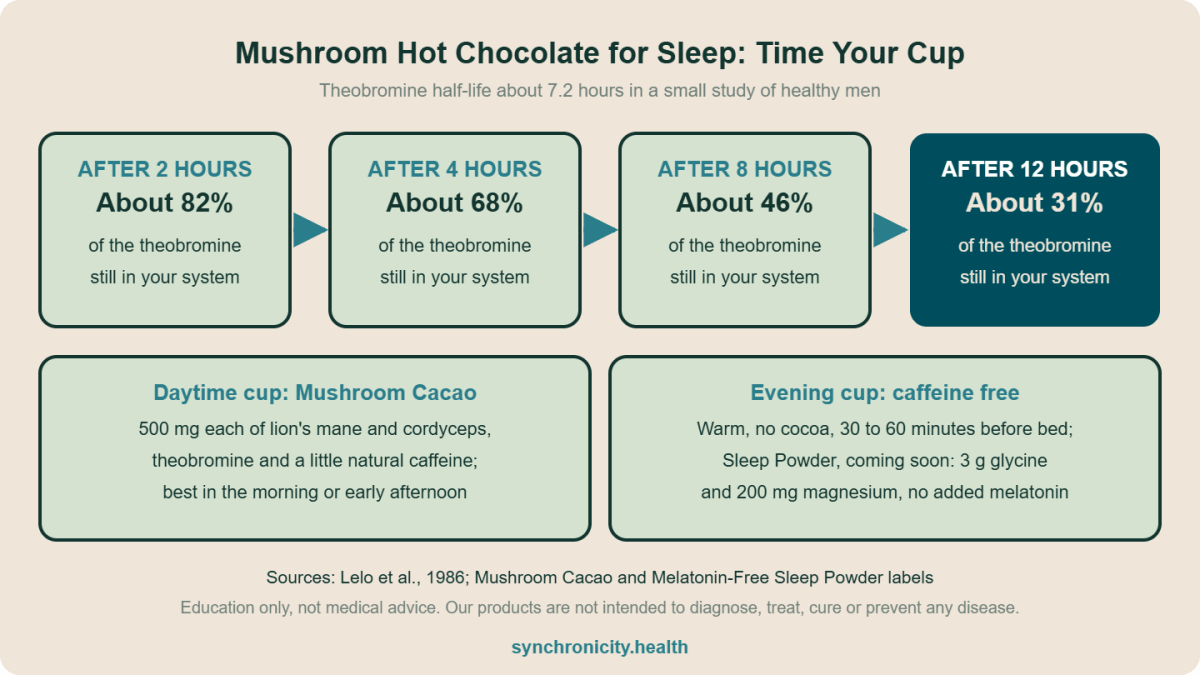
Mushroom hot chocolate is not a sleep drink. Most blends pair cocoa, which carries theobromine and a small amount of natural caffeine, with lion's mane and cordyceps, two mushrooms people use for daytime focus and energy. Theobromine has a half-life of about 7 hours, so a cup is best in the morning or early afternoon. For a warm cup at night, choose something caffeine free built for winding down.
Key Takeaways
- Cocoa's main stimulant is theobromine, which lasted longer in the body than caffeine in a small study of healthy men: a half-life of about 7.2 hours against 4.1 hours for caffeine (Lelo et al., 1986).
- In 80 healthy adults, 250 mg of theobromine had limited effects people could feel, while higher amounts raised heart rate (Baggott et al., 2013).
- Cocoa and cacao also contain a little natural caffeine, so a mushroom hot chocolate is low in caffeine but not caffeine free.
- Lion's mane and cordyceps are daytime mushrooms; reishi is the mushroom most linked with sleep, mainly in animal studies.
- An evening cup works best when it is caffeine free, warm and built around ingredients studied for sleep, such as glycine and magnesium.

Featured in this article
Mushroom CacaoA mushroom hot chocolate made with cocoa and cacao, with 500 mg each of lion's mane and cordyceps per serving and 0g sugar.
Shop Mushroom CacaoThird-party tested ingredients. 15 calories per serving.
Does Mushroom Hot Chocolate Help You Sleep?
The honest answer is no, not the usual kind. A mushroom hot chocolate is cocoa or cacao plus mushroom extracts, and our guide to mushroom hot chocolate covers what goes into a cup and how to make it. The cocoa base brings theobromine and a small amount of caffeine, both of which gently lift alertness. The most common mushrooms, lion's mane and cordyceps, are the ones people reach for when they want to feel sharp and energized.
That makes it a good morning or early afternoon drink, and a poor choice right before bed. The warmth and ritual of a hot drink can feel calming, but what is in the cup matters more than how it feels in your hands. The rest of this guide covers why, how late you can have a cup, and what an evening cup should look like instead.
Does Theobromine Keep You Awake?
Theobromine is the main natural stimulant in cocoa. It belongs to the same family as caffeine, but it is milder. In a placebo-controlled lab study, 80 healthy adults took 250, 500 or 1,000 mg of theobromine, or 200 mg of caffeine for comparison, on separate occasions. Caffeine produced the expected feelings of alertness. Theobromine at 250 mg had limited effects people could feel, higher doses brought less pleasant moods, and heart rate rose as the dose went up (Baggott et al., 2013). The authors concluded that in normal amounts, theobromine may add to the pleasant effects of chocolate.
So theobromine is not a strong wake-up compound, but it is not a sleep aid either. The bigger issue for bedtime is how long it lasts. When six healthy men took each compound by mouth on separate days, theobromine had a half-life of about 7.2 hours, compared with about 4.1 hours for caffeine (Lelo et al., 1986). Our guide to theobromine vs caffeine compares how the two feel, and our theobromine page covers the compound itself.
Theobromine and Caffeine Timing: How Much Is Left at Bedtime
Using the half-lives above, here is roughly how much of a cup's theobromine and caffeine is still in your system after a given number of hours. Everyone clears these compounds at their own pace, so use this as a rough guide, not a rule.
| Hours between your cup and bed | Theobromine still in your system | Caffeine still in your system |
|---|---|---|
| 2 hours | About 82% | About 71% |
| 4 hours | About 68% | About 51% |
| 8 hours | About 46% | About 26% |
| 12 hours | About 31% | About 13% |
A cup at 7 PM with a 10 PM bedtime leaves about three quarters of its theobromine on board when you lie down. A cup at 8 AM leaves less than a third by 10 PM. For caffeine, a 2023 review of 24 studies found that caffeine reduced total sleep time by about 45 minutes on average, and estimated that a 250 mL cup of coffee with 107 mg of caffeine should be finished at least 8.8 hours before bed to avoid losing sleep (Gardiner et al., 2023). A mushroom hot chocolate has far less caffeine than coffee, but its theobromine lasts longer, so the same habit works well: enjoy it before mid afternoon. If you are sensitive to stimulants, make it a morning drink. Our guide to whether hot chocolate is good for you covers sugar and caffeine in regular cocoa, and cacao benefits covers the bean itself.
Which Mushrooms Have Been Studied for Sleep?
Not all functional mushrooms do the same job, and the ones in most mushroom hot chocolates are daytime picks.
- Reishi is the mushroom most often linked with sleep. In rats, a reishi fruiting body extract given for 3 days increased total sleep time and non-REM sleep (Cui et al., 2012). This was an animal study, so it shows why researchers are interested in reishi rather than what it does in people.
- Cordyceps is mostly used for energy and exercise. Our guide on whether cordyceps keeps you awake explains why many people take it earlier in the day.
- Lion's mane is used for focus and mental clarity, which is why it fits a morning cup better than a bedtime one.
So if a mushroom drink is sold for sleep, check which mushrooms it contains and whether the cocoa base adds theobromine and caffeine.
What Makes an Evening Cup Work
If you love a warm drink at night, build it around these points:
- No caffeine and little theobromine. Skip cocoa, coffee and black or green tea in the evening. Plain warm milk and most herbal infusions, such as chamomile, are caffeine free.
- Warmth and ritual. A warm mug, dim light and a regular time help signal the end of the day. Our guide to drinks that help you sleep compares bedtime drinks one by one.
- Glycine. In people who were not sleeping well, 3 g of glycine before bed was followed by shorter time to fall asleep and to reach deep sleep, plus less daytime sleepiness (Yamadera et al., 2007).
- Magnesium. In 155 adults who reported poor sleep, 250 mg of magnesium as magnesium bisglycinate taken 30 to 60 minutes before bed for 4 weeks improved a sleep questionnaire score more than placebo, a small effect (Schuster et al., 2025).
- Timing. Have it 30 to 60 minutes before bed so you are not lying down on a full stomach, and keep the cup modest if night bathroom trips wake you.
Can You Have Both? A Day and Night Routine
Yes, and many people do. A simple routine is a mushroom hot chocolate in the morning or early afternoon, in place of a second coffee, and a caffeine-free wind-down drink in the evening. The two do different jobs at different times, so they fit together rather than compete. Keep the cocoa cup at least 8 hours before bed if you are sensitive, and keep anything with caffeine out of the evening entirely.
Who Might Choose Which Cup
| If you want | Choose | Best time |
|---|---|---|
| A gentle lift without a coffee crash | Mushroom hot chocolate with lion's mane and cordyceps | Morning to early afternoon |
| A chocolate cup in the evening | A small cup early in the evening, or a caffeine-free swap | Well before bed |
| A drink made for winding down | A caffeine-free drink with glycine and magnesium | 30 to 60 minutes before bed |
Where Our Mushroom Cacao Fits
Our Mushroom Cacao is a mushroom hot chocolate made with cocoa, cacao and a high polyphenol, high theobromine cocoa extract, plus 500 mg each of lion's mane and cordyceps 8:1 fruiting body extracts per serving. Stir one rounded teaspoon (5 g) into 6 to 8 oz of hot water or milk. Each serving has 15 calories and 0 g sugar, sweetened with stevia, and a jar holds 28 servings. Cocoa and cacao naturally contain a small amount of caffeine, so it is not caffeine free; its lift comes mainly from theobromine. That makes it a daytime cup, and we recommend enjoying it in the morning or early afternoon.
For the evening, our Melatonin-Free Sleep Powder is coming soon. It combines tart cherry, 3 g of glycine, 200 mg of magnesium from two gentle forms, myo-inositol and apigenin, mixed in water 30 to 60 minutes before bed, with no added melatonin, no 5-HTP and no added sugar or sweeteners. Join the waitlist on the product page to hear when it launches. For more on rest, visit our sleep health hub.

Featured in this article
Melatonin-Free Sleep PowderTart cherry powder and tart cherry extract with glycine, magnesium and apigenin in an unsweetened drink that helps you wind down at night, with no added melatonin.
Join the WaitlistComing soon. Third-party tested ingredients.
Frequently Asked Questions
Is mushroom hot chocolate good for sleep?
Not usually. Most blends contain cocoa's theobromine and a little caffeine plus lion's mane and cordyceps, which suit the daytime. Have it in the morning or early afternoon.
What is the best mushroom hot chocolate for sleep?
For sleep, look past cocoa entirely: a caffeine-free evening drink with ingredients studied for sleep, such as glycine and magnesium, is a better fit. Save mushroom hot chocolate for earlier in the day.
Does theobromine keep you awake?
It is a mild stimulant. In a study of 80 healthy adults, 250 mg had limited effects people could feel, while higher amounts raised heart rate, so sensitive sleepers may notice an evening cup.
How long does theobromine stay in your system?
In a small study of healthy men, its half-life was about 7.2 hours, so roughly half of a cup's theobromine is still there 7 hours later.
Is it OK to drink cacao before bed?
Cacao contains theobromine and a little caffeine, so a cup right before bed is not ideal. If you want one in the evening, keep it small and early.
Is theobromine or cacao powder good for sleep?
No. Theobromine is a gentle stimulant that lasts for hours, so cacao powder fits the morning better than the night.
What can I drink at night instead of hot chocolate?
Try a caffeine-free herbal infusion, warm milk or a wind-down drink with glycine and magnesium, about 30 to 60 minutes before bed.
Does Mushroom Cacao have caffeine?
A small amount, from the cocoa and cacao. Its lift comes mainly from theobromine, which is why we suggest it as a morning or early afternoon cup.
Sources
- Lelo A, Birkett DJ, Robson RA, Miners JO. Comparative pharmacokinetics of caffeine and its primary demethylated metabolites paraxanthine, theobromine and theophylline in man. British Journal of Clinical Pharmacology, 1986. https://pubmed.ncbi.nlm.nih.gov/3756065/
- Baggott MJ, Childs E, Hart AB, et al. Psychopharmacology of theobromine in healthy volunteers. Psychopharmacology, 2013. https://pubmed.ncbi.nlm.nih.gov/23420115/
- Gardiner C, Weakley J, Burke LM, et al. The effect of caffeine on subsequent sleep: a systematic review and meta-analysis. Sleep Medicine Reviews, 2023. https://pubmed.ncbi.nlm.nih.gov/36870101/
- Cui XY, Cui SY, Zhang J, et al. Extract of Ganoderma lucidum prolongs sleep time in rats. Journal of Ethnopharmacology, 2012. https://pubmed.ncbi.nlm.nih.gov/22207209/
- Yamadera W, Inagawa K, Chiba S, et al. Glycine ingestion improves subjective sleep quality in human volunteers, correlating with polysomnographic changes. Sleep and Biological Rhythms, 2007. https://doi.org/10.1111/j.1479-8425.2007.00262.x
- Schuster J, Cycelskij I, Lopresti A, Hahn A. Magnesium bisglycinate supplementation in healthy adults reporting poor sleep: a randomized, placebo-controlled trial. Nature and Science of Sleep, 2025. https://doi.org/10.2147/NSS.S524348
These statements have not been evaluated by the Food and Drug Administration. This content is for education and is not medical advice. Our products are not intended to diagnose, treat, cure or prevent any disease. Talk with a healthcare provider before starting a new supplement if you are pregnant, breastfeeding or taking medication.


Leave a comment
All comments are moderated before being published.
This site is protected by hCaptcha and the hCaptcha Privacy Policy and Terms of Service apply.