
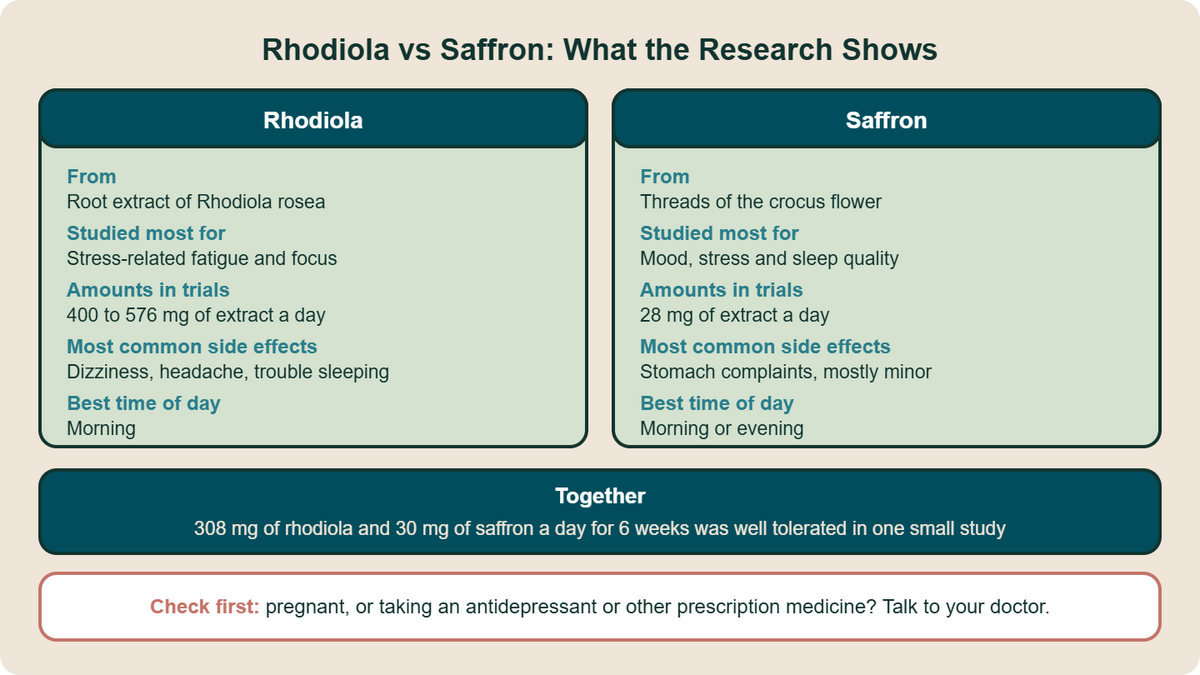
Rhodiola and saffron are both plant extracts people take for stress and mood, but the research points them in different directions. Rhodiola has been studied mostly for stress-related fatigue and staying sharp under pressure, while saffron has been studied mostly for mood. You can take them together, and one small study that gave both for 6 weeks found the pair well tolerated. Here is how they compare, what the trials used and who should check with a doctor first.
Key Takeaways
- Rhodiola is a root extract studied mostly for stress-related fatigue and mental performance under pressure; saffron comes from the threads of the crocus flower and has been studied mostly for mood.
- In 60 adults with long-term stress-related fatigue, 576 mg of rhodiola extract a day for 28 days improved fatigue scores and attention tests more than placebo (Olsson et al., 2009).
- In 128 healthy adults with low mood, 28 mg of saffron extract a day for 4 weeks improved mood scores more than placebo (Kell et al., 2017).
- One small 6-week study gave 308 mg of rhodiola and 30 mg of saffron a day together, and the combination was well tolerated (Bangratz et al., 2018).
- Both are generally well tolerated. Skip saffron supplements in pregnancy unless your doctor approves, and talk to your doctor before either one if you take an antidepressant or other prescription medicine.

Featured in this article
Clarity CapsulesRhodiola rosea extract 150 mg per 2-capsule serving, with lion's mane, bacopa, maca, epimedium and huperzine A, to support focus and mental clarity.
Shop Clarity CapsulesThird-party tested ingredients. Vegan capsules, made in the USA.
Rhodiola vs Saffron at a Glance
Rhodiola (Rhodiola rosea) is a plant from cold, mountain regions, and supplements use an extract of its root. Saffron (Crocus sativus) is the red thread inside the crocus flower, the spice used in cooking, given in supplements as an extract measured in milligrams. Here is how the two compare:
| Rhodiola | Saffron | |
|---|---|---|
| What it is | Root extract of Rhodiola rosea | Extract of the threads (stigmas) of the crocus flower |
| Studied most for | Stress-related fatigue, focus and mental performance under pressure | Mood, everyday stress and sleep quality |
| Amounts in the trials below | 400 to 576 mg of extract a day | 28 mg of extract a day, once or as 14 mg twice |
| Trial length | 2 to 4 weeks | 4 weeks |
| Most common side effects | Dizziness, headache, trouble sleeping, dry mouth or extra saliva | Stomach complaints, mostly minor and short-lived |
| Best time of day | Morning, since it can affect sleep in some people | Morning or evening, at the same time each day |
For more on the root itself, see our rhodiola rosea ingredient page.
Rhodiola: Stress, Fatigue and Focus
Most rhodiola trials look at people under strain. Three show the pattern:
- Stress-related fatigue. In a randomized, placebo-controlled trial of 60 adults aged 20 to 55 with long-term stress-related fatigue, 576 mg of rhodiola extract a day for 28 days improved fatigue scores and several attention test measures more than placebo, and changed the morning cortisol response. No serious side effects were linked to the extract (Olsson et al., 2009).
- Night shifts. In a double-blind crossover study of 56 young, healthy doctors on night duty, a daily rhodiola tablet for 2 weeks improved scores on tests of short-term memory, calculation, concentration and reaction speed compared with placebo, with no side effects reported (Darbinyan et al., 2000).
- Everyday life stress. In an open study of 101 adults with life-stress symptoms, where everyone took rhodiola, 200 mg twice a day for 4 weeks was followed by better scores for stress, fatigue and concentration. Side effects were mostly mild (Edwards et al., 2012).
For the full picture, read our guides to rhodiola rosea benefits and rhodiola vs ashwagandha.
Saffron: Mood, Stress and Sleep Quality
Saffron research centers on mood. In a randomized, placebo-controlled trial of 128 healthy adults who reported low mood, 28 mg of saffron extract a day for 4 weeks improved overall mood scores more than placebo and was taken without side effects. The effect was seen at 28 mg, not at a lower 22 mg dose (Kell et al., 2017).
Saffron has also been studied for sleep. In a 28-day trial of 63 healthy adults with self-reported poor sleep, 14 mg of saffron extract twice a day improved sleep quality ratings more than placebo, and it was well tolerated (Lopresti et al., 2020).
Our guide to saffron supplement benefits covers the wider research, and saffron vs ashwagandha compares it with another popular choice.
Rhodiola or Saffron: Which Fits Your Goal?
Because they have been studied for different things, the better choice depends on what you want support with:
- Tired and foggy from a heavy workload: rhodiola fits best, since its trials measured fatigue, attention and mental performance under stress.
- Low mood or a heavy emotional load: saffron fits best, since its trials measured mood scores.
- Unsettled sleep: saffron has been studied for sleep quality, while rhodiola is better taken in the morning because trouble sleeping is one of its listed side effects.
- A bit of both: taking the two together is an option, rhodiola in the morning for daytime steadiness and saffron for mood.
Can You Take Rhodiola and Saffron Together?
Yes. The two have been given together in one published study. It was a small open study, without a placebo group, in 45 adults. Each person took 308 mg of rhodiola and 30 mg of saffron a day for 6 weeks. Six people reported a side effect, nine events in all, such as stomach pain, dizziness or dry mouth; all were mild, all cleared before the end of the study, and there were no serious ones (Bangratz et al., 2018).
If you take both, take rhodiola in the morning and stay at the label amount of each.
Safety: Side Effects and Who Should Check First
Both are generally well tolerated at supplement amounts. The National Center for Complementary and Integrative Health lists dizziness, headache, trouble sleeping and dry mouth or extra saliva as possible rhodiola side effects, describes it as possibly safe for up to 12 weeks, and notes reported interactions with losartan, a blood pressure medicine (NCCIH). For saffron, a 2026 review of 102 clinical trials found it generally well tolerated, with stomach problems the most common complaint, mostly minor and short-lived. The authors suggest clinical monitoring at higher doses or with long use (Hasheminasab et al., 2026).
- Pregnancy and breastfeeding: skip saffron supplements unless your doctor approves; little is known about rhodiola in pregnancy or breastfeeding, so ask your doctor first.
- Antidepressants and other mood medicines: talk to your doctor before taking rhodiola, saffron or both, and never stop or change a prescribed medicine on your own.
- Blood pressure medicine or sedatives: check with your doctor first.
- Any prescription medicine: show your doctor the full label of any blend.
More detail is in our guide to saffron side effects.
Where Our Products Fit
Our Clarity Capsules contain rhodiola rosea extract 150 mg per 2-capsule serving, together with lion's mane 8:1 fruiting body extract 250 mg, epimedium extract 200 mg, maca root extract 200 mg, bacopa monnieri extract 200 mg and huperzine A 200 mcg, with ginger extract in vegan capsules. The suggested use is 2 capsules daily, preferably in the morning on an empty stomach, or as recommended by your healthcare practitioner. They are made with third-party tested ingredients.
Our Saffron Mood and Calm Capsules pair saffron extract 28 mg with L-theanine 200 mg per serving in the planned formula, the same saffron amount used in the 4-week mood trial above. They are coming soon: join the waitlist on the product page to hear when they launch. For a wider view of the options, see best supplements for stress and mood and our stress, mood and nervous system guide.

Featured in this article
Saffron Mood and Calm CapsulesSaffron extract 28 mg with L-theanine 200 mg per serving in the planned formula, for a steadier mood and a calmer day.
Join the WaitlistComing soon. Third-party tested ingredients.
Frequently Asked Questions
What is the difference between rhodiola and saffron?
Rhodiola is a root extract studied mostly for stress-related fatigue, focus and mental performance under pressure. Saffron is an extract of the crocus flower's threads studied mostly for mood, and also for sleep quality. Trials used larger amounts of rhodiola, 400 to 576 mg a day, than of saffron, about 28 mg a day.
Is rhodiola or saffron better for stress?
It depends on how stress shows up for you. If it feels like tiredness and fog after long, demanding days, rhodiola is the closer fit, since its trials measured fatigue and attention under pressure. If it shows up mostly as low or unsettled mood, saffron is the closer fit, since its trials measured mood scores. Some people take both.
Is rhodiola or saffron better for mood?
Saffron is the one most studied for mood. In 128 healthy adults with low mood, 28 mg of saffron extract a day for 4 weeks improved mood scores more than placebo. Rhodiola research focuses more on fatigue and mental performance under stress, although mood questionnaires were part of some of its trials.
Can you take rhodiola and saffron together?
Yes. One small 6-week study gave 308 mg of rhodiola and 30 mg of saffron a day together, and the side effects reported were few and mild. Take rhodiola in the morning and stay at each label amount. Talk to your doctor first if you take an antidepressant or other prescription medicine.
Which is better for energy and focus, rhodiola or saffron?
Rhodiola. Its trials measured attention, short-term memory, concentration and fatigue in people under strain, such as doctors on night duty and adults with long-term stress-related fatigue. Saffron research centers on mood and sleep quality rather than focus. Our Clarity Capsules pair rhodiola with lion's mane, bacopa and huperzine A to support focus.
Is rhodiola or saffron better for sleep?
Saffron. In a 28-day trial of adults with self-reported poor sleep, 14 mg of saffron extract twice a day improved sleep quality ratings more than placebo. Rhodiola is a daytime choice, and trouble sleeping is one of its listed side effects, so take it in the morning rather than in the evening.
How long do rhodiola and saffron take to work?
The trials here gave them every day and measured changes after 2 to 6 weeks, with 4 weeks in the main rhodiola and saffron trials. How soon you notice anything varies from person to person, so steady daily use at the label amount is the usual approach.
Who should not take rhodiola or saffron?
Skip saffron supplements during pregnancy or breastfeeding unless your doctor approves, and ask your doctor before rhodiola too, since little is known about its use then. If you take an antidepressant, blood pressure medicine, sedatives or any other prescription medicine, talk to your doctor before starting either one, and never change a prescribed medicine on your own.
Sources
- Olsson EM, et al. A randomised, double-blind, placebo-controlled, parallel-group study of the standardised extract SHR-5 of the roots of Rhodiola rosea in the treatment of subjects with stress-related fatigue. Planta Medica, 2009. https://pubmed.ncbi.nlm.nih.gov/19016404/
- Darbinyan V, et al. Rhodiola rosea in stress induced fatigue: a double blind cross-over study of a standardized extract SHR-5 with a repeated low-dose regimen on the mental performance of healthy physicians during night duty. Phytomedicine, 2000. https://pubmed.ncbi.nlm.nih.gov/11081987/
- Edwards D, Heufelder A, Zimmermann A. Therapeutic effects and safety of Rhodiola rosea extract WS 1375 in subjects with life-stress symptoms: results of an open-label study. Phytotherapy Research, 2012. https://pubmed.ncbi.nlm.nih.gov/22228617/
- Kell G, et al. affron, a novel saffron extract (Crocus sativus L.), improves mood in healthy adults over 4 weeks in a double-blind, parallel, randomized, placebo-controlled clinical trial. Complementary Therapies in Medicine, 2017. https://pubmed.ncbi.nlm.nih.gov/28735826/
- Lopresti AL, Smith SJ, Metse AP, Drummond PD. Effects of saffron on sleep quality in healthy adults with self-reported poor sleep: a randomized, double-blind, placebo-controlled trial. Journal of Clinical Sleep Medicine, 2020. https://pubmed.ncbi.nlm.nih.gov/32056539/
- Bangratz M, Ait Abdellah S, Berlin A, et al. A preliminary assessment of a combination of rhodiola and saffron in the management of mild-moderate depression. Neuropsychiatric Disease and Treatment, 2018. https://pubmed.ncbi.nlm.nih.gov/30034237/
- Hasheminasab FS, Hajimonfarednejad M, Najibi SM, Hashempur MH. Adverse events of saffron (Crocus sativus L.): systematic review of current evidence. Health Science Reports, 2026. https://pubmed.ncbi.nlm.nih.gov/42057871/
- National Center for Complementary and Integrative Health. Rhodiola. https://www.nccih.nih.gov/health/rhodiola
These statements have not been evaluated by the Food and Drug Administration. This content is for education and is not medical advice. Our products are not intended to diagnose, treat, cure or prevent any disease. Talk with a healthcare provider before starting a new supplement if you are pregnant, breastfeeding or taking medication.


Leave a comment
All comments are moderated before being published.
This site is protected by hCaptcha and the hCaptcha Privacy Policy and Terms of Service apply.