
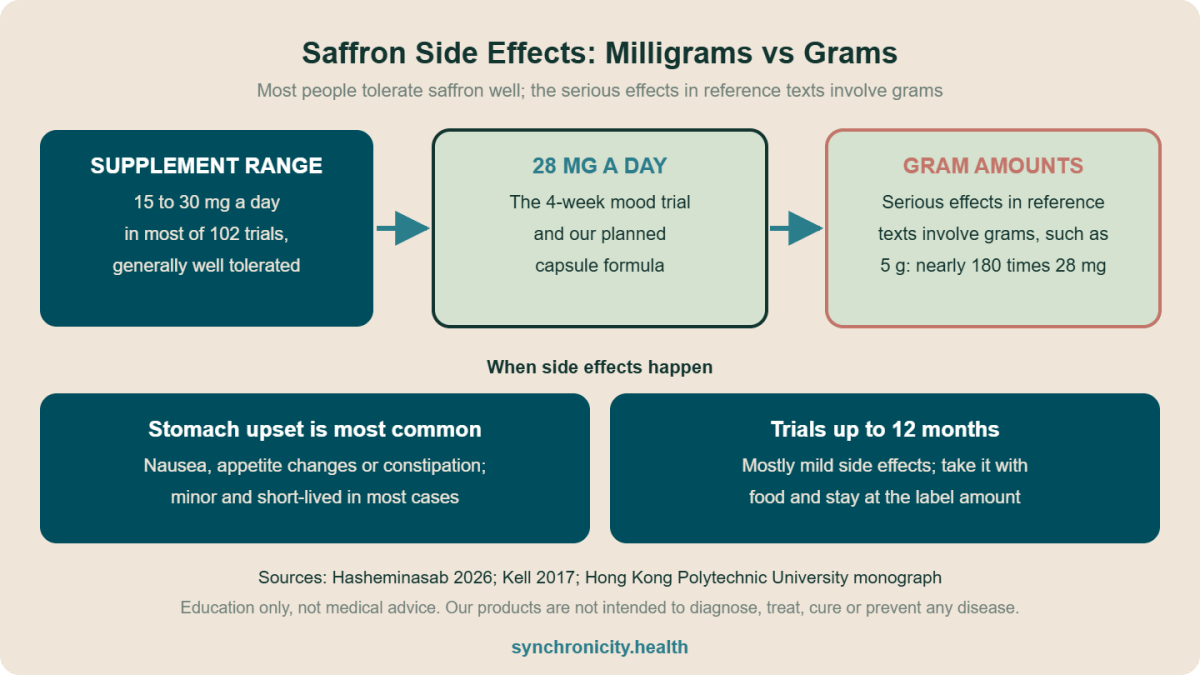
Most people tolerate saffron supplements well. A 2026 review of 102 clinical trials found saffron generally well tolerated, most trials used 15 to 30 mg a day, and the most common complaint was mild stomach upset that was minor and short-lived in most cases. The serious problems linked to saffron involve gram amounts, far above what a supplement provides. Check with your clinician first if you are pregnant or breastfeeding or take prescription medicine.
Key Takeaways
- Saffron was generally well tolerated across 102 clinical trials, most of which used 15 to 30 mg a day (Hasheminasab et al., 2026).
- Stomach complaints such as nausea, appetite changes or constipation were the most often reported, and were minor and short-lived in most cases.
- In the trials that reported side effects, a smaller share of people taking saffron reported one than people in the comparison groups.
- Trials lasting up to 12 months found mostly mild side effects.
- The cautions in reference texts involve grams of saffron, such as 5 g, while supplements provide milligrams (Hong Kong Polytechnic University).

Featured in this article
Saffron Mood and Calm CapsulesSaffron extract 28 mg with L-theanine 200 mg per serving in the planned formula, for a steadier mood and a calmer day.
Join the WaitlistComing soon. Third-party tested ingredients.
Is Saffron Safe? What the Trials Found
The broadest look at saffron's safety is a 2026 systematic review that gathered side effect data from 102 clinical trials of saffron stigma powder and extracts. Most trials used 15 to 30 mg a day, often split into two doses, and they ran from a single dose up to 12 months. The authors concluded that saffron is generally well tolerated (Hasheminasab et al., 2026).
A reassuring detail sits in the numbers. Across the 44 trials that reported side effects, about 30 percent of people in the saffron groups reported one, compared with about 44 percent in the comparison groups, which included placebo. The authors did not run a formal statistical test on this, but it shows how often everyday complaints turn up whether or not someone takes saffron.
Individual trials tell the same story:
- In a 4-week mood trial of 128 adults, the authors reported that 28 mg a day of saffron extract was taken without side effects (Kell et al., 2017).
- In a 28-day sleep trial of 63 healthy adults, 14 mg twice a day was well tolerated with no reported adverse effects (Lopresti et al., 2020).
- In a 6-week trial of 66 adults, mild or moderate side effects were about as common with 15.5 mg a day of saffron extract as with placebo, and there were no serious ones (Pachikian et al., 2021).
Common Saffron Side Effects
When side effects do turn up, the review grouped them like this (Hasheminasab et al., 2026):
| Type | Examples | How often reported | What helps |
|---|---|---|---|
| Stomach | Nausea, appetite changes, constipation, stomach discomfort | Most often | Take it with a meal; stay at the label amount |
| Head and energy | Headache, tiredness, dizziness | Second most often | Try a different time of day; check with your clinician if it lasts |
| Mood and nerves | Nervousness, irritability | Less often | Stop and talk with your clinician if it does not settle |
| Heart rhythm | Palpitations | Rare | Stop and talk with your clinician |
Most of these were classed as mild to moderate. Our guide to saffron supplement benefits covers what the same trials found on the benefit side.
Saffron and Your Stomach
Stomach complaints were the most common type of side effect in the review, and the authors described them as minor and self-limiting in most cases (Hasheminasab et al., 2026). A few simple habits keep most people comfortable:
- Take it with food. A meal or snack is the easiest way to settle a sensitive stomach.
- Split the dose. Some trials gave 14 mg twice a day rather than 28 mg at once (Lopresti et al., 2020), so splitting is a reasonable option if your label allows it.
- Stay at the studied amount. More is not better: in the 4-week mood trial, 28 mg a day was the amount that worked (Kell et al., 2017).
Is Saffron Safe to Take Every Day and Long Term?
Daily use is exactly how saffron has been studied. The trials above gave it every day for 4 to 6 weeks, and the review included trials lasting up to 12 months, which found mostly mild side effects (Hasheminasab et al., 2026). In one 12-month trial included in the review, both the saffron supplement and the placebo were well tolerated with no major or minor side effects reported.
The review's authors suggest clinical monitoring for higher doses or very long use. In practice, if you plan to take saffron for many months, stick to the label amount and mention it at your next checkup. That keeps you within the range the research covers.
How Much Saffron Is Too Much?
The gap between a supplement and a harmful amount is very wide. Saffron supplements are measured in milligrams, while the serious effects described in reference texts involve grams.
| Amount | Where it comes from |
|---|---|
| 15 to 30 mg a day | The range used in most of the 102 trials in the 2026 review |
| 28 mg a day | The amount in the 4-week mood trial and in our planned capsule formula |
| 5 g or more | Gram amounts of the spice, nearly 180 times 28 mg; this is where reference texts place their cautions |
The same monograph advises avoiding more than 5 g a day in pregnancy (Hong Kong Polytechnic University). None of that applies to a standard daily capsule; it is the reason to stick with your label and never stack several saffron products. Our saffron extract ingredient page covers amounts and standardization in more detail.
Who Should Check With a Clinician First
- Pregnancy and breastfeeding: skip saffron supplements unless your clinician approves; cooking amounts are a separate question.
- Prescription medicine: if you take any prescription medicine, check with your clinician before starting saffron.
- Long or high use: if you want to take more than the label amount, or plan many months of use, talk it through with your clinician first.
If you notice anything that worries you, stop and talk with your clinician. For how saffron compares with another popular option on safety, see saffron vs ashwagandha and ashwagandha side effects, and for a wider view, best supplements for stress and mood and our stress, mood and nervous system guide. To see how saffron and rhodiola compare on benefits and side effects, read our guide to rhodiola vs saffron.
Where Our Saffron Mood and Calm Capsules Fit
Our Saffron Mood and Calm Capsules pair saffron extract 28 mg with L-theanine 200 mg per serving in the planned formula, so the saffron sits right in the range the trials used. They are coming soon: join the waitlist on the product page to hear when they launch, and no payment is taken now. Directions will be on the label at launch.
L-theanine has a gentle safety record of its own, covered in our guide to L-theanine side effects. If you want it on its own today, our Theanine Nasal Spray gives 36 mg of L-theanine in every 2-spray serving, with alkaline water as the only other ingredient. It is caffeine-free, made with third-party tested ingredients, and absorbed through the lining of the nose, so some of each dose skips digestion.
Saffron's benefits build with consistent daily use. Months 1 to 2 can bring early changes, and 3 months and beyond is where the full benefit builds.

Featured in this article
Theanine Nasal Spray36 mg of L-theanine per serving, caffeine-free, to pair with your coffee or tea.
Shop Theanine Nasal SprayThird-party tested ingredients. Vegan, non-GMO, made in the USA.
Frequently Asked Questions
What are the side effects of saffron supplements?
Most people tolerate saffron well. When side effects happen, they are usually mild stomach upset, and less often headache, tiredness or dizziness.
Is saffron safe to take every day?
Yes, daily use is how the trials gave it, mostly at 15 to 30 mg a day. Follow your label and check with your clinician first if you take prescription medicine.
Is saffron safe long term?
Trials lasting up to 12 months found mostly mild side effects. For many months of use, stay at the label amount and mention it to your clinician.
How long can you take a saffron supplement?
Trials have run from a few weeks to 12 months of daily use. Benefits build over months, so steady use at the label amount is the usual approach.
Does saffron upset your stomach?
It can in some people. Stomach complaints were the most common side effect, but minor and short-lived in most cases; taking it with food helps.
What are the side effects of saffron extract compared with saffron spice?
The 2026 review covered both stigma powder and extracts at milligram amounts and found saffron generally well tolerated. The serious effects in reference texts involve grams, not the milligrams in a capsule.
How much saffron is too much?
Supplements use milligrams, while problems in reference texts start at gram amounts, such as 5 g. Stay at your label amount and do not combine several saffron products.
Who should not take saffron supplements?
Skip them during pregnancy or breastfeeding unless your clinician approves, and check with your clinician first if you take prescription medicine.
Sources
- Hasheminasab FS, Hajimonfarednejad M, Najibi SM, Hashempur MH. Adverse events of saffron (Crocus sativus L.): systematic review of current evidence. Health Science Reports, 2026. https://pubmed.ncbi.nlm.nih.gov/42057871/
- Kell G, et al. affron, a novel saffron extract (Crocus sativus L.), improves mood in healthy adults over 4 weeks in a double-blind, parallel, randomized, placebo-controlled clinical trial. Complementary Therapies in Medicine, 2017. https://pubmed.ncbi.nlm.nih.gov/28735826/
- Lopresti AL, Smith SJ, Metse AP, Drummond PD. Effects of saffron on sleep quality in healthy adults with self-reported poor sleep: a randomized, double-blind, placebo-controlled trial. Journal of Clinical Sleep Medicine, 2020. https://pubmed.ncbi.nlm.nih.gov/32056539/
- Pachikian BD, Copine S, Suchareau M, Deldicque L. Effects of saffron extract on sleep quality: a randomized double-blind controlled clinical trial. Nutrients, 2021. https://pubmed.ncbi.nlm.nih.gov/33925432/
- Hong Kong Polytechnic University. Saffron (Stigma Croci). Chinese medicine database. https://herbaltcm.sn.polyu.edu.hk/herbal/saffron
These statements have not been evaluated by the Food and Drug Administration. This content is for education and is not medical advice. Our products are not intended to diagnose, treat, cure or prevent any disease. Talk with a healthcare provider before starting a new supplement if you are pregnant, breastfeeding or taking medication.

Leave a comment
All comments are moderated before being published.
This site is protected by hCaptcha and the hCaptcha Privacy Policy and Terms of Service apply.