
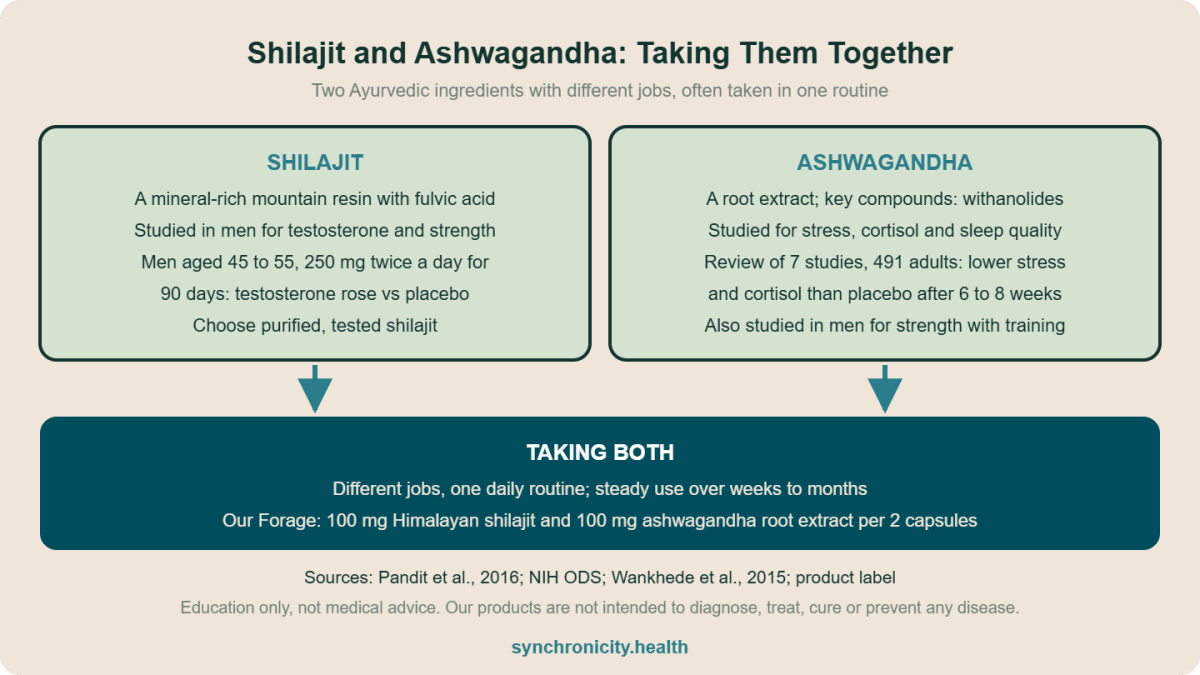
Shilajit and ashwagandha are two classic Ayurvedic ingredients that do different jobs, so many people take them together. Shilajit is a mineral-rich resin from mountain rock, studied in men for testosterone and for holding on to strength when muscles tire. Ashwagandha is a root studied mainly for everyday stress, cortisol and sleep quality, and also in men for testosterone and strength gains with training. Our Forage contains 100 mg of each.
Key Takeaways
- Shilajit is a mineral-rich resin formed over centuries in high mountain rock, and it contains fulvic acid and trace minerals.
- In healthy men aged 45 to 55, 250 mg of purified shilajit twice a day for 90 days raised total and free testosterone compared with placebo (Pandit et al., 2016).
- Ashwagandha is a root; a review of 7 studies with 491 adults found lower stress and cortisol than placebo after 6 to 8 weeks (NIH ODS).
- In 57 men on an 8-week strength program, 300 mg of ashwagandha root extract twice a day brought bigger strength gains than placebo, and testosterone rose more (Wankhede et al., 2015).
- You can take shilajit and ashwagandha together, and they suit the same morning routine. Choose purified, tested shilajit.

Featured in this article
ForageSeven functional mushroom fruiting body extracts, including lion's mane, plus Himalayan shilajit and ashwagandha root extract for everyday energy and resilience.
Shop ForageThird-party tested ingredients. Vegan capsules.
Shilajit vs Ashwagandha at a Glance
| Shilajit | Ashwagandha | |
|---|---|---|
| What it is | A mineral-rich resin from mountain rock | The root of an evergreen shrub (Withania somnifera) |
| Key compounds | Fulvic acid | Withanolides |
| Main focus of research | Testosterone in men, strength under fatigue | Everyday stress, cortisol and sleep quality |
| Studies in men | Testosterone, DHEAS, muscle strength | Testosterone, DHEA-S, strength with training |
| Amounts studied | 250 to 500 mg a day | 240 to 1,250 mg a day of extract |
| Trial length | 8 weeks to 90 days | 6 to 8 weeks in most trials |
Shilajit: What It Is and What Studies Measured
Shilajit is a naturally occurring, mineral-rich resin formed over centuries from plant material compressed in high mountain rock, and Himalayan shilajit is the best known kind. It contains fulvic acid and trace minerals, and in Ayurveda it has long been held in high regard as a rejuvenating substance. Most human research has looked at men:
- Testosterone. In a double-blind, placebo-controlled trial, healthy men aged 45 to 55 took 250 mg of purified shilajit twice a day for 90 days. Total testosterone, free testosterone and DHEAS all rose more than on placebo, while the hormones LH and FSH stayed steady (Pandit et al., 2016).
- Strength when muscles tire. In an 8-week trial, 63 recreationally active young men took 250 mg or 500 mg of shilajit a day, or a placebo, 21 per group. Among the men in the upper half for starting strength and for hydroxyproline, a marker linked to connective tissue, those on 500 mg lost about 9% of their strength after a tiring exercise test, compared with about 16% on placebo, and their resting hydroxyproline was lower. The 250 mg dose did not differ from placebo (Keller et al., 2019).
These are small trials, and they show what shilajit is studied for in men: hormone levels and muscle performance, over 8 weeks to 3 months of daily use. Our guides to shilajit benefits and how long shilajit takes to work go deeper, and our Himalayan shilajit ingredient page covers where it comes from.
Ashwagandha: What It Is and What Studies Measured
Ashwagandha is an evergreen shrub, also called winter cherry or Indian ginseng, though it is not a ginseng. It has been used in Ayurvedic medicine as an adaptogen, most supplements use the root, and its best known compounds are withanolides (NIH ODS).
- Stress and cortisol. A 2021 review of 7 studies with 491 adults found lower stress, sleeplessness, fatigue and blood cortisol than placebo after 6 to 8 weeks, at 240 to 1,250 mg a day of extract (NIH ODS).
- Sleep. A review of 5 trials with 400 adults found a small but significant benefit for sleep, larger at 600 mg a day or more and with 8 weeks or longer (Cheah et al., 2021).
Our guide to ashwagandha benefits covers dose and timing, and our ashwagandha ingredient page covers the root.
Shilajit and Ashwagandha Benefits for Men: What Was Measured
Both ingredients have been studied in men, mostly for hormone levels and strength. Here is what the trials measured, side by side:
| Study | Who and how long | What was measured |
|---|---|---|
| Shilajit, 500 mg a day | Healthy men aged 45 to 55, 90 days | Total and free testosterone and DHEAS rose more than on placebo |
| Shilajit, 500 mg a day | 63 active young men, 8 weeks | In the stronger half, less strength lost after a tiring test |
| Ashwagandha, 600 mg a day | 57 men aged 18 to 50 new to weight training, 8 weeks | Bigger gains in bench press, leg extension and muscle size; testosterone rose more |
| Ashwagandha extract, daily | 43 overweight men aged 40 to 70, 8 weeks | Testosterone rose 14.7% and DHEA-S 18% more than on placebo |
In the training trial, men took 300 mg of ashwagandha root extract twice a day alongside the same strength program as the placebo group (Wankhede et al., 2015). In the crossover trial, overweight men with mild fatigue took an extract giving 21 mg of withanolides a day; fatigue and vigor improved in both groups, with no difference between them (Lopresti et al., 2019). These results describe hormone levels and strength measured in each study, not a promise for every man. For the wider picture, see our practical guide to supplements that support testosterone.
Can You Take Shilajit and Ashwagandha Together?
Yes. No trial has tested the pair, so the evidence comes from each one on its own, but one is a mineral resin and the other a root, they act in different ways, and both come from the Ayurvedic tradition. Neither one's safety information lists the other as a concern.
Both are daily habits, and the trials above lasted 8 weeks to 90 days, so steady use matters more than timing. Taking them together in the morning is the simplest routine. If ashwagandha makes you a little drowsy, which the NIH lists as one of its mild side effects, move it to the evening. For guidance written for women, see our guides to shilajit for women and ashwagandha for women.
Who Might Choose Which
| Your main goal | A good fit |
|---|---|
| Handling everyday stress | Ashwagandha |
| Better sleep quality | Ashwagandha |
| Holding on to strength when muscles tire | Shilajit |
| Supporting healthy testosterone levels as a man | Either; both were studied |
| Calm and vitality in one routine | Both, in the morning |
Safety: What to Know About Each
Most people tolerate both well. Purified shilajit is generally well tolerated when it is sourced responsibly and tested. The main thing to watch is purity: raw, unprocessed shilajit may contain heavy metals or other impurities, so choose a purified product made with tested ingredients. Our shilajit side effects guide covers this in detail.
Most people tolerate ashwagandha well. In trials lasting up to about 3 months, side effects were mild, such as stomach upset, loose stools, nausea and drowsiness. Liver problems have been reported rarely. Some experts advise against it in pregnancy and breastfeeding, people with a thyroid condition or on thyroid medicine should check with their clinician first, and men with a hormone-sensitive condition should also check with their clinician first (NIH ODS). If you take any prescription medicine, ask your clinician before adding either.
Where Our Forage Fits
Our Forage puts both in one daily capsule. Each 2-capsule serving has 100 mg of Himalayan shilajit extract and 100 mg of ashwagandha root extract, alongside lion's mane, cordyceps and reishi at 200 mg each and chaga, maitake, turkey tail and shiitake at 150 mg each (all 8:1 fruiting body extracts), with ginger extract in vegan capsules. Take 2 capsules daily in the morning, with or without food. It is made with third-party tested ingredients. The trials above used each ingredient on its own and at their own amounts, so they describe the ingredients rather than our blend.
If you would like a warm drink as well, our Mushroom Cacao is a mushroom hot chocolate with 500 mg each of lion's mane and cordyceps 8:1 fruiting body extracts per serving, 15 calories and 0 g sugar, in a 28-serving jar. Cocoa and cacao naturally contain a small amount of caffeine, so it is not caffeine free. For more on calm and resilience, see our stress, mood and nervous system guide.
Benefits build with consistent daily use. Months 1 to 2 can bring early changes, and 3 months and beyond is where the full benefit builds.

Featured in this article
Mushroom CacaoA mushroom hot chocolate made with cocoa and cacao, with 500 mg each of lion's mane and cordyceps per serving and 0g sugar.
Shop Mushroom CacaoThird-party tested ingredients. 15 calories per serving.
Frequently Asked Questions
Can you take shilajit and ashwagandha together?
Yes. They work in different ways, come from the same Ayurvedic tradition, and neither one's safety information lists the other. Our Forage contains 100 mg of each.
Shilajit vs ashwagandha: which is better?
It depends on your goal. Ashwagandha has more research on stress, cortisol and sleep quality; shilajit has been studied in men for testosterone and for strength under fatigue.
What are the benefits of shilajit and ashwagandha for men?
In separate trials, both raised testosterone more than placebo in men over 8 to 13 weeks, shilajit helped active men hold on to strength in a tiring test, and ashwagandha brought bigger strength gains with training.
Is shilajit or ashwagandha better for testosterone?
Both were studied. Shilajit raised total and free testosterone in men aged 45 to 55 over 90 days; ashwagandha raised testosterone in men in two 8-week trials. They have not been compared head to head.
When should I take shilajit and ashwagandha?
Morning is simplest, and our Forage is taken in the morning. Move ashwagandha to the evening if it makes you drowsy.
How long do shilajit and ashwagandha take to work?
The trials ran 8 weeks to 90 days. Plan on months of steady daily use rather than days.
Can women take shilajit and ashwagandha?
Yes. Neither is only for men: the ashwagandha reviews above were in adults, while the shilajit trials described here were in men. Avoid ashwagandha if you are pregnant or breastfeeding unless your clinician says otherwise.
Who should not take shilajit and ashwagandha?
Check with a clinician first if you are pregnant or breastfeeding, have a thyroid, liver or hormone-sensitive condition, or take prescription medicine.
Sources
- Pandit S, Biswas S, Jana U, De RK, Mukhopadhyay SC, Biswas TK. Clinical evaluation of purified Shilajit on testosterone levels in healthy volunteers. Andrologia, 2016. https://europepmc.org/article/MED/26395129
- Keller JL, Housh TJ, Hill EC, Smith CM, Schmidt RJ, Johnson GO. The effects of Shilajit supplementation on fatigue-induced decreases in muscular strength and serum hydroxyproline levels. Journal of the International Society of Sports Nutrition, 2019. https://europepmc.org/article/MED/30728074
- Wankhede S, Langade D, Joshi K, Sinha SR, Bhattacharyya S. Examining the effect of Withania somnifera supplementation on muscle strength and recovery: a randomized controlled trial. Journal of the International Society of Sports Nutrition, 2015. https://europepmc.org/article/MED/26609282
- Lopresti AL, Drummond PD, Smith SJ. A randomized, double-blind, placebo-controlled, crossover study examining the hormonal and vitality effects of ashwagandha (Withania somnifera) in aging, overweight males. American Journal of Men's Health, 2019. https://europepmc.org/article/MED/30854916
- Cheah KL, Norhayati MN, Husniati Yaacob L, Abdul Rahman R. Effect of Ashwagandha (Withania somnifera) extract on sleep: a systematic review and meta-analysis. PLoS One, 2021. https://journals.plos.org/plosone/article?id=10.1371/journal.pone.0257843
- NIH Office of Dietary Supplements. Ashwagandha: Fact Sheet for Health Professionals. https://ods.od.nih.gov/factsheets/Ashwagandha-HealthProfessional/
These statements have not been evaluated by the Food and Drug Administration. This content is for education and is not medical advice. Our products are not intended to diagnose, treat, cure or prevent any disease. Talk with a healthcare provider before starting a new supplement if you are pregnant, breastfeeding or taking medication.


Leave a comment
All comments are moderated before being published.
This site is protected by hCaptcha and the hCaptcha Privacy Policy and Terms of Service apply.