
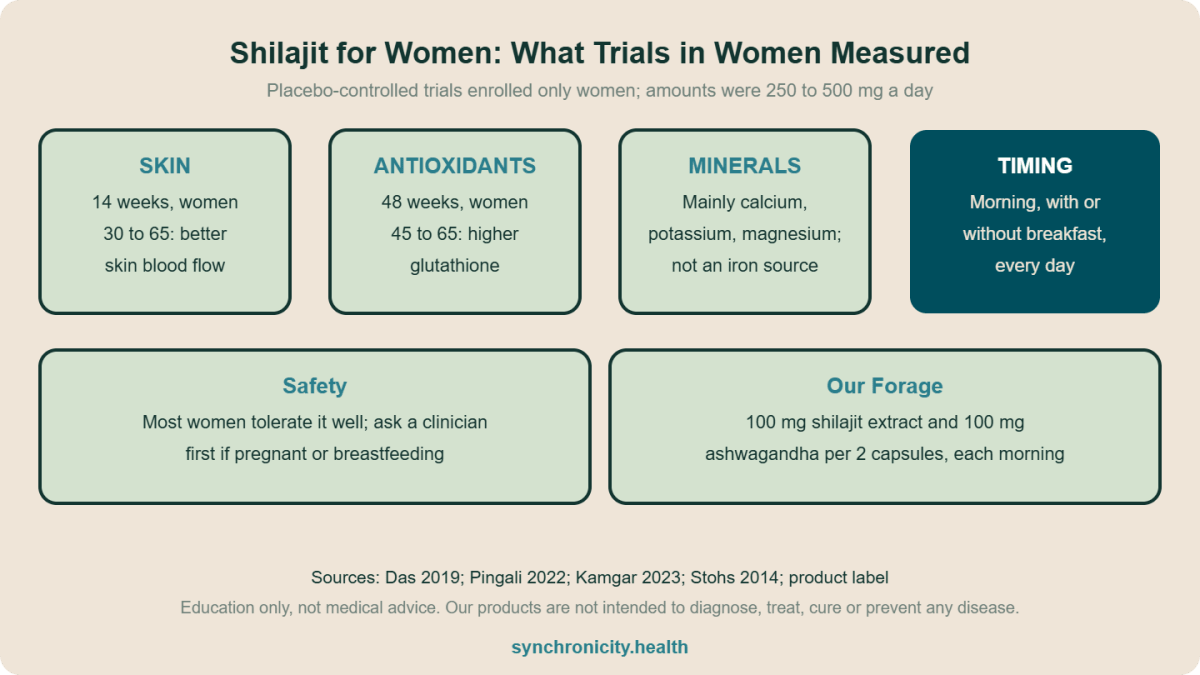
Shilajit is for women as well as men, and two placebo-controlled trials have studied it in women. In 45 healthy women aged 30 to 65, taking 250 mg twice a day for 14 weeks improved skin blood flow compared with placebo, with no side effects related to shilajit reported. A 48-week trial in women aged 45 to 65 measured bone density and antioxidant markers. Women in these trials took 250 to 500 mg a day of a purified extract, and a morning routine is the easiest way to take it.
Key Takeaways
- In healthy women aged 30 to 65, 250 mg of shilajit twice a day for 14 weeks improved skin blood flow and switched on genes linked to blood vessel growth and the skin's supporting matrix (Das et al., 2019).
- A 48-week trial in 60 women aged 45 to 65 used 250 mg or 500 mg a day and tracked bone density plus antioxidant markers such as glutathione (Pingali et al., 2022).
- Shilajit is mostly humic substances, with calcium, potassium and magnesium as its main minerals (Kamgar et al., 2023); it is not an iron supplement.
- Most women tolerate it well; a 2014 review called its safety "well documented" in animal and human studies (Stohs, 2014).
- Morning with or without breakfast is the simplest time, and daily use over months is what the trials in women measured.

Featured in this article
ForageSeven functional mushroom fruiting body extracts, including lion's mane, plus Himalayan shilajit and ashwagandha root extract for everyday energy and resilience.
Shop ForageThird-party tested ingredients. Vegan capsules.
Is Shilajit for Men or Women?
Both. Shilajit is a mineral-rich resin that seeps from high mountain rock, used for centuries in traditional practice as a revitalizer for stamina and fatigue (Stohs, 2014). A 2023 review of its chemistry found that more than 80 percent of its weight is humic substances, with calcium, potassium and magnesium making up almost 20 percent, plus amino acids, mainly glycine. Its exact makeup varies from region to region (Kamgar et al., 2023).
Shilajit is often marketed to men because the best-known trials enrolled men, but researchers have also run trials only in women, and those are the focus of this guide. For the full list of trials in both sexes, see our guide to shilajit benefits, and for sourcing, our Himalayan shilajit ingredient page.
Shilajit Benefits for Women: What Studies Measured
| Trial | Who took part | Amount and length | What was measured |
|---|---|---|---|
| Das et al., 2019 | 45 healthy women aged 30 to 65, average age 42 | 125 mg or 250 mg twice a day, 14 weeks | Skin blood flow, skin gene activity, hydration and elasticity |
| Pingali et al., 2022 | 60 postmenopausal women aged 45 to 65 with low bone density | 250 mg or 500 mg a day, 48 weeks | Spine and hip bone density, bone turnover and antioxidant markers |
Skin blood flow and the skin's support structure
In the 14-week trial, 15 women took placebo, 15 took 125 mg twice a day and 15 took 250 mg twice a day. At 250 mg twice a day, blood flow in the skin improved compared with both the start of the study and placebo. Skin biopsies showed that shilajit switched on genes tied to blood vessel growth and to the extracellular matrix, the collagen-rich scaffolding that supports skin. Skin hydration and elasticity did not differ from placebo over the 14 weeks, and no side effects related to shilajit were reported (Das et al., 2019).
Antioxidant markers
In the 48-week trial, women taking either amount of shilajit had lower levels of a marker of oxidative stress and higher levels of glutathione, the body's main antioxidant, from week 12 onward (Pingali et al., 2022). Our guide to how long shilajit takes to work sets these timelines side by side.
Shilajit for Women Over 50
The longest trial in women is the 48-week study in the table above, in 60 women aged 45 to 65. Researchers tracked spine and hip bone density, bone turnover and antioxidant markers such as glutathione over almost a year at 250 mg or 500 mg a day (Pingali et al., 2022). It is the longest shilajit trial in women so far, and it was run in one specific group, so read it as what researchers measured rather than a result to expect.
For women over 50, shilajit usually fits into a wider daily routine with protein, strength training, sleep and the nutrients that matter more at this stage. Our guide to vitamin D for women covers needs by life stage, and lion's mane for women covers a mushroom often taken alongside shilajit.
Shilajit, Iron and Everyday Energy
Women often ask whether shilajit helps with iron. Its main minerals are calcium, potassium and magnesium, and its composition varies by source (Kamgar et al., 2023), so it is not a way to meet iron needs. Those needs change with life stage (NIH Office of Dietary Supplements):
| Life stage | Recommended iron per day |
|---|---|
| Women 19 to 50 | 18 mg |
| Adults 51 and older | 8 mg |
| Pregnancy | 27 mg |
| Breastfeeding | 9 mg |
Women with heavy periods are among the groups more likely to run short of iron, so if you feel tired often, ask your clinician about an iron check rather than relying on any resin or blend. For everyday energy, shilajit's traditional role is as a revitalizer, and a 2014 review lists increased ATP production, the energy currency of cells, among its reported properties (Stohs, 2014). Our cellular energy hub explains how ATP is made.
How Much Shilajit Should a Woman Take, and When?
Women in the trials took 250 mg to 500 mg of a purified extract a day, either split into two doses or once a day. Extracts differ, so follow the label on your product, and do not stack several shilajit products.
The best time to take shilajit for women is the time you will keep. Neither trial in women set a clock time, so most women take it in the morning, with or without breakfast, where it fits the active part of the day. A split morning and early afternoon dose copies the 14-week trial. Shilajit is not a sleep aid, so if an evening dose ever feels too lively, move it earlier. Trials ran 14 and 48 weeks, so judge it over months, not days.
Shilajit Side Effects for Women
Most women tolerate it well. In the 14-week trial in healthy women, no side effects related to shilajit were reported, and a 2014 review concluded that "the safety of shilajit is well documented based on animal and human studies" (Das et al., 2019; Stohs, 2014). Quality is the point to be strict about: choose purified shilajit made with third-party tested ingredients, never raw resin of unknown origin.
Check with your clinician first if you are pregnant or breastfeeding, have an ongoing health condition or take prescription medicine. Our shilajit side effects guide covers the details.
Taking Shilajit With Ashwagandha and Mushrooms
Many women take shilajit as part of a blend rather than on its own. Ashwagandha is the classic partner for steady energy under stress; see shilajit and ashwagandha. Functional mushrooms such as cordyceps add a daytime focus angle; see cordyceps for women.
Who might choose shilajit: women who want a once-a-day morning habit for everyday energy and resilience, women over 50 building a fuller daily routine, and anyone who prefers one capsule blend to several separate bottles. If you would rather have your mushrooms in a warm cup, our Mushroom Cacao gives 500 mg each of lion's mane and cordyceps per rounded teaspoon, best earlier in the day.
Where Our Forage Fits
Our Forage gives 100 mg of Himalayan shilajit extract and 100 mg of ashwagandha root extract in every 2-capsule serving, with seven 8:1 fruiting body mushroom extracts: lion's mane 200 mg, cordyceps 200 mg, reishi 200 mg, chaga 150 mg, maitake 150 mg, turkey tail 150 mg and shiitake 150 mg. The other ingredients are ginger extract and vegan capsules, made with third-party tested ingredients. Take 2 capsules daily in the morning, with or without food.
Benefits build with consistent daily use. Months 1 to 2 can bring early changes, and 3 months and beyond is where the full benefit builds.
Featured in this article
ForageSeven functional mushroom fruiting body extracts, including lion's mane, plus Himalayan shilajit and ashwagandha root extract for everyday energy and resilience.
Shop ForageThird-party tested ingredients. Vegan capsules.
Frequently Asked Questions
Is shilajit for men or women?
Both. The best-known trials enrolled men, but placebo-controlled trials have also been run only in women, lasting 14 and 48 weeks.
What are the benefits of shilajit for women?
In healthy women, 14 weeks of shilajit improved skin blood flow and switched on genes tied to the skin's support structure. A 48-week trial in women aged 45 to 65 measured bone density and antioxidant markers.
Is shilajit good for women over 50?
The longest trial in women enrolled women aged 45 to 65 and ran 48 weeks. Many women over 50 take it as part of a morning routine for everyday energy.
What is the best time to take shilajit for women?
Morning, with or without breakfast, suits most women. One trial split the daily amount into two doses, which is another option.
How much shilajit should a woman take per day?
Trials in women used 250 mg to 500 mg of a purified extract a day. Follow the label on your product, since extracts differ.
What are the side effects of shilajit for females?
Most women tolerate it well, and no side effects related to shilajit were reported in the 14-week trial in healthy women. Choose a purified extract with third-party tested ingredients.
Does shilajit contain iron for women?
Its main minerals are calcium, potassium and magnesium, so it is not a way to meet iron needs. Women aged 19 to 50 need 18 mg of iron a day.
Can women take shilajit while pregnant or breastfeeding?
Talk with your clinician first if you are pregnant or breastfeeding.
Sources
- Das A, et al. Skin transcriptome of middle-aged women supplemented with natural herbo-mineral shilajit shows induction of microvascular and extracellular matrix mechanisms. Journal of the American College of Nutrition, 2019. https://pubmed.ncbi.nlm.nih.gov/31161927/
- Pingali U, Nutalapati C. Shilajit extract reduces oxidative stress, inflammation, and bone loss to dose-dependently preserve bone mineral density in postmenopausal women with osteopenia: a randomized, double-blind, placebo-controlled trial. Phytomedicine, 2022. https://pubmed.ncbi.nlm.nih.gov/35933897/
- Stohs SJ. Safety and efficacy of shilajit (mumie, moomiyo). Phytotherapy Research, 2014. https://pubmed.ncbi.nlm.nih.gov/23733436/
- Kamgar E, Kaykhaii M, Zembrzuska J. A comprehensive review on shilajit: what we know about its chemical composition. Critical Reviews in Analytical Chemistry, 2023. https://pubmed.ncbi.nlm.nih.gov/38133965/
- NIH Office of Dietary Supplements. Iron: Fact Sheet for Consumers. https://ods.od.nih.gov/factsheets/Iron-Consumer/
These statements have not been evaluated by the Food and Drug Administration. This content is for education and is not medical advice. Our products are not intended to diagnose, treat, cure or prevent any disease. Talk with a healthcare provider before starting a new supplement if you are pregnant, breastfeeding or taking medication.


Leave a comment
All comments are moderated before being published.
This site is protected by hCaptcha and the hCaptcha Privacy Policy and Terms of Service apply.