
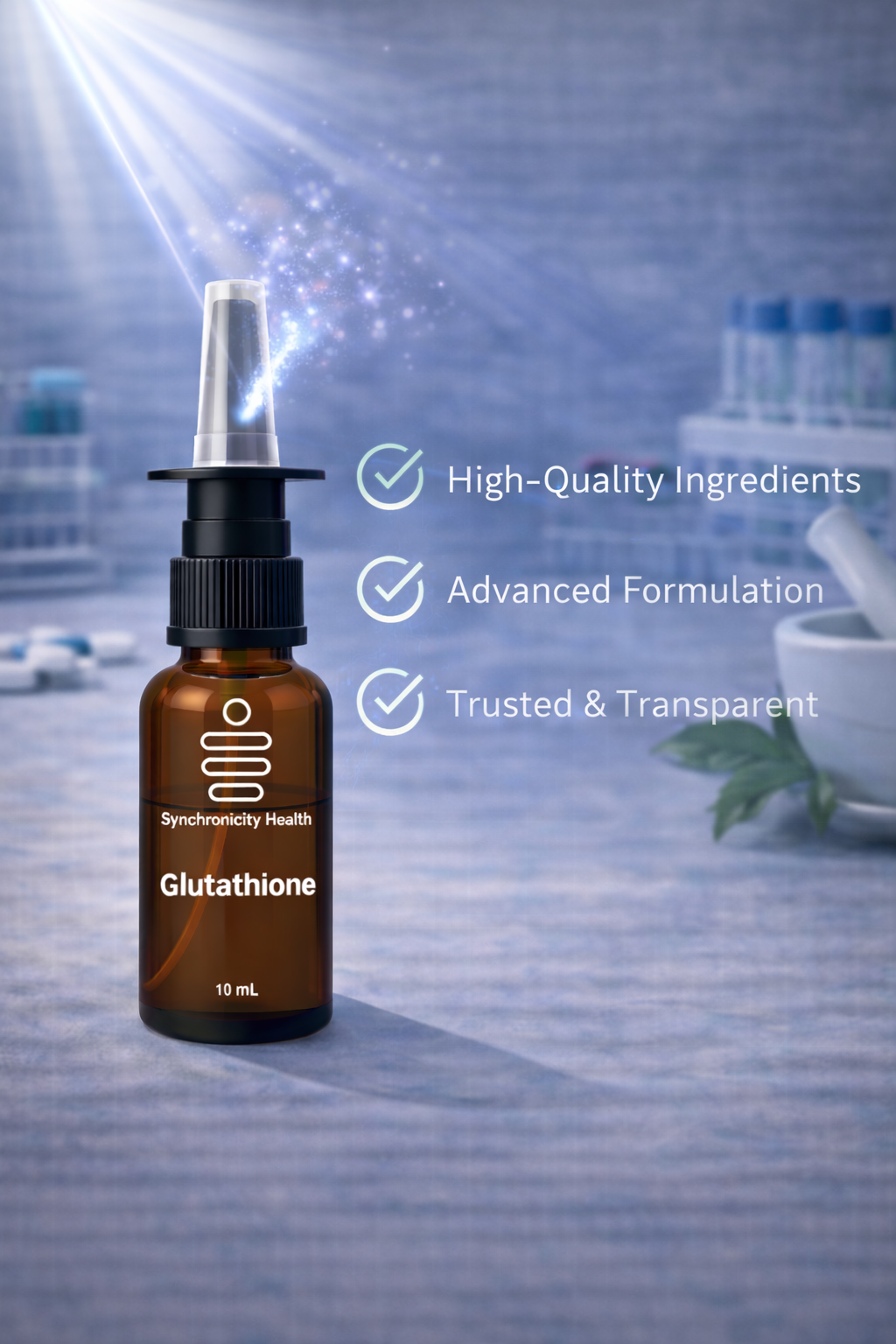
Glutathione nasal spray is gaining attention among biohackers, performance‑focused professionals, and longevity seekers for one simple reason: it delivers the body’s master antioxidant in a direct, efficient way that many traditional supplements cannot match.
Glutathione is central to detoxification, immune resilience, mitochondrial function, and healthy aging. Yet levels decline with age, chronic stress, illness, and toxin exposure. A thoughtfully designed glutathione nasal spray offers a way to support these systems without relying on the gut or invasive IV therapy—especially when the brain and respiratory tract are key targets.
Synchronicity Health’s Glutathione Nasal Spray was developed with this science in mind and formulated under medical guidance to meet the needs of people who care deeply about performance, resilience, and long-term health.
Functional medicine physician Mark Hyman, MD, often calls glutathione “the mother of all antioxidants” because of its wide‑ranging role in protecting cells from oxidative stress.
What Glutathione Does And Why Levels Matter

Glutathione is a small tripeptide made from three amino acids—cysteine, glutamate, and glycine—produced inside virtually every cell. It exists in two main forms:
-
Reduced glutathione (GSH): the active, protective form
-
Oxidized glutathione (GSSG): the “used” form after neutralizing free radicals
The ratio of GSH to GSSG is a sensitive marker of cellular health. A high GSH:GSSG ratio indicates strong antioxidant defenses; a low ratio signals significant oxidative stress.
Key roles of glutathione include:
-
Neutralizing free radicals and limiting oxidative damage to DNA, lipids, and proteins
-
Supporting liver detoxification of heavy metals, pollutants, and drug metabolites
-
Backing immune defenses by supporting lymphocyte function and proliferation
-
Maintaining mitochondrial function and ATP production
-
Regulating cell growth and programmed cell death
Low glutathione has been documented in conditions affecting:
-
The respiratory system
-
Immune function
-
The central nervous system
-
People with chronic fatigue or high metabolic stress
-
Various forms of neurodegeneration
For anyone focused on longevity, cognition, training recovery, or resilience to pollutants, glutathione status matters.
Why Delivery Route Is So Important For Glutathione
Glutathione is notoriously challenging to supplement effectively. The delivery route you choose has a major impact on how much actually reaches your cells.
Limitations Of Common Forms
-
Standard oral glutathione:
Enzymes in the digestive tract break it apart before absorption, so little intact glutathione reaches circulation. Some studies show modest changes, but results are inconsistent. -
IV glutathione:
Can raise blood levels, but:-
Requires clinic visits and medical staff
-
Is time-consuming and expensive
-
Is not practical for daily or long-term use for most people
-
-
Liposomal oral glutathione:
Improves absorption compared with standard capsules, yet still relies on the digestive system and first-pass metabolism through the liver.
These practical limits have led researchers to study alternative routes. One of the most promising: a well-formulated glutathione nasal spray.
How A Glutathione Nasal Spray Works

A glutathione nasal spray delivers the molecule into the nasal cavity, where it can act locally and be absorbed through specialized tissues.
Nose-To-Brain Delivery
The upper nasal passages sit just beneath the brain, near the olfactory and trigeminal nerves. This region offers two main routes that help a glutathione nasal spray reach the central nervous system:
-
Intraneuronal pathways
Glutathione can be taken up by olfactory and trigeminal neurons and transported along their axons deeper into the brain. This process is slower (hours to days) but can reach wide areas. -
Extraneuronal pathways
Glutathione can diffuse across the nasal mucosa and the thin bone of the cribriform plate into cerebrospinal fluid. This is a faster route that suits small, water-soluble molecules.
Magnetic resonance spectroscopy (1H‑MRS) studies in people with Parkinson’s disease have shown measurable increases in brain glutathione 20–45 minutes after intranasal dosing, confirming that glutathione from nasal sprays can reach the brain.
Local Respiratory Effects
A glutathione nasal spray also bathes the nasal and sinus mucosa directly. This is relevant for:
-
Chronic sinusitis
-
Allergies and environmental irritants
-
Recurrent sinus infections
Research in children with chronic ear and sinus issues found that glutathione delivered via nasal aerosol raised glutathione levels in the nasal mucosa and improved symptoms such as nasal obstruction and runny nose.
Systemic Absorption
The nasal cavity is highly vascular. Some glutathione from a nasal spray can enter the bloodstream through local capillaries, adding to systemic levels without going through the digestive tract. For people who struggle with oral absorption, this can be a meaningful advantage.
What The Research And User Data Show
Large trials are still limited, but several lines of evidence give a helpful picture of what a glutathione nasal spray may offer.
Patient-Reported Outcomes
A survey of adults across the US who had been prescribed intranasal reduced glutathione found:
-
78.8% reported a positive overall experience
-
62.1% noticed health benefits they attributed to the spray
-
45.5% reported improvement in their main condition
-
28.8% felt a better overall sense of well-being
-
27.3% had fewer sinus infections
-
24.2% reported better energy
-
15.2% had fewer headaches
Most participants found a glutathione nasal spray easy and comfortable to use, even over many months, which suggests that long-term adherence is realistic for many users.
Clinical Trials In Parkinson’s Disease
Two small, double-blind, placebo-controlled studies in people with Parkinson’s disease tested total daily doses of 300 mg and 600 mg of intranasal glutathione (split into three doses per day). The trials:
-
Did not show clear superiority over placebo on standard motor scales
-
Were underpowered and influenced by baseline differences and a high placebo response
-
Did show that even at 600 mg/day, increases in glutathione in certain brain regions were small and not statistically significant
The takeaway: a glutathione nasal spray can reach the brain, but ideal dosing, frequency, and treatment duration remain open questions. These studies also focused on individuals with established disease, so their results do not necessarily predict what a healthy or high‑performing person might notice.
Key Benefits Of Glutathione Nasal Spray For High-Performers

While medical research is ongoing, there are several areas where the science and user reports align with the interests of health-focused, performance-oriented individuals.
Cognitive Support And Brain Health
Oxidative stress and low glutathione are seen early in conditions such as Parkinson’s and Alzheimer’s disease. Brain imaging studies have found:
-
Reduced glutathione in brain regions involved in memory and executive function
-
Associations between lower glutathione and greater cognitive impairment
For healthy adults, this does not prove that a glutathione nasal spray prevents disease. But it does support the idea that:
-
Maintaining glutathione levels is relevant to long-term brain health
-
Supporting antioxidant defenses in the brain may help protect neurons against ongoing metabolic and environmental stress
Some users of glutathione nasal spray report clearer thinking, less brain fog, and better mental stamina, though this remains anecdotal and varies from person to person.
Sinus, Allergy, And Respiratory Support
Repeated exposure to pollutants, mold, and allergens produces free radicals and inflammation in the airways. Studies have found:
-
Lower reduced glutathione levels in the nasal mucosa of people with chronic sinusitis
-
Symptom improvements and fewer infections in survey respondents using intranasal glutathione for sinus and allergy issues
For people who frequently fly, live in cities with poor air quality, train in polluted environments, or struggle with chronic sinus problems, a glutathione nasal spray may support the local antioxidant shield of the upper airway and make day‑to‑day breathing more comfortable.
Detoxification And Chemical Sensitivity
Multiple chemical sensitivity (MCS) has been linked to:
-
Impaired detoxification pathways
-
Depleted glutathione stores and altered glutathione-metabolizing enzymes
In the patient survey:
-
MCS was the most common reason for using intranasal glutathione
-
About 72.4% of users with MCS reported a positive experience
-
44.8% reported improvement in MCS symptoms
While more research is needed, these findings align with glutathione’s central role in binding and clearing reactive chemicals and heavy metals.
For athletes, frequent sauna users, or individuals following other detox-focused protocols, a glutathione nasal spray may complement those strategies by supporting the underlying antioxidant and conjugation systems.
Aging, Skin, And Mitochondrial Health
Oxidative stress is a driver of visible aging and mitochondrial decline. Glutathione:
-
Protects mitochondria from reactive oxygen species generated during energy production
-
Helps maintain cell membrane integrity and protein structure
-
Has been studied for (PDF) Glutathione as a skin whitening agent, with research examining its effects on skin tone and appearance, especially in oral and IV forms
A glutathione nasal spray is not a cosmetic treatment, but by supporting systemic antioxidant capacity and mitochondrial function, it fits well within a broader inside‑out approach to healthy aging.
Energy, Stress, And Sleep Rhythm
The brain’s redox state (balance of oxidants and antioxidants) interacts with neurotransmitters and circadian signaling. Some users of glutathione nasal spray report:
-
More stable daytime energy
-
Better resilience under stress
-
Easier sleep onset when dosing is timed earlier in the day
Controlled trials on sleep are not yet available, so these observations should be seen as early signals rather than proof. Still, for people fine-tuning their routine for better performance and rest, glutathione status is a reasonable lever to explore with professional guidance.
Safety, Side Effects, And When To Be Cautious
Overall, glutathione nasal spray appears to be well-tolerated, but it is not free of potential side effects.
Most Common Side Effects
Across patient surveys and clinical trials, the most frequently reported issues are local and mild:
-
Nasal or sinus irritation
-
Headaches
-
Occasional nosebleeds
In one survey:
-
12.1% of users reported any adverse effect
-
People with multiple chemical sensitivity were roughly twice as likely to report irritation, headaches, or nosebleeds compared with those using it for allergies or sinusitis
Serious Events
One participant in a Parkinson’s trial taking 600 mg/day developed a reversible cardiomyopathy with rapid heartbeat. The condition resolved after discontinuing the spray. Researchers proposed that excessively high antioxidant exposure might have contributed to reductive stress, the opposite extreme of oxidative stress.
This case appears to be rare, but it reinforces some important principles:
-
Higher doses are not always better
-
People combining multiple strong antioxidant therapies should do so under medical supervision
General Safety Guidelines
Before using a glutathione nasal spray, talk with a qualified healthcare professional if you:
-
Are pregnant, breastfeeding, or planning pregnancy
-
Have chronic heart disease, arrhythmias, or cardiomyopathy
-
Have severe, unexplained headaches or frequent nosebleeds
-
Have known sensitivities to preservatives or excipients
This article is for educational purposes only and is not a substitute for personalized medical advice.
How To Use A Glutathione Nasal Spray Thoughtfully
There is no universally agreed-upon “correct” dosing schedule yet, but research and real-world experience provide some practical guardrails.
Dosing Considerations
In Parkinson’s trials, total daily doses were:
-
300 mg/day (100 mg three times daily)
-
600 mg/day (200 mg three times daily)
These doses were safe for most participants but did not produce strong clinical improvements on their own.
A simple way to view these study doses is:
|
Study Context |
Total Daily Dose |
Schedule |
|---|---|---|
|
Parkinson’s trial (lower) |
300 mg |
100 mg, three times/day |
|
Parkinson’s trial (higher) |
600 mg |
200 mg, three times/day |
For people using a glutathione nasal spray for general wellness:
-
Many clinicians start with lower doses and adjust based on tolerance and response
-
Splitting the daily amount into two or three smaller doses helps maintain more stable levels
Always follow the instructions on your specific product and the guidance of your clinician.
Timing For Different Goals
People often time their glutathione nasal spray around:
-
Morning or early daytime for energy, cognition, and respiratory support
-
Before or after exposure to pollutants, travel, or intense training
-
Away from bedtime at first, to observe how it affects alertness and sleep
Helpful practical tips include:
-
Tracking your own response for several weeks in a simple journal or app
-
Adjusting dose and timing gradually, rather than making large changes overnight
-
Reviewing your plan regularly with a practitioner, especially if you add or remove other supplements or medications
Why Synchronicity Health’s Glutathione Nasal Spray Stands Out
Not all glutathione nasal sprays are the same. Stability, purity, and formulation strategy can dramatically influence effectiveness.
Synchronicity Health’s Glutathione Nasal Spray is designed for discerning users who expect both solid science and practical results.
Key strengths include:
-
Medical oversight
The product is developed under the direction of a Yale-trained physician, with attention to real-world dosing, safety, and clinical relevance—not just marketing claims. -
High purity and third-party testing
Each batch is tested by independent laboratories to confirm identity, potency, and absence of contaminants. For anyone taking a glutathione nasal spray regularly, this level of quality control matters. -
Formulation designed for absorption
The spray is crafted to support efficient nasal uptake and maintain glutathione in its reduced, active form. The goal is to deliver the molecule where it matters most, rather than simply listing it on a label. -
Convenience for busy people
A portable bottle and quick administration make it feasible for:-
High-performing professionals with demanding schedules
-
Athletes and frequent travelers
-
Individuals managing chronic sinus or sensitivity issues
-
Synchronicity Health positions this glutathione nasal spray as part of a broader, evidence-guided approach to health rather than a stand-alone miracle cure.
Frequently Asked Questions About Glutathione Nasal Spray
How Fast Can I Feel The Effects?
Imaging studies show changes in brain glutathione within 20–45 minutes after intranasal dosing. Subjectively, some people notice changes in clarity or sinus comfort within the first week, while others notice more gradual shifts over several weeks.
What you feel, and how quickly, can depend on:
-
Your baseline health and glutathione status
-
Your dose and how consistently you use it
-
Other lifestyle factors such as sleep, diet, and stress load
Can I Use A Glutathione Nasal Spray With Other Supplements?
Often yes, but combinations with other strong antioxidant therapies (IV vitamin C, high-dose NAC, multiple glutathione forms) should be supervised. Discuss your full regimen with a practitioner familiar with redox biology.
When you review your stack, make sure to mention:
-
All prescription medications
-
Any IV or injectable therapies
-
Over-the-counter supplements, including powders and drinks
Is Glutathione Nasal Spray Better Than IV Glutathione?
They serve different purposes:
-
IV glutathione: broad, systemic exposure; requires appointments and higher cost
-
Glutathione nasal spray: easier, home-based use with more direct access to brain and upper airway
Many people prefer a glutathione nasal spray for ongoing support and reserve IV therapy for specific, time-limited needs, under the guidance of a clinician.
How Long Can I Safely Use It?
Survey data include people using intranasal glutathione for many months to years with good tolerability. Long-term use should be periodically reviewed with your clinician, especially if your health status or supplement stack changes.
A sensible approach is to:
-
Reassess every few months with lab work and symptom tracking when appropriate
-
Take breaks if advised by your practitioner
-
Adjust dose over time instead of assuming the same amount is right indefinitely
The Bottom Line
For people serious about health span, brain performance, respiratory resilience, and recovery, how you support glutathione matters as much as how much you take. A well-designed glutathione nasal spray offers:
-
Direct access to the brain and sinus tissues
-
Avoidance of digestive breakdown and first-pass metabolism
-
A practical alternative to frequent IV infusions
Synchronicity Health’s Glutathione Nasal Spray brings this science into a carefully formulated, physician-guided product aimed at those who expect both data and integrity behind what they use.
Used thoughtfully and under appropriate guidance, a glutathione nasal spray can be a powerful addition to a broader strategy for long-term health, performance, and resilience.


Leave a comment
All comments are moderated before being published.
This site is protected by hCaptcha and the hCaptcha Privacy Policy and Terms of Service apply.