
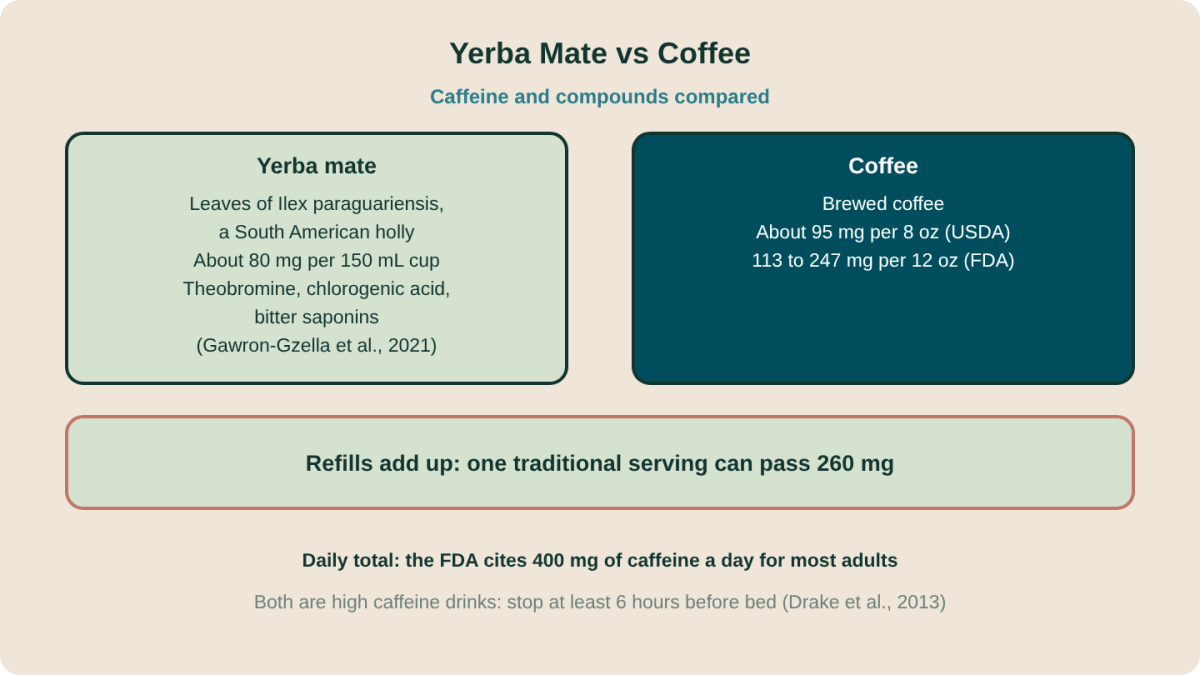
Yerba mate and coffee have similar caffeine per cup, but mate is drunk in a very different way. A review of yerba mate puts a cup of about 150 mL at about 80 mg of caffeine, comparable to a cup of coffee, and notes that the traditional habit of refilling the vessel with water can take a serving past 260 mg (Gawron-Gzella et al., 2021). Brewed coffee has about 95 mg per 8 oz (USDA FoodData Central). Mate also carries theobromine, a caffeine relative, plus polyphenols led by chlorogenic acid (Gawron-Gzella et al., 2021). This guide compares caffeine, compounds, taste and how to choose.
It is educational, not medical advice.
Key Takeaways
- What mate is: an infusion of the leaves of Ilex paraguariensis, a South American holly tree (Gawron-Gzella et al., 2021).
- Caffeine per cup: about 80 mg per 150 mL cup of mate, comparable to coffee (Gawron-Gzella et al., 2021); brewed coffee has about 95 mg per 8 oz (USDA FoodData Central).
- Refills add up: repeatedly topping up the vessel can give more than 260 mg of caffeine per serving (Gawron-Gzella et al., 2021).
- Other compounds: mate contains caffeine and theobromine, polyphenols with chlorogenic acid as the main phenolic acid, and bitter saponins (Gawron-Gzella et al., 2021).
- Daily total: the FDA cites 400 mg a day for most adults (FDA).

Featured in this article
Theanine Nasal Spray36 mg of L-theanine per serving, caffeine-free, to pair with your coffee or tea.
Shop Theanine Nasal SprayThird-party tested ingredients. Vegan, non-GMO, made in the USA.

Yerba Mate vs Coffee at a Glance
| Yerba mate | Coffee | |
|---|---|---|
| Source | Leaves of Ilex paraguariensis | Roasted coffee beans |
| Caffeine | About 80 mg per 150 mL cup; over 260 mg with traditional refills | About 95 mg per 8 oz brewed; 113 to 247 mg per 12 oz |
| Other compounds noted | Theobromine, chlorogenic acid, flavonoids, bitter saponins | See our coffee guides |
Mate figures are from a 2021 review in Nutrients (Gawron-Gzella et al., 2021). Coffee figures are from USDA, 40 mg of caffeine per 100 g of brewed coffee (USDA FoodData Central), and FDA typical amounts (FDA).
What Is Yerba Mate?
Yerba mate is an infusion made from the leaves of Ilex paraguariensis, a holly tree of the Aquifoliaceae family native to South America (Gawron-Gzella et al., 2021). The leaves are briefly roasted to stop enzymes, dried, then crushed and matured for at least 12 months to develop their flavor. Traditionally mate is brewed in a vessel of calabash, wood or porcelain and drunk through a straw called a bombilla, with water added to the same leaves again and again (Gawron-Gzella et al., 2021). Our coffee alternatives guide lists it among the drinks that keep some caffeine.
Caffeine: Mate vs Coffee
Per cup, the two are closer than many people expect. The Nutrients review puts a cup of mate, about 150 mL, at about 80 mg of caffeine, comparable to a cup of coffee (Gawron-Gzella et al., 2021). Brewed coffee has about 40 mg per 100 g (USDA FoodData Central), which works out to about 60 mg in 150 mL and about 95 mg in an 8 oz cup. The big difference is serving style: with the traditional vessel, repeatedly adding more water to the same leaves can take one serving past 260 mg of caffeine (Gawron-Gzella et al., 2021). A 12 oz regular brewed coffee, for comparison, typically has 113 to 247 mg (FDA).
So mate is not a low caffeine drink. If you are switching from coffee to cut back, a single bag of mate tea may help, but a long session of refills can give you as much caffeine as two or three coffees. For gentler swaps, see tea vs coffee and matcha vs coffee.
What Else Is in Yerba Mate?
Besides caffeine, mate contains theobromine, the other main purine alkaloid; polyphenols, mainly phenolic acids, with chlorogenic acid the dominant one; flavonoids; and bitter, water-soluble saponins, along with minerals and vitamins (Gawron-Gzella et al., 2021). Theobromine is the caffeine relative best known from cacao; our guide to theobromine vs caffeine explains how the two differ. The saponins are bitter, which is part of mate's strong taste (Gawron-Gzella et al., 2021).
Does Mate Feel Different From Coffee?
Some people say mate gives a smoother lift than coffee. That is an impression, not a research finding. What is known is that the stimulant in both is mainly caffeine, and that caffeine affects people very differently: the FDA notes wide variation in how sensitive people are to caffeine and how fast they clear it (FDA). The amount you drink, and how quickly, will matter more than the leaf or the bean.
Which Should You Choose?
- Choose coffee: if you want a predictable cup; an 8 oz brewed coffee has about 95 mg (USDA FoodData Central).
- Choose mate: if you like its taste or its ritual, and keep track of refills, which can pass 260 mg in one serving (Gawron-Gzella et al., 2021).
- Cutting back: brewed black tea has about 47 mg per 8 oz, about half of coffee (USDA FoodData Central; USDA FoodData Central); see energy drink alternatives for more options.
- Evenings: both are high in caffeine; 400 mg taken 6 hours before bed still disrupted sleep in a study (Drake et al., 2013).
How Much Is Too Much?
For most adults, the FDA cites 400 mg of caffeine a day as an amount not generally associated with negative effects, and lists signs of too much such as jitters, a racing heart, sleep problems and upset stomach (FDA). See how much caffeine is too much for the full list.
Where Our Products Fit
Some people pair caffeine with L-theanine: in a placebo-controlled study, 50 mg of caffeine with 100 mg of L-theanine improved speed and accuracy on an attention switching task (Owen et al., 2008). Theanine Nasal Spray gives 36 mg of L-theanine per serving and is caffeine-free. The Energy Stack combines NAD+ Nasal Spray, Forage and Methyl B-12 Nasal Spray in one daily energy routine. Read more in L-theanine and caffeine, on our L-theanine ingredient page and in the Non-Stimulant Energy and Focus hub.

Featured in this article
Energy StackNAD+ Nasal Spray, Forage and Methyl B-12 Nasal Spray together in one daily energy routine.
Shop Energy StackThird-party tested ingredients.
Frequently Asked Questions
Does yerba mate have more caffeine than coffee?
Per cup it is comparable, about 80 mg per 150 mL (Gawron-Gzella et al., 2021), against about 95 mg per 8 oz of brewed coffee (USDA FoodData Central). Traditional refills can push a serving past 260 mg (Gawron-Gzella et al., 2021).
Is yerba mate healthier than coffee?
Research has not settled that. Mate brings theobromine, chlorogenic acid and saponins (Gawron-Gzella et al., 2021); both drinks are mainly a source of caffeine.
Is yerba mate a tea?
It is brewed like a tea, but from the leaves of a holly tree, Ilex paraguariensis, not the tea plant (Gawron-Gzella et al., 2021).
Does yerba mate have theobromine?
Yes, along with caffeine (Gawron-Gzella et al., 2021).
Can yerba mate replace coffee?
Yes for many people, since the caffeine per cup is similar (Gawron-Gzella et al., 2021), but it will not cut your caffeine unless you drink less of it.
Why is yerba mate bitter?
Its leaves contain bitter, water-soluble saponins (Gawron-Gzella et al., 2021).
Can I drink yerba mate at night?
It has as much caffeine as coffee per cup (Gawron-Gzella et al., 2021), so the same 6 hour cutoff before bed applies (Drake et al., 2013). See how long caffeine lasts.
How much yerba mate a day is safe?
Count it with your other caffeine; the FDA cites 400 mg a day for most adults (FDA).
Sources
- Gawron-Gzella A, Chanaj-Kaczmarek J, Cielecka-Piontek J. Yerba Mate: a long but current history. Nutrients. 2021. PubMed 34835962
- Drake C, Roehrs T, Shambroom J, Roth T. Caffeine effects on sleep taken 0, 3, or 6 hours before going to bed. J Clin Sleep Med. 2013. PubMed 24235903
- Owen GN, Parnell H, De Bruin EA, Rycroft JA. The combined effects of L-theanine and caffeine on cognitive performance and mood. Nutr Neurosci. 2008. PubMed 18681988
- U.S. Food and Drug Administration. Spilling the Beans: How Much Caffeine Is Too Much? FDA
- U.S. Department of Agriculture. FoodData Central: Beverages, coffee, brewed, prepared with tap water (FDC 171890); Beverages, tea, black, brewed, prepared with tap water (FDC 173227). FoodData Central
Our products are not intended to diagnose, treat, cure or prevent any disease. This article is for education only and is not medical advice.


Leave a comment
All comments are moderated before being published.
This site is protected by hCaptcha and the hCaptcha Privacy Policy and Terms of Service apply.