
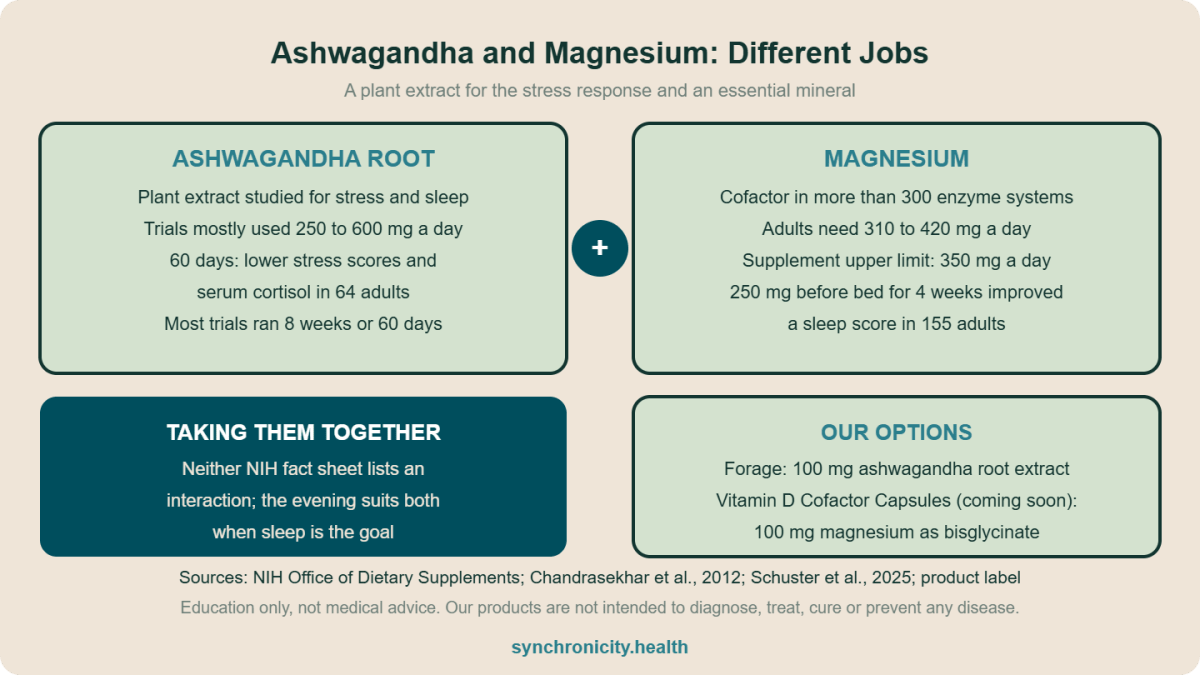
Yes, you can take ashwagandha and magnesium together, and many people do, often in the evening. They do different jobs: ashwagandha is a root extract whose trials measured stress scores, cortisol and sleep, while magnesium is an essential mineral your body uses in more than 300 enzyme systems, including those behind nerve and muscle function. Neither NIH fact sheet lists an interaction between the two; just keep supplemental magnesium at or under 350 mg a day.
Key Takeaways
- In 64 adults with a history of chronic stress, 300 mg of ashwagandha root extract twice a day for 60 days lowered stress scores and serum cortisol compared with placebo (Chandrasekhar et al., 2012).
- Magnesium is a cofactor in more than 300 enzyme systems, and 48% of Americans get less of it from food and drinks than the estimated average requirement (NIH Office of Dietary Supplements).
- In 155 adults who reported poor sleep, 250 mg of magnesium as bisglycinate each evening for 4 weeks improved a sleep questionnaire score more than placebo (Schuster et al., 2025).
- The upper limit for magnesium from supplements is 350 mg a day for adults; magnesium from food does not count toward it.
- Most people tolerate both well. People who are pregnant, take thyroid medication or have liver problems should check with a clinician before starting ashwagandha.

Featured in this article
ForageSeven functional mushroom fruiting body extracts, including lion's mane, plus Himalayan shilajit and ashwagandha root extract for everyday energy and resilience.
Shop ForageThird-party tested ingredients. Vegan capsules.
Ashwagandha vs Magnesium: How They Differ
People often compare ashwagandha vs magnesium, but the two are not substitutes. One is a plant extract, the other a mineral your body needs every day.
| Ashwagandha | Magnesium | |
|---|---|---|
| What it is | Root extract of Withania somnifera, an evergreen shrub | An essential mineral |
| Main job | Studied for a healthier stress response and sleep quality | Cofactor in more than 300 enzyme systems, including nerve and muscle function |
| Daily need | Not a nutrient; trials mostly used 250 to 600 mg a day | 310 to 420 mg a day for adults from all sources |
| Limits | 125 to 600 mg a day was well tolerated in a 2026 safety review | Upper limit of 350 mg a day from supplements |
| In food | Not a food | Leafy greens, legumes, nuts, seeds, whole grains |
| Most common side effects | Mild stomach upset, loose stools, nausea, drowsiness | Loose stools, nausea or cramping at high supplement doses |
What Ashwagandha Does
Ashwagandha is an evergreen shrub, and most supplements use extracts of its root, which is rich in compounds called withanolides (NIH Office of Dietary Supplements). Its best-studied area is stress. In a double-blind trial, 64 adults with a history of chronic stress took 300 mg of root extract or a placebo twice a day for 60 days. The ashwagandha group scored lower on every stress scale used, and their serum cortisol fell compared with placebo (Chandrasekhar et al., 2012).
Sleep is its second big area. In an 8-week trial, 60 healthy adults with high stress scores took 250 mg or 600 mg a day of root extract or a placebo. Both doses lowered perceived stress and serum cortisol, and the ashwagandha groups rated their sleep better than the placebo group (Salve et al., 2019). Our guide to ashwagandha benefits covers its full research, and our ashwagandha root extract ingredient page covers the plant itself.
What Magnesium Does
An adult body holds about 25 grams of magnesium, 50% to 60% of it in bone. Magnesium is a cofactor in more than 300 enzyme systems, and it helps move calcium and potassium across cell membranes, which matters for nerve signals, muscle contraction and a normal heart rhythm (NIH Office of Dietary Supplements).
How much you need depends on age and sex:
| Age | Men | Women |
|---|---|---|
| 19 to 30 | 400 mg | 310 mg |
| 31 and older | 420 mg | 320 mg |
Those amounts count food and supplements together. Good food sources include green leafy vegetables, legumes, nuts, seeds and whole grains, yet 48% of Americans take in less magnesium from food and drinks than the estimated average requirement. For supplements alone, the upper limit for adults is 350 mg a day (NIH Office of Dietary Supplements). Our guide to magnesium glycinate benefits covers the gentle form many people choose.
Ashwagandha and Magnesium for Sleep
Sleep is the most common reason people pair these two, and each has its own trials.
- Ashwagandha. A review of 5 randomized trials with 400 adults found a small but significant improvement in overall sleep, larger at 600 mg a day or more and after 8 weeks or more (Cheah et al., 2021).
- Magnesium. In a double-blind trial in Germany, 155 adults aged 18 to 65 who reported poor sleep took 250 mg of magnesium as magnesium bisglycinate, or a placebo, 30 to 60 minutes before bed for 4 weeks. Scores on a standard sleep questionnaire improved more with magnesium than with placebo, a small but significant difference, and no serious side effects were reported (Schuster et al., 2025).
In that magnesium trial, the stress questionnaire did not change more than placebo, while ashwagandha's trials are built around stress and cortisol. That is one reason the two pair well: magnesium covers a daily mineral need, and ashwagandha is aimed at the stress side of a restless evening. For the full picture on the mineral and rest, see magnesium glycinate for sleep and our sleep health guide.
Taking Them Together: Ashwagandha With Magnesium Glycinate
Magnesium glycinate, also called bisglycinate, is magnesium bound to the amino acid glycine. It is the form used in the sleep trial above, and it pairs easily with ashwagandha.
- Timing. If sleep is your goal, the evening suits both: the magnesium trial gave it 30 to 60 minutes before bed. If ashwagandha is part of a morning routine, take magnesium at night; they do not need to be taken at the same moment. See the best time to take magnesium.
- Count all your magnesium. Add up the magnesium in every product you take, including multivitamins, and keep the supplement total at or under 350 mg a day.
- Stay within studied amounts. Most ashwagandha trials used 250 to 600 mg a day of root extract.
- With food if your stomach is sensitive. Mild stomach upset is a common side effect of both.
Benefits build with consistent daily use: months 1 to 2 can bring early changes, and 3 months and beyond is where the full benefit builds.
Safety: Who Should Check First
Most people tolerate both well. A 2026 review of 23 randomized trials with 2,317 healthy adults, using standardized ashwagandha root extract at 125 to 600 mg a day for up to 180 days, found liver, kidney, blood and hormone markers within normal ranges and no serious side effects linked to ashwagandha (Coope et al., 2026). Magnesium from food poses no health risk for healthy people, and the side effects of supplements, mainly loose stools, nausea and cramping, come with high doses (NIH Office of Dietary Supplements).
A few groups should ask a clinician before starting ashwagandha (NIH Office of Dietary Supplements):
- Thyroid. Ashwagandha might affect thyroid function, so if you take thyroid medication, check first; your clinician may want to recheck your levels.
- Pregnancy and breastfeeding. Some experts advise against ashwagandha during pregnancy and breastfeeding, so ask your provider first.
- Liver. Case reports have linked ashwagandha to liver reactions, mostly with non-standardized or multi-ingredient products, so people with liver problems should check first.
- Prescription medicine. If you take any prescription medicine, check with your clinician before adding either one.
Our guide to ashwagandha side effects covers each of these in detail. For ashwagandha with melatonin, see ashwagandha and melatonin. If you drink, our guide to ashwagandha and alcohol covers safety and timing for that combination.
Who Might Choose Which
- Ashwagandha may suit you if everyday stress is what keeps you wound up, since its trials measured stress scores and cortisol over 8 weeks or 60 days.
- Magnesium may suit you if your diet is light on leafy greens, legumes, nuts, seeds and whole grains, or you want a simple evening mineral for rest.
- Both may suit you if you want to cover a daily mineral need and support a calmer stress response at the same time.
Where Our Forage and Vitamin D Cofactor Capsules Fit
Forage. Our Forage capsules include 100 mg of ashwagandha root extract per 2-capsule serving, alongside 8:1 fruiting body extracts of lion's mane, cordyceps and reishi (200 mg each) and chaga, maitake, turkey tail and shiitake (150 mg each), plus 100 mg of Himalayan shilajit extract, with ginger extract in vegan capsules. Take 2 capsules daily in the morning, with or without food, which leaves the evening open for magnesium. Forage is built as a daily adaptogen blend, so ashwagandha works beside the mushrooms rather than at the single-ingredient amounts used in the trials above. It is made with third-party tested ingredients.
Vitamin D Cofactor Capsules (coming soon). Our Vitamin D Cofactor Capsules give 100 mg of magnesium and 10 mg of zinc, both as bisglycinate, plus 3 mg of boron as glycinate, per 2 capsules. They are made to pair with our Vitamin D3 + K2 Drops, and 100 mg of magnesium sits well under the 350 mg supplement limit, leaving room for magnesium from other sources. They are coming soon: join the waitlist on the product page to hear when they launch. Our guide to vitamin D and magnesium explains why the two go together. Also coming soon, our Melatonin-Free Sleep Powder includes 200 mg of magnesium from two gentle forms for the evening.

Featured in this article
Vitamin D Cofactor CapsulesMagnesium 100 mg, zinc 10 mg and boron 3 mg per 2 capsules, all as glycinates, made to pair with vitamin D3.
Join the WaitlistComing soon. Third-party tested ingredients.
Frequently Asked Questions
Can you take ashwagandha and magnesium together?
Yes. Many people do, and neither NIH fact sheet lists an interaction between them. Keep supplemental magnesium at or under 350 mg a day and ashwagandha within studied amounts.
Can I take ashwagandha with magnesium glycinate?
Yes. Magnesium glycinate (bisglycinate) is a common evening choice and was the form used in a 4-week sleep trial of 155 adults. Many people take it at night and ashwagandha in the morning or evening.
Is ashwagandha or magnesium better for sleep?
Both have sleep trials. Ashwagandha's sleep benefits were larger at 600 mg a day and after 8 weeks or more, and 250 mg of magnesium bisglycinate improved a sleep score in 4 weeks. Many people use both.
Is ashwagandha or magnesium better for stress?
Ashwagandha has the stronger stress research, with lower stress scores and serum cortisol after 60 days in adults with chronic stress. Magnesium's main role is as an essential mineral.
Should I take ashwagandha and magnesium at night?
Taking both in the evening is common when sleep is the goal. If ashwagandha is part of your morning routine, take magnesium at night instead.
How much magnesium should I take with ashwagandha?
Adults need 310 to 420 mg a day from food and supplements combined, and supplements should stay at or under 350 mg a day. The sleep trial above used 250 mg.
How long does it take to notice a difference?
The magnesium sleep trial measured changes over 4 weeks, and ashwagandha's trials ran 8 weeks or 60 days. Take them daily and give the routine a few months.
Who should not take ashwagandha with magnesium?
Check with a clinician first if you are pregnant or breastfeeding, take thyroid or other prescription medicine, or have liver problems.
Sources
- NIH Office of Dietary Supplements. Magnesium: Fact Sheet for Health Professionals. https://ods.od.nih.gov/factsheets/Magnesium-HealthProfessional/
- NIH Office of Dietary Supplements. Ashwagandha: Is it helpful for stress, anxiety, or sleep? Health Professional Fact Sheet. https://ods.od.nih.gov/factsheets/Ashwagandha-HealthProfessional/
- Chandrasekhar K, Kapoor J, Anishetty S. A prospective, randomized double-blind, placebo-controlled study of safety and efficacy of a high-concentration full-spectrum extract of ashwagandha root in reducing stress and anxiety in adults. Indian Journal of Psychological Medicine, 2012. https://pubmed.ncbi.nlm.nih.gov/23439798/
- Salve J, et al. Adaptogenic and Anxiolytic Effects of Ashwagandha Root Extract in Healthy Adults: A Double-blind, Randomized, Placebo-controlled Clinical Study. Cureus, 2019. https://pubmed.ncbi.nlm.nih.gov/32021735/
- Cheah KL, et al. Effect of Ashwagandha (Withania somnifera) extract on sleep: A systematic review and meta-analysis. PLoS One, 2021. https://pubmed.ncbi.nlm.nih.gov/34559859/
- Schuster J, Cycelskij I, Lopresti A, Hahn A. Magnesium Bisglycinate Supplementation in Healthy Adults Reporting Poor Sleep: A Randomized, Placebo-Controlled Trial. Nature and Science of Sleep, 2025. https://pubmed.ncbi.nlm.nih.gov/40918053/
- Coope OC, et al. Back to the Roots: Safety and Tolerability of Standardised Ashwagandha (Withania somnifera) Root Extract in Healthy Adults: A Systematic Review of Biomarkers and Adverse Events. Pharmaceuticals, 2026. https://www.mdpi.com/1424-8247/19/5/725
These statements have not been evaluated by the Food and Drug Administration. This content is for education and is not medical advice. Our products are not intended to diagnose, treat, cure or prevent any disease. Talk with a healthcare provider before starting a new supplement if you are pregnant, breastfeeding or taking medication.


Leave a comment
All comments are moderated before being published.
This site is protected by hCaptcha and the hCaptcha Privacy Policy and Terms of Service apply.