
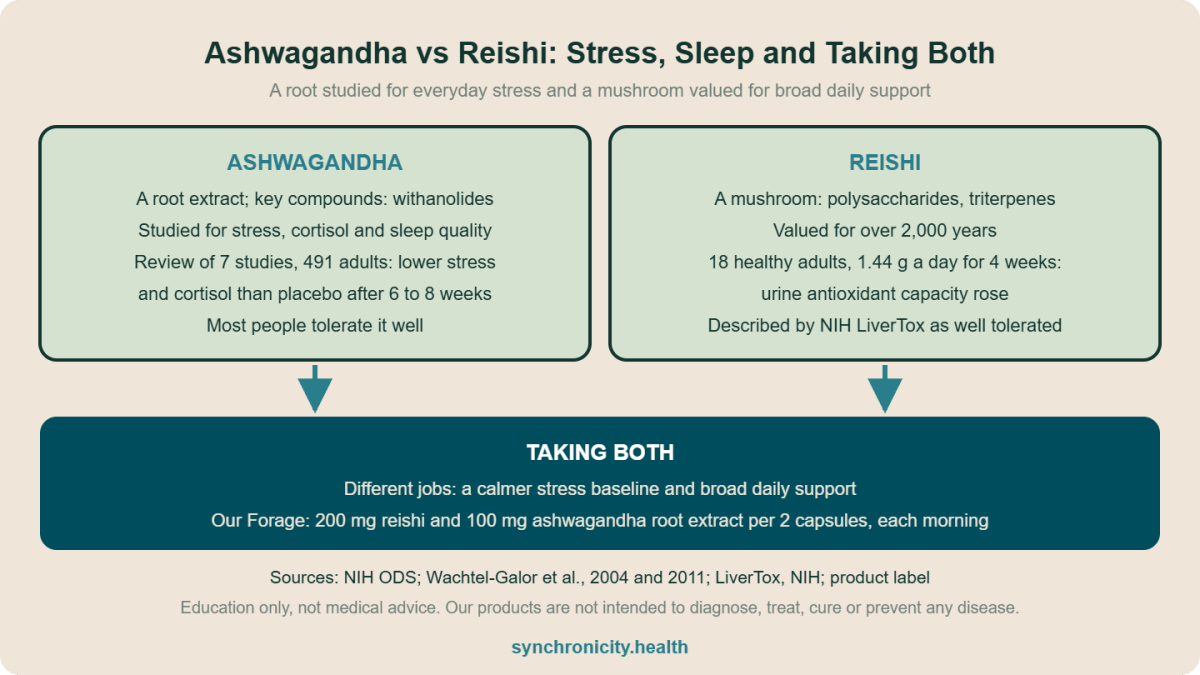
Ashwagandha and reishi are both called adaptogens, but they are very different. Ashwagandha is a root with human trials on everyday stress, cortisol and sleep quality. Reishi is a mushroom valued for over 2,000 years and described in Chinese tradition as easing the mind, with human research on antioxidant markers and tolerance, and animal studies on sleep. They do not compete, so you can take ashwagandha and reishi together, and our Forage contains both.
Key Takeaways
- Ashwagandha is the root of an evergreen shrub; a review of 7 studies with 491 adults found lower stress and cortisol than placebo after 6 to 8 weeks (NIH ODS).
- Reishi is a mushroom rich in polysaccharides and more than 100 bitter triterpenes, recognized as a medicinal mushroom for over 2,000 years (Wachtel-Galor et al., 2011).
- In 18 healthy adults, 1.44 g of reishi a day for 4 weeks raised antioxidant capacity in urine, with no sign of liver, kidney or DNA toxicity (Wachtel-Galor et al., 2004).
- For stress and sleep, ashwagandha has the larger body of human trials; reishi brings a long history of calming use and broad daily support.
- You can take both. Our Forage has 200 mg of reishi and 100 mg of ashwagandha root extract per 2 capsules.

Featured in this article
ForageSeven functional mushroom fruiting body extracts, including lion's mane, plus Himalayan shilajit and ashwagandha root extract for everyday energy and resilience.
Shop ForageThird-party tested ingredients. Vegan capsules.
Ashwagandha vs Reishi at a Glance
| Ashwagandha | Reishi | |
|---|---|---|
| What it is | The root of an evergreen shrub (Withania somnifera) | A large, glossy, woody mushroom (Ganoderma lucidum) |
| Key compounds | Withanolides | Polysaccharides, peptidoglycans and triterpenes |
| Main focus of human research | Everyday stress, cortisol and sleep quality | Antioxidant markers and tolerance |
| Sleep research | Human trials and a review of 5 trials | Mostly animal studies so far |
| Amounts studied | 240 to 1,250 mg a day of extract | 1.44 g a day; usual range 500 mg to 3 g |
| Safety record | Well tolerated; mild side effects in trials of up to about 3 months | Described by NIH LiverTox as well tolerated |
Ashwagandha: What Studies Measured
Ashwagandha is an evergreen shrub, also called winter cherry or Indian ginseng, though it is not a ginseng. It has a long history in Ayurvedic medicine as an adaptogen. Most supplements use the root, and its best known compounds are withanolides (NIH ODS).
- Stress and cortisol. A 2021 review of 7 studies with 491 adults found lower stress, sleeplessness, fatigue and blood cortisol than placebo after 6 to 8 weeks. Doses ranged from 240 to 1,250 mg a day of extract, and benefits looked greater at 500 to 600 mg a day (NIH ODS).
- A longer trial. In a 90-day trial, 130 adults took 300 mg a day of a root extract; stress and sleep quality improved and blood cortisol fell (NIH ODS).
- Sleep. A review of 5 trials with 400 adults found a small but significant benefit for sleep, larger at 600 mg a day or more and with 8 weeks or longer. People also felt more alert on waking, and no serious side effects were reported (Cheah et al., 2021).
Our guide to ashwagandha benefits covers dose and timing, and our ashwagandha ingredient page covers the root itself.
Reishi: What Studies Measured
Reishi, also called lingzhi, is a large, dark mushroom with a glossy, varnished-looking surface and a woody texture. It has been recognized as a medicinal mushroom for over 2,000 years. Its three main active groups are polysaccharides, peptidoglycans and triterpenes; more than 100 triterpenes have been found in it, and they give reishi its bitter taste. The Chinese pharmacopoeia describes it as replenishing qi and easing the mind (Wachtel-Galor et al., 2011).
- Healthy adults. In a double-blind, placebo-controlled crossover study, 18 healthy adults aged 22 to 52 took 1.44 g of reishi a day, equal to 13.2 g of fresh mushroom, for 4 weeks. Antioxidant capacity in their urine rose, other markers did not change significantly, and there was no sign of liver, kidney or DNA toxicity, which the authors called reassuring (Wachtel-Galor et al., 2004).
- Sleep, in mice. Mice given a reishi extract daily for 4 weeks fell asleep sooner and slept longer in a standard sleep test, and serotonin in the part of the brain that governs sleep went up. The effect disappeared when their gut flora were removed, which points to a gut link (Yao et al., 2021). This was an animal study, so it points to how reishi may work rather than a result in people.
Our guides to reishi mushroom benefits and reishi for sleep go deeper, and our reishi ingredient page covers the mushroom.
Ashwagandha vs Reishi for Stress and Sleep
If your main goal is handling everyday stress, ashwagandha is the better studied choice: its trials measured stress scores and cortisol in people, over 6 weeks to 90 days. For sleep, ashwagandha also has human trials and a pooled review, while reishi's sleep research so far comes mostly from animals.
Reishi earns its place differently. It has centuries of use as a calming mushroom, a well tolerated record in people, and polysaccharides and triterpenes behind its antioxidant research. Many people take it for broad daily support rather than for one measured outcome. That is also why the two are so often taken together: ashwagandha for a calmer stress baseline, reishi for steady, all-round support. Our guide to adaptogenic mushrooms explains how mushrooms like reishi differ from herbal adaptogens like ashwagandha.
Can You Take Ashwagandha and Reishi Together?
Yes. No trial has measured the pair, so the evidence comes from each one on its own, but one is a root and the other a mushroom, they work in different ways, and blends such as our Forage combine them. Neither the NIH fact sheet on ashwagandha nor the NIH LiverTox entry on reishi lists the other as a concern.
Timing is flexible. Ashwagandha works as a daily habit at any time of day, and reishi has no set time either, so taking them together in the morning is the simplest routine. If ashwagandha makes you a little drowsy, one of its possible mild side effects, take your dose in the evening instead. For other pairings with ashwagandha, see lion's mane vs ashwagandha, and for reishi alongside another mushroom, lion's mane vs reishi. If energy is more your goal than calm, our guide to cordyceps vs ashwagandha compares ashwagandha with the energy mushroom.
Who Might Choose Which
| Your main goal | A good fit |
|---|---|
| Handling everyday stress | Ashwagandha |
| Better sleep quality backed by human trials | Ashwagandha |
| Broad daily support from a traditional mushroom | Reishi |
| Antioxidant support | Reishi |
| Calm plus all-round support in one routine | Both, taken together |
Safety: What to Know About Each
Most people tolerate both well. Reishi is described by the NIH LiverTox database as well tolerated: in small placebo-controlled trials, side effects were few or absent and liver enzymes did not change. Rare cases of liver injury have been reported, many poorly documented and without other causes ruled out, and people recovered after stopping. The usual daily amount is 500 mg to 3 g (LiverTox, NIH). Skip it if you are allergic to mushrooms.
Most people tolerate ashwagandha well. In trials lasting up to about 3 months, side effects were mild, such as stomach upset, loose stools, nausea and drowsiness. Liver problems have been reported rarely. Some experts advise against it in pregnancy and breastfeeding, and people with a thyroid condition or on thyroid medicine should check with their clinician first (NIH ODS). If you take any prescription medicine, ask your clinician before adding either.
Where Our Forage Fits
Our Forage puts ashwagandha and reishi in one daily capsule. Each 2-capsule serving has 200 mg of reishi 8:1 fruiting body extract and 100 mg of ashwagandha root extract, alongside lion's mane and cordyceps at 200 mg each, chaga, maitake, turkey tail and shiitake at 150 mg each (all 8:1 fruiting body extracts) and 100 mg of Himalayan shilajit extract, with ginger extract in vegan capsules. Take 2 capsules daily in the morning, with or without food. It is made with third-party tested ingredients. The studies above tested each ingredient on its own, so they describe the ingredients rather than our blend.
If you would rather drink your mushrooms, our Mushroom Cacao is a mushroom hot chocolate with 500 mg each of lion's mane and cordyceps 8:1 fruiting body extracts per serving, 15 calories and 0 g sugar, in a 28-serving jar. Cocoa and cacao naturally contain a small amount of caffeine, so it is not caffeine free. For more on calm and resilience, see our stress, mood and nervous system guide.
Benefits build with consistent daily use. Months 1 to 2 can bring early changes, and 3 months and beyond is where the full benefit builds.

Featured in this article
Mushroom CacaoA mushroom hot chocolate made with cocoa and cacao, with 500 mg each of lion's mane and cordyceps per serving and 0g sugar.
Shop Mushroom CacaoThird-party tested ingredients. 15 calories per serving.
Frequently Asked Questions
Is ashwagandha or reishi better?
It depends on your goal. Ashwagandha has more human trials on stress, cortisol and sleep quality; reishi is a traditional mushroom taken for broad daily support, with human research on antioxidant markers.
Can you take ashwagandha and reishi together?
Yes. They work in different ways, neither one's NIH safety information lists the other, and many blends, including our Forage, combine them.
Is reishi an adaptogen like ashwagandha?
Both are commonly called adaptogens. Ashwagandha is an herbal root with an Ayurvedic history; reishi is a mushroom recognized for over 2,000 years and described in Chinese tradition as easing the mind.
Which is better for stress, reishi or ashwagandha?
Ashwagandha. A review of 7 studies with 491 adults found lower stress and cortisol than placebo after 6 to 8 weeks.
Which is better for sleep, reishi or ashwagandha?
Ashwagandha has human sleep trials, with a larger effect after 8 weeks or more. Reishi's sleep research so far is mostly in animals.
When should I take ashwagandha and reishi?
Neither has a set time, so taking both in the morning is easiest. Move ashwagandha to the evening if it makes you drowsy.
How long do ashwagandha and reishi take to work?
The studies above ran 4 weeks to 90 days. Plan on months of steady daily use rather than days.
Who should not take ashwagandha or reishi?
Check with a clinician first if you are pregnant or breastfeeding, have a thyroid or liver condition, have a mushroom allergy, or take prescription medicine.
Sources
- NIH Office of Dietary Supplements. Ashwagandha: Fact Sheet for Health Professionals. https://ods.od.nih.gov/factsheets/Ashwagandha-HealthProfessional/
- Cheah KL, Norhayati MN, Husniati Yaacob L, Abdul Rahman R. Effect of Ashwagandha (Withania somnifera) extract on sleep: a systematic review and meta-analysis. PLoS One, 2021. https://journals.plos.org/plosone/article?id=10.1371/journal.pone.0257843
- Wachtel-Galor S, Yuen J, Buswell JA, Benzie IFF. Ganoderma lucidum (Lingzhi or Reishi): a medicinal mushroom. In: Herbal Medicine: Biomolecular and Clinical Aspects, 2nd edition, 2011. https://www.ncbi.nlm.nih.gov/books/NBK92757/
- Wachtel-Galor S, Tomlinson B, Benzie IFF. Ganoderma lucidum ('Lingzhi'), a Chinese medicinal mushroom: biomarker responses in a controlled human supplementation study. British Journal of Nutrition, 2004. https://www.cambridge.org/core/journals/british-journal-of-nutrition/article/ganoderma-lucidum-lingzhi-a-chinese-medicinal-mushroom-biomarker-responses-in-a-controlled-human-supplementation-study/CC461FCEFC25B893402F61174E70E85F
- Yao C, Wang Z, Jiang H, et al. Ganoderma lucidum promotes sleep through a gut microbiota-dependent and serotonin-involved pathway in mice. Scientific Reports, 2021. https://www.nature.com/articles/s41598-021-92913-6
- LiverTox: Clinical and Research Information on Drug-Induced Liver Injury. Lingzhi, Reishi. National Institutes of Health. https://www.ncbi.nlm.nih.gov/books/NBK609014/
These statements have not been evaluated by the Food and Drug Administration. This content is for education and is not medical advice. Our products are not intended to diagnose, treat, cure or prevent any disease. Talk with a healthcare provider before starting a new supplement if you are pregnant, breastfeeding or taking medication.


Leave a comment
All comments are moderated before being published.
This site is protected by hCaptcha and the hCaptcha Privacy Policy and Terms of Service apply.