
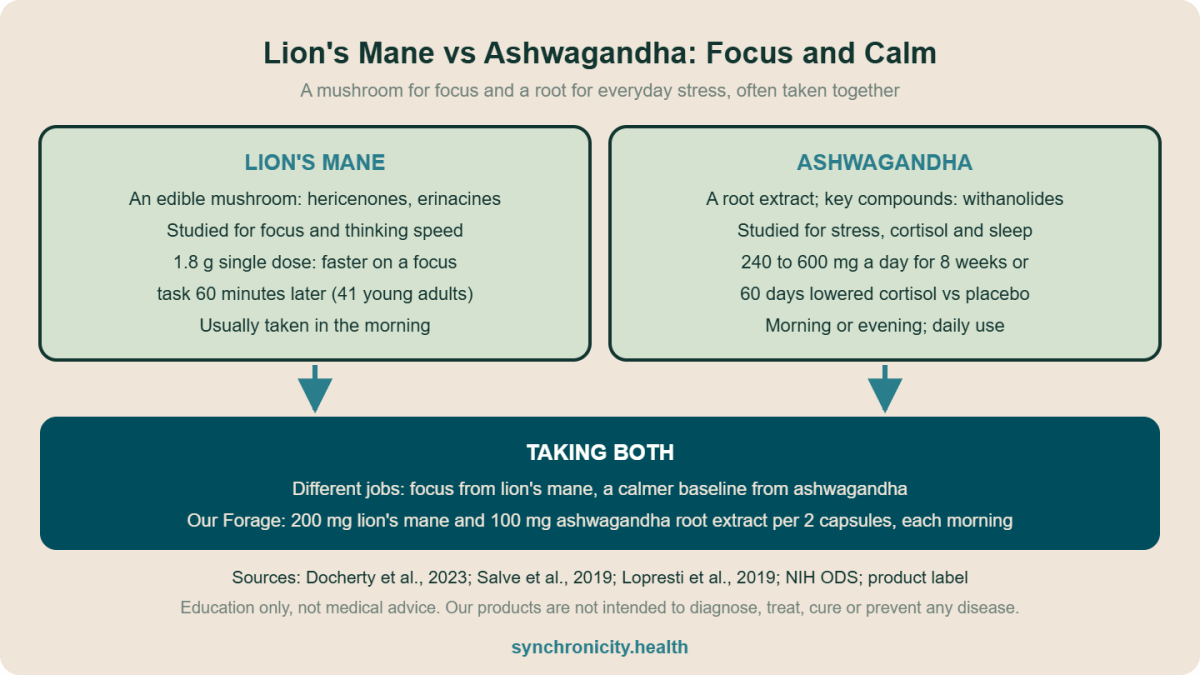
Lion's mane and ashwagandha do different jobs. Lion's mane is a mushroom studied mainly for focus and thinking speed, while ashwagandha is a root studied mainly for everyday stress, cortisol and sleep quality. Because they work in different ways, you can take lion's mane and ashwagandha together, and many daily blends, including our Forage, combine them.
Key Takeaways
- Lion's mane is a mushroom; in a pilot trial of 41 healthy young adults, a single 1.8 g dose made them faster on a focus task 60 minutes later (Docherty et al., 2023).
- Ashwagandha is a root; in trials of stressed adults, 240 to 600 mg a day for 8 weeks or 60 days lowered cortisol compared with placebo (Salve et al., 2019; Lopresti et al., 2019).
- Lion's mane leans toward focus and thinking; ashwagandha leans toward stress, calm and sleep quality.
- You can take both, and they suit the same morning routine. Our Forage has 200 mg of lion's mane and 100 mg of ashwagandha root extract per 2 capsules.
- Both are well tolerated by most people; ashwagandha has a few specific notes on pregnancy, thyroid and the liver (NIH ODS).

Featured in this article
ForageSeven functional mushroom fruiting body extracts, including lion's mane, plus Himalayan shilajit and ashwagandha root extract for everyday energy and resilience.
Shop ForageThird-party tested ingredients. Vegan capsules.
Lion's Mane vs Ashwagandha at a Glance
| Lion's mane | Ashwagandha | |
|---|---|---|
| What it is | An edible mushroom (Hericium erinaceus) | The root of a shrub (Withania somnifera) |
| Key compounds | Hericenones and erinacines | Withanolides |
| Main focus of research | Focus, thinking speed and memory scores | Everyday stress, cortisol and sleep quality |
| Amounts studied | 1.8 g to 3 g a day of dried mushroom | 240 to 600 mg a day of root extract |
| Trial length | A single dose up to 16 weeks | 8 weeks to 60 days in most trials |
| Usual time of day | Morning | Morning or evening; trials often split it into two doses |
Lion's Mane: What It Is and What Studies Measured
Lion's mane is an edible mushroom. It contains compounds called hericenones and erinacines, which lab and animal studies link to new nerve cell growth and to BDNF, a protein involved in brain signaling (Saitsu et al., 2019; Menon et al., 2025). In people, research has looked at focus and thinking:
- Healthy young adults. In a double-blind pilot study, 41 adults aged 18 to 45 took 1.8 g of lion's mane or a placebo. After a single dose, they were faster on the Stroop task, a test of focus, 60 minutes later. After 28 days, there was a trend toward lower self-rated stress (Docherty et al., 2023).
- Adults aged 50 to 80. In a 16-week trial, 30 Japanese adults with mild cognitive impairment took tablets of dried lion's mane, four 250 mg tablets three times a day, or a placebo. Scores on a cognitive function scale were higher than placebo at weeks 8, 12 and 16 and rose the longer people took it. Four weeks after stopping, scores fell again (Mori et al., 2009).
Both are small studies, and together they show what lion's mane is studied for: focus and thinking, with steady daily use. Our guide to lion's mane for focus and concentration goes deeper, and our lion's mane ingredient page covers the mushroom itself. For a timeline and guidance written for women, see how long lion's mane takes to work and lion's mane for women.
Ashwagandha: What It Is and What Studies Measured
Ashwagandha is an evergreen shrub, sometimes called winter cherry or Indian ginseng, though it is not a ginseng. Most supplements use the root. Its best known compounds are withanolides, and several trials found it lowered cortisol, a stress hormone (NIH ODS).
- Stress and cortisol. In a 60-day trial, 64 adults with a history of chronic stress took 300 mg of root extract twice a day or a placebo. Stress scores and blood cortisol fell more than on placebo, and side effects were mild and similar in both groups (Chandrasekhar et al., 2012).
- Two doses compared. In an 8-week trial, 60 stressed but healthy adults took 250 mg or 600 mg a day, or a placebo. Both doses lowered perceived stress and cortisol, and sleep quality improved compared with placebo (Salve et al., 2019).
- A lower dose. In a 60-day trial, 60 healthy adults with high self-reported stress took 240 mg once a day. Morning cortisol fell more than on placebo (Lopresti et al., 2019).
- Sleep. A review of 5 trials with 400 people found a small but significant benefit for sleep, larger at 600 mg a day or more and with 8 weeks or longer of use (Cheah et al., 2021).
For more, see our guides to ashwagandha benefits and ashwagandha vs L-theanine, our ashwagandha ingredient page and our stress, mood and nervous system guide. If memory is your focus, our guide to bacopa vs ashwagandha compares ashwagandha with an herb studied for memory, learning and attention.
Can You Take Lion's Mane and Ashwagandha Together?
Yes. The trials above tested each one on its own, so there is no measured result for the pair yet. Neither one's safety information lists the other as a concern, and they act on different things. Lion's mane is studied for focus and thinking; ashwagandha for stress, cortisol and sleep quality. That is why they are often paired in one daily routine: one for a clear head, the other for a calmer baseline.
Timing is easy. Lion's mane is usually taken in the morning. Ashwagandha works as a daily habit, and trials gave it in the morning, the evening or both, so taking the two together in the morning is simple. If ashwagandha makes you a little drowsy, which the NIH lists as one of its mild side effects, move it to the evening. Lion's mane and ashwagandha are also often combined with other mushrooms in adaptogenic blends; our guide to adaptogenic mushrooms covers the wider group.
Who Might Choose Which
| Your main goal | A good fit |
|---|---|
| Sharper focus at work or study | Lion's mane |
| Handling everyday stress | Ashwagandha |
| Better sleep quality | Ashwagandha |
| Focus and calm in one routine | Both, in the morning |
| A warm drink instead of capsules | Lion's mane in a mushroom cocoa drink |
Safety: What to Know About Each
Most people tolerate both well. For lion's mane, a 2025 systematic review found side effects are rarely reported; the ones noted were stomach discomfort, headache and, rarely, allergic reactions (Menon et al., 2025). In the 16-week trial above, lab tests showed no adverse effects (Mori et al., 2009). Anyone with a mushroom allergy should skip it.
Ashwagandha is well tolerated for up to about 3 months, and its common side effects are mild: stomach upset, loose stools, nausea and drowsiness. Liver problems have been reported rarely. Some experts advise against it in pregnancy and breastfeeding, and because small studies showed changes in thyroid hormones, people with a thyroid condition or on thyroid medicine should check with their clinician first (NIH ODS). If you take any prescription medicine, ask your clinician before adding either. Our guides to lion's mane side effects and ashwagandha side effects cover the details.
Where Our Forage Fits
Our Forage puts both in one daily capsule. Each 2-capsule serving has 200 mg of lion's mane 8:1 fruiting body extract and 100 mg of ashwagandha root extract, alongside cordyceps 200 mg, reishi 200 mg, chaga, maitake, turkey tail and shiitake 150 mg each (all 8:1 fruiting body extracts) and 100 mg of Himalayan shilajit extract, with ginger extract in vegan capsules. Take 2 capsules daily in the morning, with or without food. It is made with third-party tested ingredients.
If you prefer a warm drink, our Mushroom Cacao gives 500 mg each of lion's mane and cordyceps 8:1 fruiting body extracts per serving in a mushroom hot chocolate with 15 calories and 0 g sugar. Cocoa and cacao naturally contain a small amount of caffeine, so it is not caffeine free.
Benefits build with consistent daily use. Months 1 to 2 can bring early changes, and 3 months and beyond is where the full benefit builds.

Featured in this article
Mushroom CacaoA mushroom hot chocolate made with cocoa and cacao, with 500 mg each of lion's mane and cordyceps per serving and 0g sugar.
Shop Mushroom CacaoThird-party tested ingredients. 15 calories per serving.
Frequently Asked Questions
Can you take lion's mane and ashwagandha together?
Yes. They work on different things, focus for lion's mane and stress and sleep quality for ashwagandha, and neither one's safety information lists the other as a concern. Many daily blends, including our Forage, contain both.
Which is better, lion's mane or ashwagandha?
It depends on your goal. Lion's mane is studied for focus and thinking speed; ashwagandha is studied for everyday stress, cortisol and sleep quality.
What are the benefits of lion's mane with ashwagandha?
Together they cover two goals in one routine: lion's mane for focus and ashwagandha for a calmer baseline. Each was studied on its own, with daily use over weeks.
Is lion's mane or ashwagandha better for stress?
Ashwagandha has more research on stress, with trials showing lower stress scores and cortisol. Lion's mane showed a trend toward lower self-rated stress after 28 days in one small study.
Is lion's mane or ashwagandha better for focus?
Lion's mane. In a pilot study, a single 1.8 g dose made healthy young adults faster on a focus task 60 minutes later.
Should I take lion's mane and ashwagandha in the morning or at night?
Most people take lion's mane in the morning. Ashwagandha works at either time, so taking both in the morning is simple; move ashwagandha to the evening if it makes you drowsy.
How long do lion's mane and ashwagandha take to work?
Ashwagandha trials ran 8 weeks to 60 days, and lion's mane scores kept rising over 16 weeks in one trial. Plan on months of steady daily use.
Who should not take ashwagandha?
Check with a clinician first if you are pregnant or breastfeeding, have a thyroid or liver condition, or take prescription medicine.
Sources
- Docherty S, Doughty FL, Smith EF. The acute and chronic effects of lion's mane mushroom supplementation on cognitive function, stress and mood in young adults: a double-blind, parallel groups, pilot study. Nutrients, 2023. https://europepmc.org/article/MED/38004235
- Mori K, Inatomi S, Ouchi K, Azumi Y, Tuchida T. Improving effects of the mushroom Yamabushitake (Hericium erinaceus) on mild cognitive impairment: a double-blind placebo-controlled clinical trial. Phytotherapy Research, 2009. https://europepmc.org/article/MED/18844328
- Saitsu Y, Nishide A, Kikushima K, Shimizu K, Ohnuki K. Improvement of cognitive functions by oral intake of Hericium erinaceus. Biomedical Research, 2019. https://europepmc.org/article/MED/31413233
- Menon A, Jalal A, Arshad Z, Nawaz FA, Kashyap R. Benefits, side effects, and uses of Hericium erinaceus as a supplement: a systematic review. Frontiers in Nutrition, 2025. https://europepmc.org/article/MED/40959699
- Chandrasekhar K, Kapoor J, Anishetty S. A prospective, randomized double-blind, placebo-controlled study of safety and efficacy of a high-concentration full-spectrum extract of ashwagandha root in reducing stress and anxiety in adults. Indian Journal of Psychological Medicine, 2012. https://europepmc.org/article/MED/23439798
- Salve J, Pate S, Debnath K, Langade D. Adaptogenic and anxiolytic effects of ashwagandha root extract in healthy adults: a double-blind, randomized, placebo-controlled clinical study. Cureus, 2019. https://europepmc.org/article/MED/32021735
- Lopresti AL, Smith SJ, Malvi H, Kodgule R. An investigation into the stress-relieving and pharmacological actions of an ashwagandha (Withania somnifera) extract: a randomized, double-blind, placebo-controlled study. Medicine (Baltimore), 2019. https://europepmc.org/article/MED/31517876
- Cheah KL, Norhayati MN, Husniati Yaacob L, Abdul Rahman R. Effect of Ashwagandha (Withania somnifera) extract on sleep: a systematic review and meta-analysis. PLoS One, 2021. https://europepmc.org/article/MED/34559859
- NIH Office of Dietary Supplements. Ashwagandha: Fact Sheet for Health Professionals. https://ods.od.nih.gov/factsheets/Ashwagandha-HealthProfessional/
These statements have not been evaluated by the Food and Drug Administration. This content is for education and is not medical advice. Our products are not intended to diagnose, treat, cure or prevent any disease. Talk with a healthcare provider before starting a new supplement if you are pregnant, breastfeeding or taking medication.


Leave a comment
All comments are moderated before being published.
This site is protected by hCaptcha and the hCaptcha Privacy Policy and Terms of Service apply.