
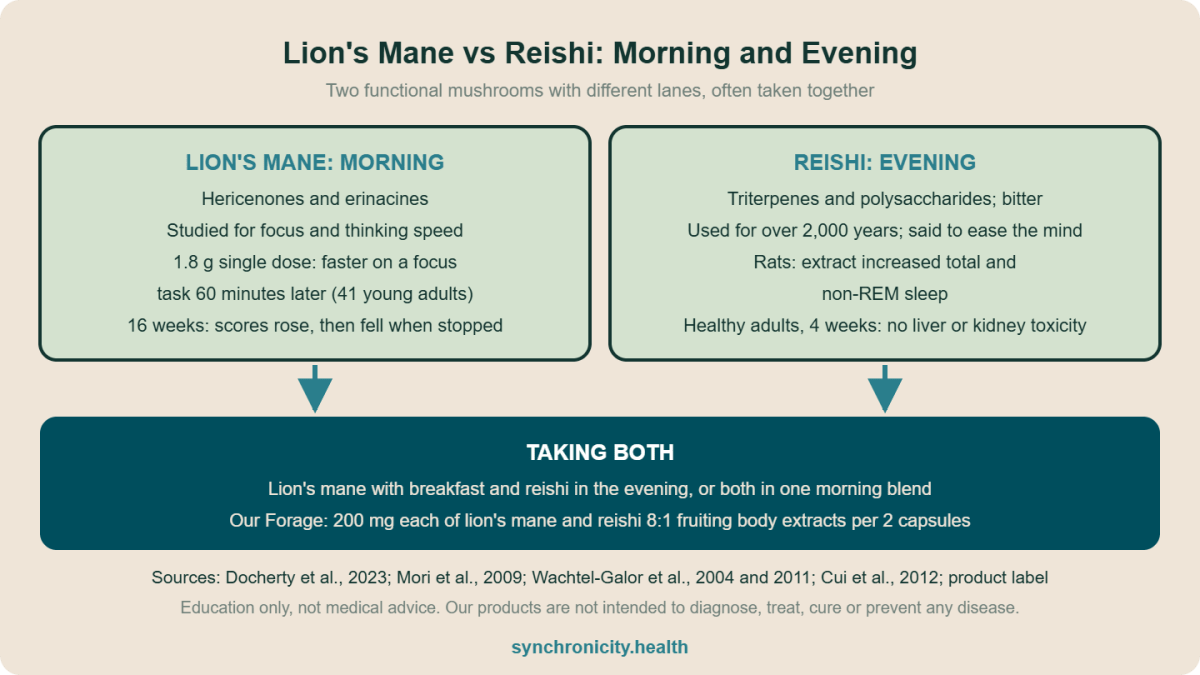
Lion's mane and reishi are both functional mushrooms, but they suit different parts of the day. Lion's mane is studied for focus and thinking speed, so most people take it in the morning. Reishi has a long history of use to calm the mind and is the mushroom people reach for in the evening. You can take lion's mane and reishi together, and many daily blends, including our Forage, contain both.
Key Takeaways
- Lion's mane is studied for focus: in a pilot trial of 41 healthy young adults, a single 1.8 g dose made them faster on a focus task 60 minutes later (Docherty et al., 2023).
- Reishi has been used for over 2,000 years in Asia, and China's official pharmacopoeia describes it as able to "ease the mind" (Wachtel-Galor et al., 2011).
- For sleep, reishi is the better fit: a fruiting body extract increased total and non-REM sleep in rats (Cui et al., 2012), while lion's mane research centers on daytime focus.
- In a 4-week controlled study in 18 healthy adults, 1.44 g a day of reishi showed no sign of liver, kidney or DNA toxicity (Wachtel-Galor et al., 2004).
- You can take both. Our Forage has 200 mg each of lion's mane and reishi 8:1 fruiting body extracts per 2 capsules.

Featured in this article
ForageSeven functional mushroom fruiting body extracts, including lion's mane, plus Himalayan shilajit and ashwagandha root extract for everyday energy and resilience.
Shop ForageThird-party tested ingredients. Vegan capsules.
Lion's Mane vs Reishi at a Glance
| Lion's mane | Reishi | |
|---|---|---|
| What it looks like | An edible mushroom | A large, dark, glossy mushroom with a woody texture |
| Key compounds | Hericenones and erinacines | Triterpenes (ganoderic acids) and polysaccharides |
| Main focus of research | Focus, thinking speed and memory scores | Calm, sleep and antioxidant status |
| Best time of day | Morning | Evening, or as part of a morning blend |
Lion's Mane: The Focus Mushroom
Lion's mane (Hericium erinaceus) contains hericenones and erinacines, compounds that lab and animal studies link to new nerve cell growth and to BDNF, a protein involved in brain signaling (Saitsu et al., 2019; Menon et al., 2025). Human studies have measured focus and thinking:
- In a double-blind pilot study, 41 healthy adults aged 18 to 45 took 1.8 g of lion's mane or a placebo. After one dose they were faster on the Stroop task, a focus test, 60 minutes later, and after 28 days there was a trend toward lower self-rated stress (Docherty et al., 2023).
- In a 16-week trial, 30 Japanese adults aged 50 to 80 with mild cognitive impairment took four 250 mg tablets of dried lion's mane three times a day or a placebo. Their cognitive function scores were higher than placebo at weeks 8, 12 and 16, then fell 4 weeks after they stopped (Mori et al., 2009).
Both are small studies, and they point to the same habit: steady daily use, usually in the morning when focus matters most. Read more in lion's mane for focus and concentration and on our lion's mane ingredient page.
Reishi: The Evening Mushroom
Reishi (Ganoderma lucidum), also called lingzhi, has been valued as a health mushroom in China, Japan and other Asian countries for over 2,000 years. Its main active compounds are polysaccharides, including beta-glucans, and more than 100 triterpenes, mostly ganoderic and lucidenic acids, which give it a bitter taste. China's official pharmacopoeia describes reishi as able to "ease the mind", and that is the root of its reputation as a calming, evening mushroom (Wachtel-Galor et al., 2011).
In a controlled cross-over study, 18 healthy adults aged 22 to 52 took 1.44 g a day of a reishi extract, equal to 13.2 g of fresh mushroom, or a placebo for 4 weeks. Urine antioxidant capacity rose, and there was no sign of liver, kidney or DNA toxicity (Wachtel-Galor et al., 2004). Our guide to reishi mushroom benefits and our reishi ingredient page cover more.
Lion's Mane vs Reishi for Sleep
If sleep is your goal, reishi is the one to look at. In a study in rats, 3 days of an extract from reishi fruiting bodies increased total sleep time and non-REM sleep, and the researchers linked the effect to TNF-alpha, a cytokine, or signaling protein (Cui et al., 2012). That is an animal study, and it lines up with reishi's long traditional use to ease the mind.
Lion's mane research is about daytime focus rather than sleep, so it is usually taken in the morning. A simple split is lion's mane with breakfast and reishi in the evening, or both in one morning blend if you would rather keep one routine. Our guide to reishi for sleep covers timing in detail, and our sleep health guide covers the habits that matter most.
Lion's Mane vs Cordyceps vs Reishi
These three are often compared because they turn up in the same blends. Each has its own lane:
| Mushroom | Studied for | Usual time |
|---|---|---|
| Lion's mane | Focus and thinking speed | Morning |
| Cordyceps | Exercise: VO2max and time to exhaustion | Morning or before training |
| Reishi | Calm, sleep and antioxidant status | Evening, or in a morning blend |
For cordyceps, a 3-week trial in 28 young adults taking 4 g a day of a mushroom blend containing Cordyceps militaris found VO2max improved and, in the mushroom group, time to exhaustion improved too (Hirsch et al., 2017). Our guide to lion's mane vs cordyceps compares those two in depth, and our guide to adaptogenic mushrooms covers the wider group. For more reishi comparisons, see cordyceps vs reishi, chaga vs reishi, reishi vs turkey tail and ashwagandha vs reishi. For another mushroom often compared with reishi, see chaga mushroom benefits, and for women weighing their options, see lion's mane for women. For lion's mane next to the gut and immune mushroom, see our guide to lion's mane vs turkey tail. To weigh reishi against maitake, another mushroom in Forage, read our guide to maitake vs reishi.
Taking Lion's Mane and Reishi Together
Yes, you can take lion's mane and reishi together. The studies above tested each one on its own, so there is no measured result for the pair yet, but they cover different ground: lion's mane for focus, reishi for a calmer baseline. That is why so many blends combine them.
Most people tolerate both well. A 2025 systematic review found side effects from lion's mane are rarely reported, the ones noted being stomach discomfort, headache and, rarely, allergic reactions (Menon et al., 2025), and the reishi study above found no sign of liver, kidney or DNA toxicity over 4 weeks. Skip both if you have a mushroom allergy, and check with your clinician first if you are pregnant or breastfeeding or take prescription medicine. Our guide to lion's mane side effects has more.
Who Might Choose Which
| Your main goal | A good fit |
|---|---|
| Focus for work or study | Lion's mane, in the morning |
| An evening wind-down | Reishi |
| Focus and calm in one routine | Both, in a daily blend |
| A warm morning drink | Lion's mane in a mushroom cocoa drink |
Where Our Forage Fits
Our Forage gives you both in one capsule routine. Each 2-capsule serving has 200 mg each of lion's mane, reishi and cordyceps, plus 150 mg each of chaga, maitake, turkey tail and shiitake, all as 8:1 fruiting body extracts, with 100 mg of Himalayan shilajit extract, 100 mg of ashwagandha root extract and ginger extract in vegan capsules. Take 2 capsules daily in the morning, with or without food. It is made with third-party tested ingredients.
If you would rather drink your lion's mane, our Mushroom Cacao is a mushroom hot chocolate with 500 mg each of lion's mane and cordyceps 8:1 fruiting body extracts per serving, 15 calories and 0 g sugar. Cocoa and cacao naturally contain a small amount of caffeine, so it is not caffeine free; its lift comes mainly from theobromine, which makes it a morning or early afternoon drink.
Benefits build with consistent daily use. Months 1 to 2 can bring early changes, and 3 months and beyond is where the full benefit builds.

Featured in this article
Mushroom CacaoA mushroom hot chocolate made with cocoa and cacao, with 500 mg each of lion's mane and cordyceps per serving and 0g sugar.
Shop Mushroom CacaoThird-party tested ingredients. 15 calories per serving.
Frequently Asked Questions
What is the difference between lion's mane and reishi?
Lion's mane is studied for focus and thinking speed and is usually taken in the morning. Reishi is traditionally used to ease the mind and is the mushroom people choose for the evening.
Can you take lion's mane and reishi together?
Yes. They cover different ground, focus and calm, and many daily blends, including our Forage, contain both.
Is lion's mane or reishi better for sleep?
Reishi. A reishi extract increased total and non-REM sleep in rats, and it has a long traditional use for calm. Lion's mane research centers on daytime focus.
Is lion's mane or reishi better for focus?
Lion's mane. In a pilot study, a single 1.8 g dose made healthy young adults faster on a focus task 60 minutes later.
Should I take lion's mane in the morning and reishi at night?
That is a common split. If you prefer one routine, a morning blend with both works too.
Does reishi make you sleepy?
In a rat study, a reishi extract increased sleep time, and in people it is traditionally used to ease the mind, which is why many save it for the evening. Notice how you feel and pick the time that suits you.
Which is better: lion's mane, cordyceps or reishi?
Each has its own lane: lion's mane for focus, cordyceps for exercise, reishi for calm and sleep. Blends that include all three cover the whole day.
How long do lion's mane and reishi take to work?
The studies above ran 4 to 16 weeks, and lion's mane scores kept rising through 16 weeks in one trial. Plan on months of steady daily use.
Sources
- Docherty S, Doughty FL, Smith EF. The acute and chronic effects of lion's mane mushroom supplementation on cognitive function, stress and mood in young adults: a double-blind, parallel groups, pilot study. Nutrients, 2023. https://europepmc.org/article/MED/38004235
- Mori K, Inatomi S, Ouchi K, Azumi Y, Tuchida T. Improving effects of the mushroom Yamabushitake (Hericium erinaceus) on mild cognitive impairment: a double-blind placebo-controlled clinical trial. Phytotherapy Research, 2009. https://europepmc.org/article/MED/18844328
- Saitsu Y, Nishide A, Kikushima K, Shimizu K, Ohnuki K. Improvement of cognitive functions by oral intake of Hericium erinaceus. Biomedical Research, 2019. https://europepmc.org/article/MED/31413233
- Menon A, Jalal A, Arshad Z, Nawaz FA, Kashyap R. Benefits, side effects, and uses of Hericium erinaceus as a supplement: a systematic review. Frontiers in Nutrition, 2025. https://europepmc.org/article/MED/40959699
- Wachtel-Galor S, Yuen J, Buswell JA, Benzie IFF. Ganoderma lucidum (Lingzhi or Reishi): a medicinal mushroom. In: Herbal Medicine: Biomolecular and Clinical Aspects, 2nd edition, 2011. https://www.ncbi.nlm.nih.gov/books/NBK92757/
- Wachtel-Galor S, Tomlinson B, Benzie IFF. Ganoderma lucidum ("Lingzhi"), a Chinese medicinal mushroom: biomarker responses in a controlled human supplementation study. British Journal of Nutrition, 2004. https://doi.org/10.1079/BJN20041039
- Cui XY, Cui SY, Zhang J, et al. Extract of Ganoderma lucidum prolongs sleep time in rats. Journal of Ethnopharmacology, 2012. https://europepmc.org/article/MED/22207209
- Hirsch KR, Smith-Ryan AE, Roelofs EJ, Trexler ET, Mock MG. Cordyceps militaris improves tolerance to high-intensity exercise after acute and chronic supplementation. Journal of Dietary Supplements, 2017. https://europepmc.org/article/MED/27408987
These statements have not been evaluated by the Food and Drug Administration. This content is for education and is not medical advice. Our products are not intended to diagnose, treat, cure or prevent any disease. Talk with a healthcare provider before starting a new supplement if you are pregnant, breastfeeding or taking medication.


Leave a comment
All comments are moderated before being published.
This site is protected by hCaptcha and the hCaptcha Privacy Policy and Terms of Service apply.