
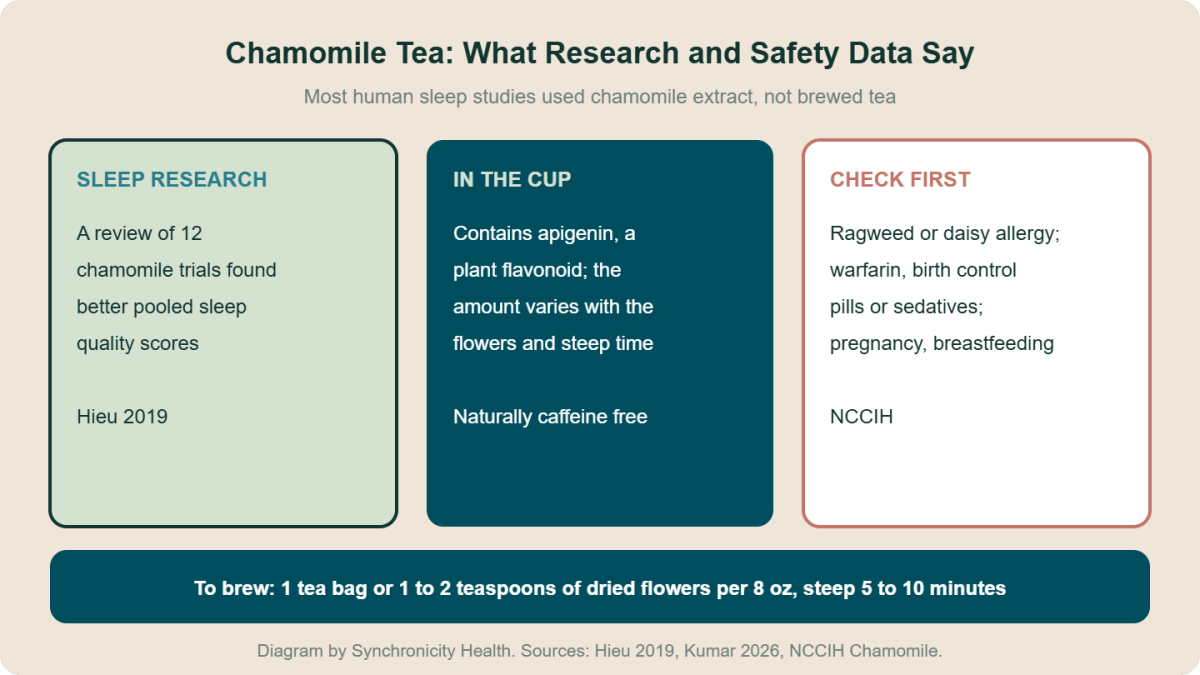
Chamomile tea is a caffeine-free herbal tea made from dried chamomile flowers, and most people drink it as a calm evening ritual; research on chamomile and sleep includes one review of 12 trials reporting better pooled sleep quality scores. This guide covers what is in a cup, what studies measured, how to brew it, side effects and who should check with a clinician first.
It is educational, not medical advice.
Key Takeaways
- What it is: a caffeine-free infusion of dried chamomile flowers. Chamomile contains apigenin, a plant flavonoid.
- Sleep research: a 2019 review of 12 chamomile trials reported better pooled sleep quality scores, while a small pilot trial in adults with chronic primary insomnia found no significant difference in total sleep time.
- Tea vs supplements: most human studies used chamomile extract, not tea or apigenin on its own, and the apigenin in a cup varies with the flowers, the amount and the steep time.
- Safety: NCCIH says chamomile is likely safe in the amounts found in teas and foods. Side effects are uncommon, and people allergic to ragweed, chrysanthemums, marigolds or daisies are more likely to react.
- Check first: if you take warfarin, birth control pills or sedatives, or if you are pregnant or breastfeeding.

Featured in this article
Melatonin-Free Sleep PowderTart cherry powder and tart cherry extract with glycine, magnesium and apigenin in an unsweetened drink that helps you wind down at night, with no added melatonin.
Join the WaitlistComing soon. Third-party tested ingredients.
What Is Chamomile Tea and What Is in It?
Chamomile tea is an infusion of dried chamomile flowers in hot water. There are two types of chamomile, German chamomile and Roman chamomile, and most research and safety information focuses on German chamomile (NCCIH, 2024). Chamomile has a long history: it was described in ancient medical writings and was an important medicinal herb in ancient China, Egypt, Greece and Rome (NCCIH, 2024).
The compound people ask about most is apigenin. Apigenin is a plant flavonoid found in chamomile, parsley, celery and several other herbs and vegetables, and a 2026 review calls chamomile tea one of the richest dietary sources (Kumar et al., 2026). There isn't one fixed figure for how much apigenin is in a cup; it depends on the flowers, how much you use and how long you steep. Apigenin also dissolves poorly in water, which reduces how much is absorbed by mouth (Kumar et al., 2026). Our apigenin guide covers the compound in more depth.
Chamomile Tea for Sleep and Relaxation: What Research Shows
Most human sleep research connected to chamomile has used chamomile extract in capsules rather than brewed tea, so the findings below describe the products and people each study tested. Results in one group may not apply to others.
A Review of 12 Chamomile Trials
A 2019 systematic review and meta-analysis included 12 randomized or quasi-randomized chamomile trials. Pooled sleep quality scores were significantly better with chamomile (Hieu et al., 2019). Only one included trial looked at people with insomnia, and it found no significant change in insomnia severity. For state anxiety, three trials showed no significant difference from control. Side effects reported were mild, and the authors called for larger trials (Hieu et al., 2019).
A Small Pilot Trial of Chamomile Extract
A 2011 randomized, double-blind pilot study enrolled 34 adults aged 18 to 65 with chronic primary insomnia lasting at least six months. They took 270 mg of chamomile extract or a placebo twice a day for 28 days. Sleep diaries showed no significant differences between groups in total sleep time (Zick et al., 2011). Capsule analysis found 3.9 mg of apigenin per 90 mg, so each 270 mg dose carried roughly 12 mg, and side effects were mild and similar to placebo. Because this trial enrolled people with a diagnosed sleep condition and used an extract, its results may not apply to healthy people drinking tea.
Relaxation and Stress
NCCIH notes that some preliminary studies have tested a chamomile supplement in people with generalized anxiety disorder (NCCIH, 2024). Those were capsule studies in a diagnosed group, so they say little about a cup of tea for everyday stress. Many people simply enjoy chamomile tea as a warm, quiet pause at the end of the day, alongside other evening habits covered in our guide to falling asleep faster.
How Apigenin Fits In
In a 2015 study, apigenin given by mouth lengthened sleep time in mice in a chemically induced sleep test. When the same team tested apigenin directly on GABA-A receptors expressed in frog egg cells, it did not increase GABA-driven currents (Gazola et al., 2015). Animal and lab findings like these explain why researchers are interested in apigenin, but they are not the same as results in people.
Other Things People Ask About Chamomile Tea
Is Chamomile Tea Good for You?
For most adults, chamomile tea is a simple, caffeine-free drink. NCCIH says chamomile is likely safe when used orally in amounts commonly found in teas and other foods (NCCIH, 2024). It is also an easy swap for an evening coffee or soda; our coffee alternatives guide lists other caffeine-free options.
Why Do Some Studies Use Blends?
Some studies test products that combine chamomile with other herbs, which makes chamomile's own role hard to pin down (NCCIH, 2024). When you read about a blend, the result belongs to the whole mix, not chamomile alone.
How Does It Compare With Lemon Balm Tea?
Lemon balm is another caffeine-free herbal tea people reach for in the evening, made from leaves rather than flowers. Our lemon balm tea guide covers its own studies and cautions.
How to Make Chamomile Tea and When to Drink It
Chamomile tea is easy to brew with tea bags or loose dried flowers:
- Measure: use one tea bag or about 1 to 2 teaspoons of dried chamomile flowers per 8 oz cup.
- Heat: pour water just off the boil over the flowers.
- Cover and steep: cover the cup and steep for about 5 minutes for a light cup, or up to 10 minutes for a stronger, more floral flavor.
- Strain and flavor: strain loose flowers, then add honey, lemon or a splash of milk if you like.
- Iced: brew it double strength, cool it and pour it over ice.
Because it is caffeine free, chamomile tea works any time of day. Many people save it for the evening as part of a regular wind-down routine, and it pairs well with a tart cherry drink such as the one in our sleepy girl mocktail guide. If a full cup right before bed means a trip to the bathroom at night, drink it a little earlier.
Is Chamomile Tea Caffeine Free?
Yes. Pure chamomile tea is made from chamomile flowers, not leaves of the tea plant, so it is naturally caffeine free. Check the label on blends, since some mix chamomile with green or black tea, which do contain caffeine.
Chamomile Tea vs an Apigenin Supplement
Tea, chamomile extract and stand-alone apigenin deliver very different amounts, and they have been studied in different ways. Most human sleep research connected to apigenin has used chamomile extract, not apigenin on its own. The table below compares the forms; it is not a ranking.
| Form | Apigenin | How it has been studied |
|---|---|---|
| Chamomile tea | Varies with the flowers, the amount used and the steep time | Enjoyed as a food and drink; NCCIH calls tea amounts likely safe |
| Chamomile extract capsules | Roughly 12 mg per 270 mg dose in one 2011 trial | The form used in most human sleep trials |
| Stand-alone apigenin | A set amount on the label | Mostly lab research on the compound itself |
If you want to compare apigenin with other common sleep ingredients, see our apigenin vs magnesium vs melatonin guide and our roundup of sleep supplements without melatonin. For our sleep products, browse our Sleep collection. For how much apigenin a cup of tea provides, see our guide to apigenin dosage.
Chamomile Tea Side Effects and Who Should Check With a Clinician
NCCIH says chamomile is likely safe in the amounts commonly found in teas and other foods. Side effects are uncommon and may include nausea, dizziness and allergic reactions, including severe reactions (NCCIH, 2024). Talk with a clinician or pharmacist before drinking chamomile regularly if any of these apply:
- Daisy family allergies: people allergic to related plants such as ragweed, chrysanthemums, marigolds or daisies are more likely to have an allergic reaction to chamomile.
- Warfarin and other medicines: interactions have been reported with warfarin, a blood thinner, and with some drugs processed by the liver. NCCIH also notes possible interactions with sedatives.
- Birth control pills: chamomile may act like estrogen, and preliminary studies suggest taking it with birth control pills may make them less effective.
- Estrogen-sensitive conditions: because of those estrogen-like effects, chamomile may make some estrogen-sensitive conditions worse.
- Pregnancy and breastfeeding: little is known about whether chamomile is safe during pregnancy or while breastfeeding.
- Eyes: chamomile used near the eyes may cause irritation.
Because NCCIH notes that allergic reactions to chamomile can be severe, stop drinking it and get medical help if you think you are having one.
Coming Soon From Synchronicity
Our Melatonin-Free Sleep Powder is coming soon, with 50 mg of apigenin from chamomile flower per 9.5 g scoop, plus 200 mg of magnesium, 3,000 mg of glycine, tart cherry and 2,000 mg of myo-inositol. It is made to support restful sleep and help you wind down at night, with no added melatonin and no 5-HTP. Mix 1 scoop in 8 oz of water 30 to 60 minutes before bed. It is not on sale yet. Join the waitlist on the product page to hear when it launches; no payment is taken.
To learn more about the other ingredients, read our glycine for sleep guide and tart cherry for sleep guide, or visit our sleep health hub and Learn page.
Featured in this article
Melatonin-Free Sleep PowderTart cherry powder and tart cherry extract with glycine, magnesium and apigenin in an unsweetened drink that helps you wind down at night, with no added melatonin.
Join the WaitlistComing soon. Third-party tested ingredients.
Frequently Asked Questions
What are the main benefits of chamomile tea?
It is a caffeine-free drink that many people use as part of an evening routine. In research, a 2019 review of 12 chamomile trials, mostly using extracts, reported better pooled sleep quality scores, though results across studies are mixed.
Does chamomile tea help you sleep?
Pooled sleep quality scores were better with chamomile in a 2019 review, while a 28-day pilot trial in adults with chronic primary insomnia found no significant difference in total sleep time. Most trials used extract capsules rather than tea.
Is chamomile tea good for you?
For most adults it is a simple, caffeine-free drink, and NCCIH says chamomile is likely safe in the amounts found in teas and foods. People with daisy family allergies, those taking warfarin, birth control pills or sedatives, and anyone pregnant or breastfeeding should check with a clinician.
What are the side effects of chamomile tea?
Side effects are uncommon. NCCIH lists nausea, dizziness and allergic reactions, including severe reactions, and notes that chamomile near the eyes may cause irritation.
Can I drink chamomile tea every night?
Many people do. NCCIH describes chamomile as likely safe in amounts commonly found in teas. If you take medication, are pregnant or breastfeeding, or have plant allergies, ask your clinician whether a nightly cup suits you.
How much apigenin is in a cup of chamomile tea?
There isn't one fixed figure. It depends on the flowers, how much you use and how long you steep, so a cup of tea and an apigenin supplement are not directly comparable.
Is chamomile tea caffeine free?
Yes, pure chamomile tea is naturally caffeine free because it is made from flowers rather than tea leaves. Blends that add green or black tea do contain caffeine.
Who should not drink chamomile tea?
Anyone allergic to chamomile, ragweed, chrysanthemums, marigolds or daisies should avoid it. Check with a clinician first if you take warfarin, birth control pills, sedatives or other prescription medicines, have an estrogen-sensitive condition, or are pregnant or breastfeeding.
Sources
- Hieu et al., 2019. Systematic review and meta-analysis of chamomile trials for anxiety, insomnia and sleep quality. Phytotherapy Research. PubMed 31006899
- Zick et al., 2011. Randomized, placebo-controlled pilot trial of a standardized chamomile extract in adults with chronic primary insomnia. BMC Complementary and Alternative Medicine. PubMed 21939549
- Gazola et al., 2015. Study of the GABA pathway and the sedative activity of apigenin. Revista Brasileira de Farmacognosia. doi.org/10.1016/j.bjp.2015.03.009
- Kumar et al., 2026. Review of the pharmacology of apigenin. Exploration of Foods and Foodomics. doi.org/10.37349/eff.2026.1010174
- National Center for Complementary and Integrative Health. Chamomile. Last updated November 2024. nccih.nih.gov/health/chamomile
These statements have not been evaluated by the Food and Drug Administration. This content is for education and is not medical advice. Our products are not intended to diagnose, treat, cure or prevent any disease. Talk with a healthcare provider before starting a new supplement if you are pregnant, breastfeeding or taking medication.

Leave a comment
All comments are moderated before being published.
This site is protected by hCaptcha and the hCaptcha Privacy Policy and Terms of Service apply.